Archives

Play Video

You can 3D print your own interactive objects

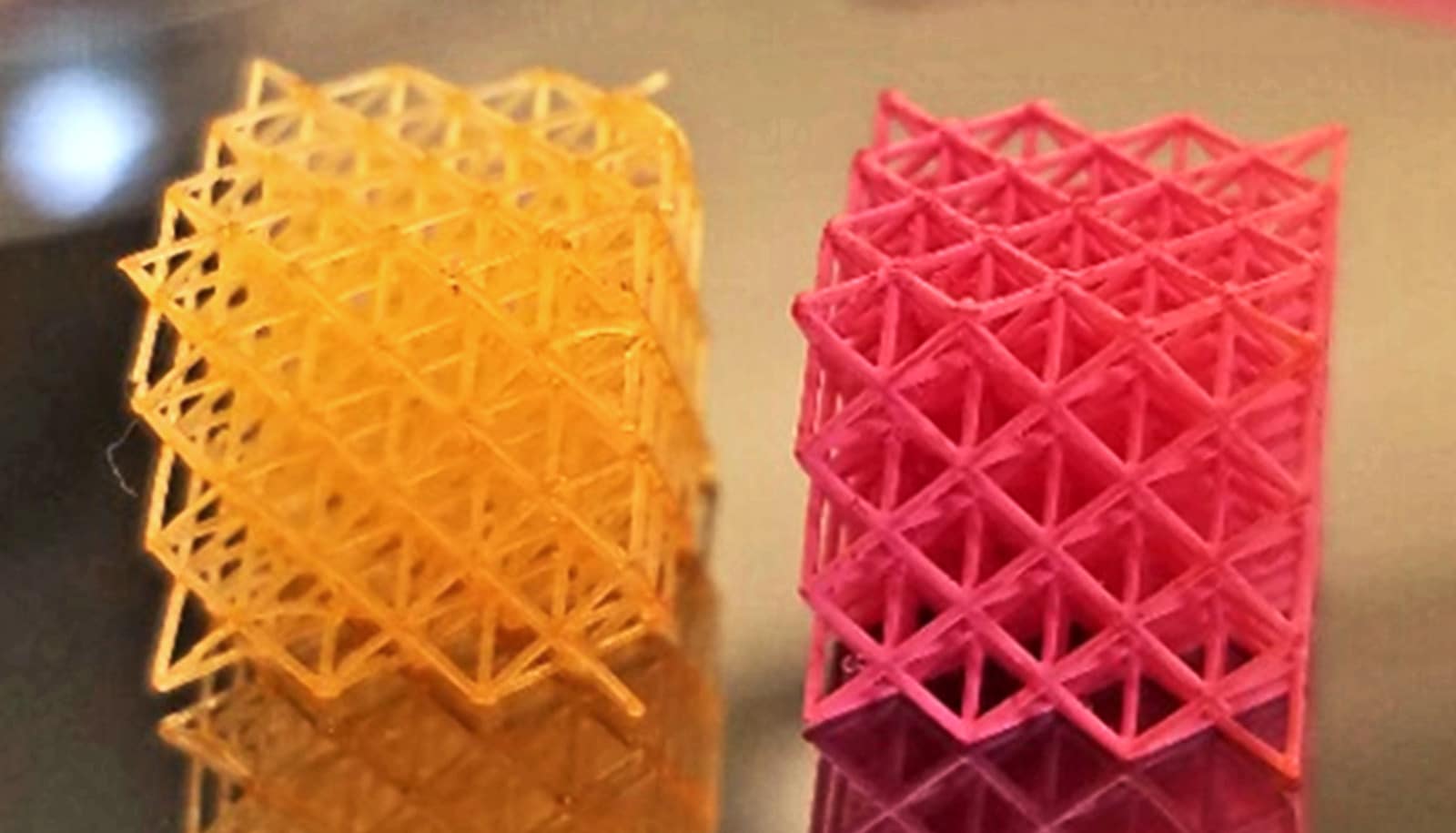
"The wild thing about our technique is that, in principle, anyone can use it to print objects and make them interactive—i.e. store information for specific parts of an object. For example, you can print a model of the brain, a bone or a cell for educators to use," says Carlos Eduardo Tejada.(Credit: Ali Eminov/Flickr)

A new method allows anyone to 3D print interactive objects, researchers report.

These might include models of the brain for use as educational tools, for example.

Slowly but surely, we print pretty much everything on 3D printers. We can now create eyeglasses, buildings, hearing aids—even new hip bones—using a few materials that, once connected to a 3D printer, are layered into a desired object. It almost seems like magic.

Now, researchers  have developed an easy to use technique for making 3D printed objects interactive.

“The wild thing about our technique is that, in principle, anyone can use it to print objects and make them interactive—i.e. store information for specific parts of an object. For example, you can print a model of the brain, a bone, or a cell for educators to use,” says Carlos Eduardo Tejada, a PhD student at the computer science department at the University of Copenhagen.

Getting touchy feely

Being able to print a model of the brain at home might sound crazy. But if you can draw it in 3D, you can print it too—and that’s true across the board, explains Tejada. The discovery that an air compressor and pneumatic sensors can make otherwise static objects interactive is entirely new.

“We refer to our technique as AirTouch. Here, we blow air into 3D printed objects by way of tiny hoses with small openings that inject air and sense external pressure using a computer,” says Tejada.

In the future, Tejada envisions using the technique as an educational tool. Teachers could use it a biology class, where students sit with their own models of a brain and press on individual lobes to retrieve information about a specific function, via a computer.

Other than using it as a teaching tool, Tejada also hopes that the technique can help people with vision impairments.

“One might imagine the usefulness for someone who is blind, sitting with an object, uncertain about what is what. Here, we have the ability to store information within the object and have it read out loud, ‘this is the nose’ and ‘this is the ear’,” he says.

Anyone can use it

Another unique aspect of the AirTouch technique is that, in principle, anyone can use it.

“It doesn’t take more than 10 seconds—or perhaps a few minutes—to connect the hoses into your 3D printed object, blow air into it, and detect what you are pressing,” he says.

The only things required are a 3D printer, costing between DKK 1,500 and DKK 15,000 (€200-€2000 or $217.19-$2,171.01), an air compressor, and a pressure sensor.

“You don’t need any training or much knowledge beforehand. Simply watching our video of the technique allows anyone to get started,” explains Tejada.

The next phase of the study, which will serve as a contribution to the ACM CHI Conference on Human Factors in Computing Systems, is to develop a technique that increases the number of pressure points on 3D printed objects. Currently, the method can take pressure measurements from 12 separate points on an object.

Source: University of Copenhagen
Play Video

Smartphone video makes super accurate 3D face models

Researchers have created an accurate 3D model of someone’s face using video recorded on an ordinary smartphone.

Normally, it takes pricey equipment and expertise to create an accurate 3D reconstruction of a face that’s realistic and doesn’t look creepy.

Using a smartphone to shoot a continuous video of the front and sides of the face generates a dense cloud of data. The two-step process uses that data, with some help from deep learning algorithms, to build a digital reconstruction of the face.

The team’s experiments show that their method can achieve sub-millimeter accuracy, outperforming other camera-based processes.

A man poses for a face-on shot. In the second image, a computer has made a rough 3D model of his face. In the third shot, the 3D face model is smoothed out and texture-less
(Credit: Carnegie Mellon)

A digital face might be used to build an avatar for gaming or for virtual or augmented reality, and could also be used in animation, biometric identification, and even medical procedures. An accurate 3D rendering of the face might also be useful in building customized surgical masks or respirators.

“Building a 3D reconstruction of the face has been an open problem in computer vision and graphics because people are very sensitive to the look of facial features,” says Simon Lucey, an associate research professor at Carnegie Mellon University’s Robotics Institute. “Even slight anomalies in the reconstructions can make the end result look unrealistic.”

Laser scanners, structured light, and multicamera studio setups can produce highly accurate scans of the face, but these specialized sensors are prohibitively expensive for most applications. The newly developed method, however, requires only a smartphone.

The method begins with shooting 15-20 seconds of video. In this case, the researchers used an iPhone X in the slow-motion setting.

“The high frame rate of slow motion is one of the key things for our method because it generates a dense point cloud,” Lucey says.

The researchers then employ a commonly used technique called visual simultaneous localization and mapping (SLAM). Visual SLAM triangulates points on a surface to calculate its shape, while at the same time using that information to determine the position of the camera. This creates an initial geometry of the face, but missing data leave gaps in the model.

In the second step of this process, the researchers work to fill in those gaps, first by using deep learning algorithms. Deep learning is used in a limited way, however: it identifies the person’s profile and landmarks such as ears, eyes and nose. Classical computer vision techniques are then used to fill in the gaps.

“Deep learning is a powerful tool that we use every day,” Lucey says. “But deep learning has a tendency to memorize solutions,” which works against efforts to include distinguishing details of the face. “If you use these algorithms just to find the landmarks, you can use classical methods to fill in the gaps much more easily.”

The method isn’t necessarily quick; it took 30-40 minutes of processing time. But the entire process can be performed on a smartphone.

In addition to face reconstructions, the team’s methods might also be employed to capture the geometry of almost any object, Lucey says. Digital reconstructions of those objects can then be incorporated into animations or perhaps transmitted across the internet to sites where the objects could be duplicated with 3D printers.

The researchers presented their work at the IEEE Winter Conference on Applications of Computer Vision.

Source: Carnegie Mellon University

Play Video

Computer model turns text into animation

(Credit: Getty Images)

A new computer model can translate text describing physical movements directly into simple computer-generated animation, a first step toward someday generating movies directly from scripts.

Scientists have made tremendous leaps in getting computers to understand natural language, as well as in generating a series of physical poses to create realistic animations. These capabilities might as well exist in separate worlds, however, because the link between natural language and physical poses has been missing.

The researchers are working to bring those worlds together using a neural architecture they call Joint Language-to-Pose, or JL2P. The JL2P model enables researchers to jointly embed sentences and physical motions, so it can learn how language is related to action, gestures, and movement.

“I think we’re in an early stage of this research, but from a modeling, artificial intelligence and theory perspective, it’s a very exciting moment,” says Louis-Philippe Morency, associate professor in the Language Technologies Institute at Carnegie Mellon University. “Right now, we’re talking about animating virtual characters. Eventually, this link between language and gestures could be applied to robots; we might be able to simply tell a personal assistant robot what we want it to do.

“We also could eventually go the other way—using this link between language and animation so a computer could describe what is happening in a video,” he adds.

To create JL2P, LTI PhD student Chaitanya Ahuja used a curriculum-learning approach that focuses on the model first learning short, easy sequences—”A person walks forward”—and then longer, harder sequences—”A person steps forward, then turns around and steps forward again,” or “A person jumps over an obstacle while running.”

Verbs and adverbs describe the action and its speed/acceleration, while nouns and adjectives describe locations and directions. The ultimate goal is to animate complex sequences with multiple actions happening either simultaneously or in sequence, Ahuja says. For now, the animations are for stick figures.

Making it more complicated is the fact that lots of things are happening at the same time, even in simple sequences, Morency explains.

“Synchrony between body parts is very important,” Morency says. “Every time you move your legs, you also move your arms, your torso, and possibly your head. The body animations need to coordinate these different components, while at the same time achieving complex actions. Bringing language narrative within this complex animation environment is both challenging and exciting. This is a path toward better understanding of speech and gestures.”

Ahuja will present the work at the International Conference on 3D Vision in Quebec City, Canada.

Source: Carnegie Mellon University