Archives

Play Video

Map of Milky Way’s halo sheds light on dark matter ‘ocean’

Images of the Milky Way and the Large Magellanic Cloud (LMC) are overlaid on a map of the surrounding galactic halo. The smaller structure is a wake created by the LMC’s motion through this region. The larger light-blue feature corresponds to a high density of stars observed in the northern hemisphere of our galaxy. (Credit: NASA/ESA/JPL-Caltech/Conroy et. al.)

Astronomers have released a new map of the outermost region of our galaxy.

Known as a galactic halo, this area lies outside the swirling spiral arms that make up the Milky Way’s recognizable central disk, and is sparsely populated with stars.

Though the halo may appear mostly empty, scientists predict it contains a massive reservoir of dark matter, an invisible material thought to make up the bulk of all mass in the universe.

The new map, which appears as part of a paper in Nature, reveals how a small galaxy called the Large Magellanic Cloud—so-named because it is the larger of two dwarf galaxies orbiting the Milky Way—has sailed through the galactic halo like a ship through water, its gravity disturbing the halo and creating a wake in the stars behind it as it orbits the Milky Way some 130,000 light years from Earth.

Previous studies have hinted at the wake’s existence, but the all-sky map confirms its presence and offers a detailed view of its shape and size.

A swirl of dark and light blue colors against a black background
This visualization, taken from the video animation, shows the central disk of our Milky Way galaxy (small blue circle in center) and a smaller nearby galaxy called the Large Magellanic Cloud (red dot and line). A new, all-sky star map charts the location of stars in the Milky Way’s outer reaches, known as the galactic halo, about 200,000 light years to 325,000 light years from the Milky Way’s center. (Credit: R. Hurt/N. Garavito-Camargo & G. Besla/NASA/JPL-Caltech/NSF)

Dark matter’s invisible ocean

The disturbance in the halo also provides astronomers with an opportunity to study something they can’t observe directly: dark matter.

Though dark matter doesn’t emit, reflect, or absorb light, its gravitational influence has been observed across the universe. It creates a scaffolding on which galaxies are built, and without it, galaxies would fly apart as they spin. Dark matter is estimated to be five times more common in the universe than all that is visible, including stars, planets, and gas clouds.

The nature of dark matter—such as whether it is made up of particles, like “regular matter,” and what the properties of those particles are—is still mostly unknown. There are multiple theories about the nature of dark matter, but all of them indicate that the Milky Way’s halo should be full of it.

As the Large Magellanic Cloud, or LMC, sails through this region, it should leave a wake behind. The stars seen trailing the LMC in the new star map are thought to be the outline of this dark matter wake, with the stars “floating” on it like flotsam on an invisible ocean.

“We think this wake is made up of dark matter, and it drags stars along with it, which is how we can detect it,” says Nicolás Garavito-Camargo, a doctoral student who is part of a research group led by Gurtina Besla, an associate professor of astronomy at the University of Arizona’s Steward Observatory. Both are coauthors of the new paper.

Garavito-Camargo adds that “the Milky Way is the only galaxy in which we can resolve the stars and the halo to this level of detail, so it is our most important ‘natural laboratory’ in which we can study how galaxies work in general. We think that what we observe here likely applies to similar galaxies throughout the universe.”

“The wake in our map is a really neat confirmation that our basic picture for how galaxies merge is on point.”

The paper’s lead author, Harvard University professor Charlie Conroy, and his colleagues were inspired to hunt for LMC’s wake after learning about work done by Garavito-Camargo and Besla, whose research group specializes in computer models that predict what dark matter in the galactic halo should look like.

Their model accurately predicted the general structure and specific location of the star wake revealed in the new map. It also revealed that the LMC is likely on its first orbit around the Milky Way; if the smaller galaxy had already made multiple orbits, the shape and location of the wake would be very different from what is observed.

“What has been a purely theoretical prediction has now been validated by observational data, providing a compelling argument for the existence of dark matter,” Besla says.

“Confirming our theoretical prediction with observational data tells us that our understanding of the interaction between these two galaxies, including the dark matter, is on the right track,” adds Garavito-Camargo, who led the work on the model included in the paper.

The Large Magellanic Cloud’s ‘wake’

The LMC can be spotted with the naked eye, as long as the observer happens to be in the southern hemisphere. The interaction between the dark matter and the LMC has big implications for our galaxy. As the LMC orbits the Milky Way, the dark matter’s gravity drags on the smaller galaxy and slows it down.

This will cause the LMC’s orbit to get smaller and smaller, astronomers say, until the galaxy finally collides with the Milky Way in about 2 billion years. Though it might sound like a destructive event, astronomers believe that a similar process is responsible for the growth of the Milky Way and other large galaxies across the universe; in fact, our galaxy is thought to have merged with another small galaxy about 8 billion years ago.

“This robbing of a smaller galaxy’s energy is not only why the LMC is merging with the Milky Way but also why all galaxy mergers happen,” says coauthor Rohan Naidu, a graduate student at Harvard University. “The wake in our map is a really neat confirmation that our basic picture for how galaxies merge is on point.”

As the LMC and the other Magellanic Clouds enter the shores and part the “waters” around the Milky Way, they drag with them not only other small satellite galaxies but streams of stars as well. To astrophysicists trying to understand the nature of dark matter, the movements of our galaxy and its satellites hold telltale clues, serving as important beacons in the dark matter “ocean.”

“We are trying to explain the distribution of dark matter, but we can’t see it,” Besla says. “All we can see is the stars, streams of stars, and galaxies that are following the distribution of dark matter. They have the potential to tell us something about how dark matter is distributed.”

Various theories exist about the nature of dark matter, and each predicts different properties for the halo of the Milky Way. For this study, Besla, Garavito-Camargo, and colleagues used a dark matter theory known as cold dark matter, which is currently favored by astrophysicists. The location and appearance of the LMC’s wake may be different if they used another model for dark matter, according to Besla and Garavito-Camargo.

“You can imagine that the wake behind a boat will be different if the boat is sailing through water or through honey,” Conroy says. “In this case, the properties of the wake are determined by which dark matter theory we apply.”

Besla’s team is running similar tests with different dark matter theories, to see which one best matches the wake observed in the stars.

The simulations were created using the University of Arizona’s High Performance Computing Facilities, specifically the El Gato supercomputer. Work that builds and expands on the simulations is already underway on Puma, the newest high performance computing cluster at the university, which will have 10 times more processing power than El Gato

Besla explains that the models used by the scientific community to describe the distribution of dark matter in the Milky Way generally presume the distribution is symmetric and static in time, which turns out to not be the case.

“The problem is, we can’t look into the past nor the future; we’re looking at all of these objects right now,” Besla says. “But we want to rewind the clock and see where everything came from.”

The researchers’ findings show that unless the calculations used to model the movements of the Milky Way’s satellites over time account for the effect of the wake created by the LMC, they will be incorrect.

“About 30% of Milky Way-type galaxies have one or more of these massive companions similar to the LMC,” Garavito-Camargo says. “We think that anytime a massive satellite goes by, the same kind of wake distortion should happen. In other words, you’d be modeling the distribution of dark matter incorrectly in 30% of galaxies, and you will infer the wrong conclusions about cold dark matter. Our model is the first step towards solving this problem for the Milky Way, as it provides a tool to assess how big that error would be.”

Dennis Zaritsky, deputy director of Steward Observatory, also is a co-author of the Nature publication. The study used data from NASA and European Space Agency telescopes, specifically the Gaia mission. NASA funded the theoretical part of the research, and the National Science Foundation funded the simulations.

Source: University of Arizona
Play Video

Galaxy simulations shed light on Milky Way’s origins

"Just counting these galaxies can tell scientists about the nature of dark matter. Studying their structure and the motions of their stars can tell us even more," says Elaad Applebaum. (Credit: Greg Rakozy/Unsplash)

New galaxy simulations could help reveal the origins of the Milky Way and dozens of small neighboring dwarf galaxies, researchers report.

The simulations, which the researchers believe to be the most advanced of their kind, could also aid the decades-old search for dark matter, which fills an estimated 27% of the universe.

Further, the computer simulations of “ultra-faint” dwarf galaxies could help shed light on how the first stars formed in the universe.

“Our supercomputer-generated simulations provide the highest-ever resolution of a Milky Way-type galaxy,” says Alyson M. Brooks, an associate professor in the physics and astronomy department in the School of Arts and Sciences at Rutgers University–New Brunswick and coauthor of the working paper.

“The high resolution allows us to simulate smaller neighbor galaxies than ever before—the ‘ultra-faint’ dwarf galaxies. These tiny galaxies are mostly dark matter and therefore are some of the best probes we have for learning about dark matter, and this is the first time that they have ever been simulated around a Milky Way-like galaxy,” Brooks says.

“The sheer variety of the simulated galaxies is unprecedented, including one that lost all of its dark matter—similar to what’s been observed in space.”

The team generated two new simulations of Milky Way-type galaxies and their surroundings. They call them the “DC Justice League Simulations,” naming them after two women who have served on the US Supreme Court: current Associate Justice Elena Kagan and retired Associate Justice Sandra Day O’Connor.

These are cosmological simulations, meaning they begin soon after the Big Bang and model the evolution of galaxies over the entire age of the universe (almost 14 billion years). Bound via gravity, galaxies consist of stars, gas, and dust. The Milky Way is an example a large barred spiral galaxy, according to NASA.

In recent years, scientists have discovered “ultra-faint” satellite galaxies of the Milky Way, thanks to digital sky surveys that can reach fainter depths than ever. While the Milky Way has about 100 billion stars and is thousands of light years across, ultra-faint galaxies have a million times fewer stars (under 100,000 and as low as few hundred) and are much smaller, spanning tens of light years.

For the first time, the simulations allow scientists to begin modeling these ultra-faint satellite galaxies around a Milky Way-type galaxy, meaning they provide some of the first predictions for what future sky surveys will discover.

This video shows the formation of the stellar halo of a Milky Way-mass galaxy. The immediate surroundings of a Milky Way-like galaxy. Only stars are shown, and are color coded by their chemical composition, with blue signaling fewer heavy elements and red showing more heavy elements.

In one simulation, a galaxy lost all its dark matter, and while scientists have seen real galaxies like that before, this is the first time anyone has simulated such a galaxy.

These kinds of results tell scientists what’s possible when it comes to forming galaxies, and they are learning new ways that neighbor galaxies can arise, allowing scientists to better understand what telescopes find.

In about a year, the Large Synoptic Survey Telescope, recently renamed the Vera C. Rubin Observatory, will begin a survey targeting the whole sky and scientists expect to find hundreds of ultra-faint galaxies. In recent years, surveys targeting a small patch of the sky have discovered dozens of them.

“Just counting these galaxies can tell scientists about the nature of dark matter,” says doctoral student Elaad Applebaum, the paper’s lead author. “Studying their structure and the motions of their stars can tell us even more. These galaxies are also very old, with some of the most ancient stars, meaning they can tell us about how the first stars formed in the universe.”

Additional coauthors are from Grinnell College, the University of Oklahoma, the University of Washington, the University of Oslo, and the Yale Center for Astronomy & Astrophysics.

Source: Rutgers University

Play Video

Check it out: The first image of a black hole

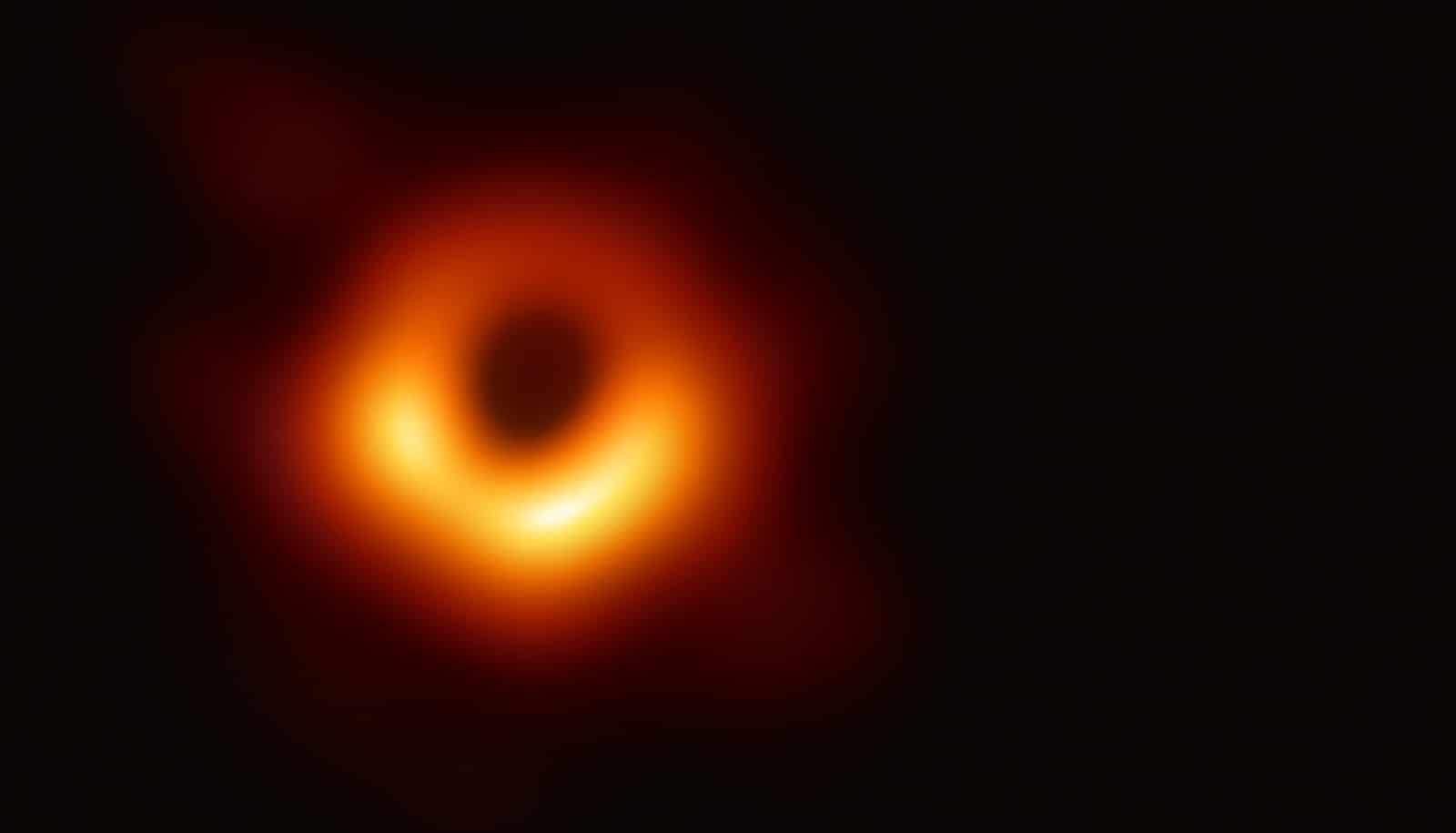
The first direct visual evidence of the supermassive black hole in the center of Messier 87 and its shadow. (Credit: EHT Collaboration)

Astronomers have taken the first direct image of a black hole.

By connecting radio telescopes across five continents into one Earth-sized virtual telescope, they managed to resolve the shadow of a supermassive black hole, a prediction of Einstein’s General Theory of Relativity.

Black holes have been the realm of science fiction and abstract textbook diagrams for more than a century. No one had ever seen what was deemed an object that, by its very definition, cannot be seen. Ever. An object so alien that it defies our imagination, whose mere presence rips apart everything we think we know about the laws of physics, and so extreme it twists space and time and the very essence of our existence into a swirling, contorted maelstrom of… nothing.

Welcome to Messier 87, or M87, a massive galaxy in the Virgo galaxy cluster 55 million light-years from Earth. At its fuzzy, glowing center sits a supermassive black hole, with a mass 6.5 billion times that of our sun.

Taking a direct image of the black hole in M87 is a feat that would not have been possible a decade ago. Even though the object is about the size of our solar system, it is so far away that resolving its features across 55 million light-years is like “taking a picture of a doughnut placed on the surface of the moon,” according to EHT Project Scientist Dimitrios Psaltis, a professor of astronomy and physics at the University of Arizona.

A huge ‘virtual telescope’

Supermassive black holes are relatively tiny astronomical objects, which has made them impossible to directly observe until now. The size of a black hole is proportional to its mass, so the more massive a black hole, the larger the shadow. Scientists now think that black holes with masses that are millions or even billions of times that of the sun lie at the centers of most galaxies, with some outshining all of the other stars combined.

“We’re seeing the unseeable.”

Thanks to its enormous mass and relative proximity, M87’s black hole was predicted to be one of the largest viewable from Earth, making it a perfect target for the EHT. Eight telescopes came together into one virtual telescope as big as Earth, offering unprecedented sensitivity and resolution.

The EHT observations use a technique called very-long-baseline interferometry, or VLBI, which synchronizes telescope facilities around the world and exploits the rotation of our planet to form one huge telescope observing at a wavelength of 1.3mm.

“The observations were a coordinated dance in which we simultaneously pointed our telescopes in a carefully planned sequence,” says Daniel Marrone, associate professor of astronomy at the University of Arizona. Marrone traveled to Antarctica with graduate student Junhan Kim several times to integrate the South Pole Telescope into the EHT array. “To make sure these observations were truly simultaneous, so that we could see the same wavefront of light as it landed on each telescope, we used extremely precise atomic clocks at each of the telescopes.”

south pole telescope
The South Pole Telescope. (Credit: Junhan Kim/U. Arizona)

After two weeks of observing, the researchers collected about 5,000 trillion bytes of data on 1,000 disks—enough to keep a playlist of high-quality mp3 files playing for 4,700 years. The data were flown to supercomputers known as correlators at the Max Planck Institute for Radio Astronomy in Bonn, Germany, and the Massachusetts Institute of Technology’s Haystack Observatory in Westford, Massachusetts. There, VLBI experts distilled the raw data to a more usable volume.

Following calibration of the data, members of the EHT collaborated to reconstruct the black hole images. Working in separate groups using different methods, they all arrived at the same result.

Still, how can an object so dense that nothing, not even light, can escape its gravitational pull be seen? As ferocious as they are, black holes are extremely compressed cosmic objects, containing incredible amounts of mass within a tiny region. While the black hole itself is invisible, it gives away its presence by warping spacetime and superheating any surrounding material.

A simulated image by the University of Arizona shows the turbulent plasma in the extreme environment around a supermassive black hole.
A simulated image shows the turbulent plasma in the extreme environment around a supermassive black hole. (Credit: U. Arizona)

Capturing the shadow

As surrounding gas and dust plunge into the abyss of space and time, and entire stars are shredded into wispy swirls, matter piles up around the black hole, forming a so-called accretion disk of plasma—charged particles heated to billions of degrees and accelerated to almost the speed of light. Due to the black hole’s massive gravity, light gets bent around it, creating a tell-tale photon ring, the appearance of which is predicted by Einstein’s equations. If Einstein’s equations are correct, a dark region should appear in the center, caused by the absence of light captured by the black hole.

An image of the shadow of a black hole is the closest thing to an image of the black hole itself, a completely dark object from which light cannot escape. In the case of M87, the shadow appears around 2.5 times larger than the true size of the black hole’s boundary—the event horizon from which the EHT takes its name—due to light bending. For M87, the horizon should be just under 25 billion miles across, about three times the size of Pluto’s orbit.

Multiple independent EHT observations and imaging methods have revealed a ring-like structure with a dark central region—the black hole’s shadow.

“This is a huge day in astrophysics,” says France Córdova , director of the National Science Foundation, which funded the work. “We’re seeing the unseeable. Black holes have sparked imaginations for decades. They have exotic properties and are mysterious to us. Yet with more observations like this one they are yielding their secrets. This is why NSF exists. We enable scientists and engineers to illuminate the unknown, to reveal the subtle and complex majesty of our universe.”

“The Event Horizon Telescope allows us for the very first time to test the predictions of Einstein’s General Theory of Relativity around supermassive black holes in the centers of galaxies,” Psaltis says. “The predicted size and shape of the shadow theory match our observations remarkably well, increasing our confidence in this century-old theory.”

The Submillimeter Telescope magnifies the evening sky
The Submillimeter Telescope magnifies the evening sky as the sun sets on Mount Graham near Tucson, Arizona. (Credit: Paul Schulz)

‘Natural laboratories’

“Black holes are natural laboratories that the universe provides us with. Everything about them is extreme,” says Feryal Ozel, a member of the EHT Science Council and professor of astronomy and physics at the University of Arizona. “Take quantum mechanics and our theory of gravity, for example: They are not compatible, and around a black hole, they might even break down completely. This is what we have aimed to test with the EHT.”

Ozel led the Modeling and Analysis Working Group, which had the task of measuring the size of the black hole’s shadow and comparing the predictions of Einstein’s theories to the EHT observations. Once EHT scientists were sure they had imaged the shadow, they compared their observations to extensive computer models that include the physics of warped space, superheated matter, and strong magnetic fields.

In addition to building and maintaining the EHT cloud infrastructure, the team generated high-fidelity models of EHT observations by harnessing the power of a supercomputer consisting of 140 Nvidia graphics-processing units, or GPUs, commonly used for graphics-heavy video-gaming applications.

The team developed the first code that traced the path of light and simulated its encounters with black holes to compute realistic images of black holes. The time-dependent simulations of the black hole’s shadow as predicted by general relativity are hosted in the CyVerse, with headquarters at the university. They help scientists visualize light trapped in the fabric of space and time, curving around the black hole by its massive gravity, to study how black holes interact with nearby matter.

“New technologies such as cloud computing are essential to support international collaborations like this,” says Chi-kwan Chan, leader of the EHT Computations and Software Working Group and an assistant astronomer at the university. Chan built and maintains the cloud infrastructure for the EHT. “When we were working on the six papers, we had over 20 powerful virtual machines running in two Google data centers—one on the East Coast and one on the West Coast—to serve the EHT members’ computation needs across the globe.”

The EHT consortium involves more than 200 researchers from Africa, Asia, Europe, North and South America, and consists of 13 stakeholder institutes (listed alphabetically): the Academia Sinica Institute of Astronomy and Astrophysics; the University of Arizona; the University of Chicago; the East Asian Observatory; Goethe-Universität Frankfurt; Institut de Radioastronomie Millimétrique; Large Millimeter Telescope; Max Planck Institute for Radio Astronomy; MIT Haystack Observatory; National Astronomical Observatory of Japan; Perimeter Institute for Theoretical Physics; Radboud University; and the Smithsonian Astrophysical Observatory.

The work involved a network of telescopes around the world: the South Pole Telescope; the Submillimeter Telescope on Mount Graham in southeastern Arizona; the Atacama Large Millimeter Array, or ALMA, and the Atacama Pathfinder Experiment, or APEX, both in the Chilean Atacama Desert; the IRAM 30-meter telescope in the Spanish Sierra Nevada; the James Clerk Maxwell Telescope and the Submillimeter Array in Hawai`I; and the Large Millimeter Telescope Alfonso Serrano in Mexico.

This research appears in a series of six papers published today in a special issue of The Astrophysical Journal Letters.

Source: University of Arizona