Archives

Play Video

Brain stimulation could help doctors learn to use surgery robots

(Credit: Johns Hopkins)

People who received gentle electric currents on the back of their heads learned to maneuver a robotic surgery tool in virtual reality and then in a real setting much more easily than people who didn’t receive those nudges, a new study shows.

The findings offer the first glimpse of how stimulating a specific part of the brain called the cerebellum could help health care professionals take what they learn in virtual reality to real operating rooms, a much-needed transition in a field that increasingly relies on digital simulation training, says author and Johns Hopkins University roboticist Jeremy D. Brown.

“It was really cool that we were actually able to influence behavior using this setup…”

“Training in virtual reality is not the same as training in a real setting, and we’ve shown with previous research that it can be difficult to transfer a skill learned in a simulation into the real world,” says Brown, an associate professor of mechanical engineering.

“It’s very hard to claim statistical exactness, but we concluded people in the study were able to transfer skills from virtual reality to the real world much more easily when they had this stimulation.”

The work appears in Nature Scientific Reports.

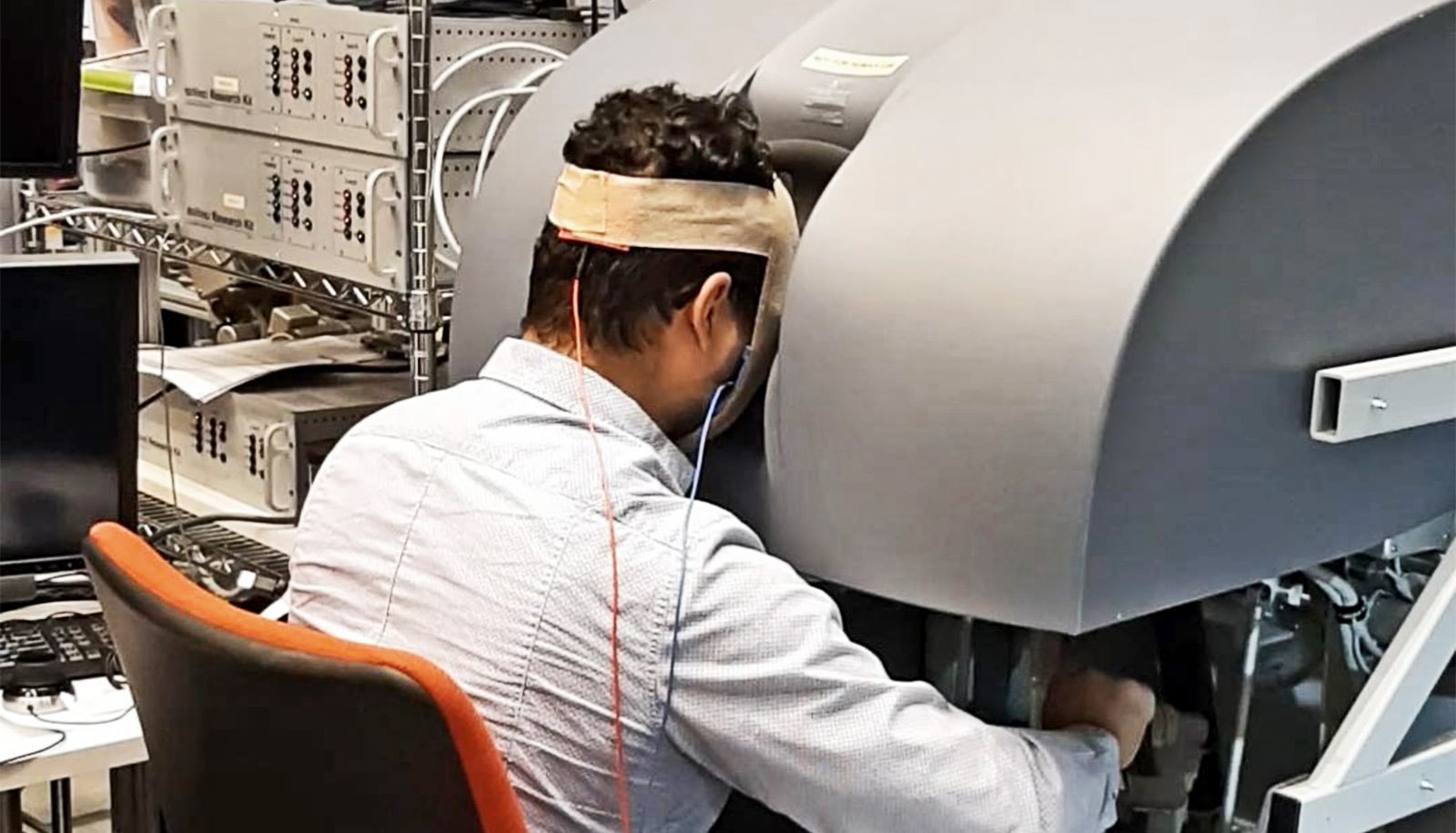
Participants drove a surgical needle through three small holes, first in a virtual simulation and then in a real scenario using the da Vinci Research Kit, an open-source research robot. The exercises mimicked moves needed during surgical procedures on organs in the belly, the researchers say.

Participants received a subtle flow of electricity through electrodes or small pads placed on their scalps meant to stimulate their brain’s cerebellum. While half the group received steady flows of electricity during the entire test, the rest of the participants received a brief stimulation only at the beginning and nothing at all for the rest of the tests.

People who received the steady currents showed a notable boost in dexterity. None of them had prior training in surgery or robotics.

“The group that didn’t receive stimulation struggled a bit more to apply the skills they learned in virtual reality to the actual robot, especially the most complex moves involving quick motions,” says Guido Caccianiga, a former Johns Hopkins roboticist, now at Max Planck Institute for Intelligent Systems, who designed and led the experiments. “The groups that received brain stimulation were better at those tasks.”

Noninvasive brain stimulation is a way to influence certain parts of the brain from outside the body, and scientists have shown how it can benefit motor learning in rehabilitation therapy, the researchers say. With their work, the team is taking the research to a new level by testing how stimulating the brain can help surgeons gain skills they might need in real-world situations, says coauthor Gabriela Cantarero, a former assistant professor of physical medicine and rehabilitation at Johns Hopkins.

“It was really cool that we were actually able to influence behavior using this setup, where we could really quantify every little aspect of people’s movements, deviations, and errors,” Cantarero says.

Robotic surgery systems provide significant benefits for clinicians by enhancing human skill. They can help surgeons minimize hand tremors and perform fine and precise tasks with enhanced vision.

Besides influencing how surgeons of the future might learn new skills, this type of brain stimulation also offers promise for skill acquisition in other industries that rely on virtual reality training, particularly work in robotics.

Even outside of virtual reality, the stimulation can also likely help people learn more generally, the researchers say.

“What if we could show that with brain stimulation you can learn new skills in half the time?” Caccianiga says. “That’s a huge margin on the costs because you’d be training people faster; you could save a lot of resources to train more surgeons or engineers who will deal with these technologies frequently in the future.”

Additional authors are from Johns Hopkins University School of Medicine and the Shirley Ryan AbilityLab.

Source: Johns Hopkins University

Play Video

‘Cybersickness’ from VR headsets hits women more often

In a new study participants could stop using a VR headset if they felt too sick to continue. Women ended the game early twice as often as men and reported a 40% higher sickness intensity. (Credit: Getty Images)

Women experience cybersickness with virtual reality headsets more often than men, a new study finds.

Gender discrepancies in cybersickness may not seem that important when it’s related to video games and other forms of entertainment, says Jonathan Kelly, a professor of psychology at Iowa State University.

“But it’s still a problem, and when VR gets to the point where it’s a bigger part of job training or education in a classroom, it’s even more important to make sure people can access this technology,” Kelly says. “If not, a lot of people are going to get left out, and there could be a backlash.”

Like motion sickness, cybersickness can occur when there’s a mismatch between visual motion and body motion. Symptoms, including nausea, dizziness, headaches, and eye fatigue, usually resolve quickly after removing the headset. But in severe cases, they sometimes last for hours.

Kelly and colleagues recently coauthored two related papers for the IEEE Virtual Reality Conference. The first paper provides an overview of existing research on gender and cybersickness, including their own findings.

As part of a larger study on adaptation to cybersickness, the researchers recruited 150 participants to play up to 20 minutes of a VR game with a headset. The participants were new to VR and could stop if they felt too sick to continue. The researchers found women ended the game early twice as often as men and reported a 40% higher sickness intensity.

The paper also helps clarify why previous studies, many of which came from engineering or computer science, show conflicting results.

“A lot of the older papers that found no difference in cybersickness between men and women had very small sample sizes or a large gender imbalance. If the effect is small or individual differences are large, you may need 200 participants to identify statistically significant differences,” says Kelly.

“I think this methodological expertise is something we in psychology can really provide. It also highlights the value of interdisciplinary collaboration to tackle complex problems like cybersickness.”

For the second paper, the researchers explored whether the distance between an individual’s pupils could help explain the gender difference in cybersickness. VR headsets have an adjustable lens set-up to accommodate different users, but some people fall outside the range.

The researchers found women participants on average had smaller distances between their pupils than men, but it did not predict whether they would get cybersick during the game.

What seemed to matter more was whether they had previous experience with motion sickness or screen sickness (e.g., feeling sick in movie theaters, while playing a video game.)

“Women reported experiencing more motion sickness and screen-based sickness than men, and this increased susceptibility is part of the reason that women experience more cybersickness,” says Kelly.

The researchers will continue to investigate the causes of cybersickness and methods to help individuals have a positive experience with VR.

“One of the things we’re doing now is comparing the settings of headsets and virtual environments to see which are most effective at reducing cybersickness for first-time users, and whether some are better than others for certain individuals,” says Kelly.

This includes adding “blinders,” which reduce the users’ peripheral vision while they move through a space, and options to teleport from point A to point B. Both reduce cybersickness by reducing visual stimulation.

The researchers will also study how these settings can be adjusted over time to help the user adapt comfortably and ease into VR. Kelly likens it to beginner swimming lessons in the zero-entry part of the pool, rather than the deep end.

Source: Iowa State University

  • VR relaxes patients during wide-awake surgery