Archives

Play Video

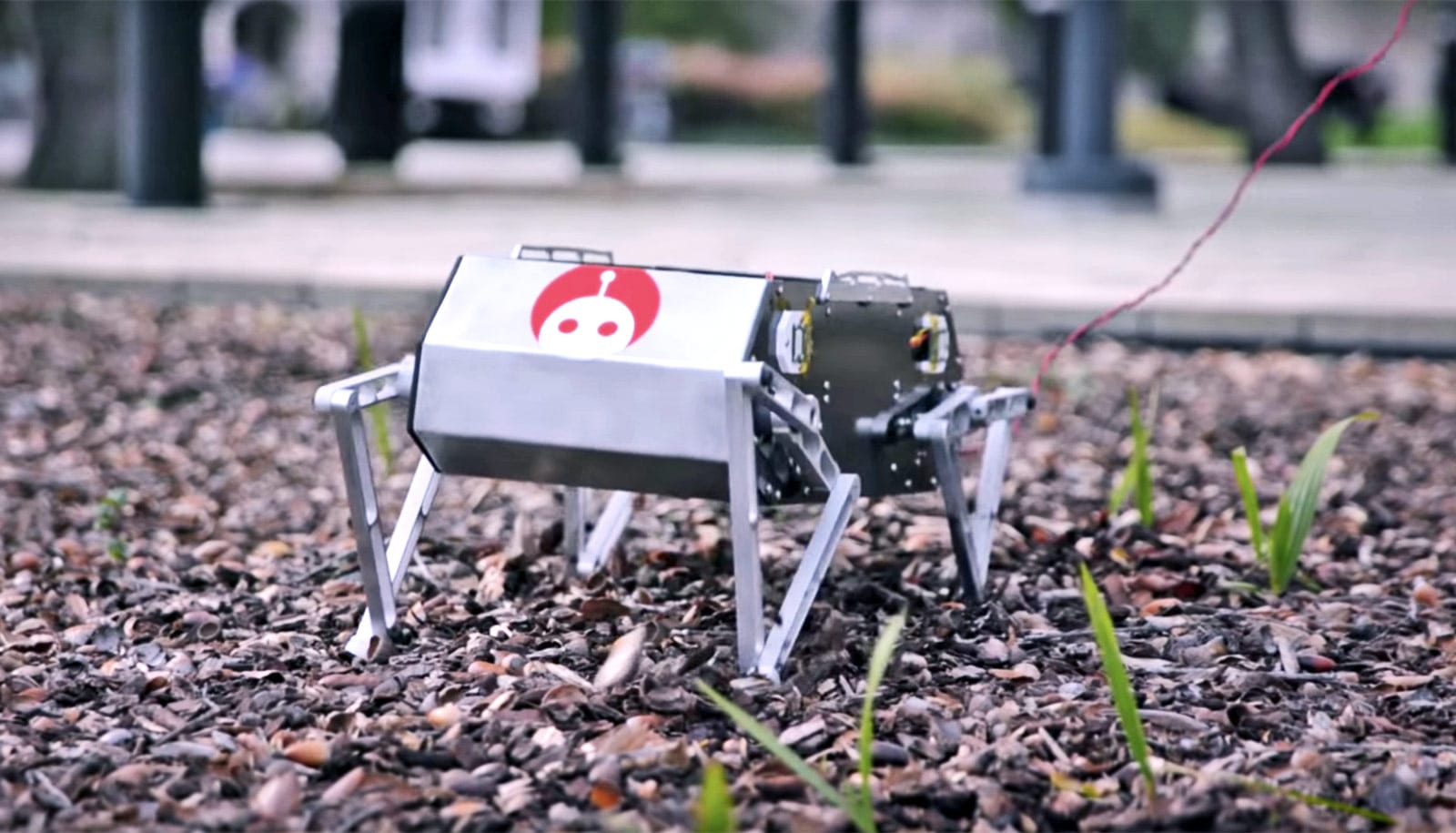
Watch this open-source dog robot do backflips

Stanford Doggo. (Credit: Kurt Hickman/Stanford)

With reproducibility in mind, Stanford University students developed a four-legged robot that perform acrobatic tricks and traverse challenging terrain.

Anyone who wants their own version of the robot, dubbed Stanford Doggo, can consult comprehensive plans, code, and a supply list that the students have made freely available online.

“We had seen these other quadruped robots used in research, but they weren’t something that you could bring into your own lab and use for your own projects,” says Nathan Kau, a mechanical engineering major and lead for the student robotics club’s Extreme Mobility team.

“We wanted Stanford Doggo to be this open source robot that you could build yourself on a relatively small budget.”

Whereas other similar robots can cost tens or hundreds of thousands of dollars and require customized parts, the students estimate the cost of Doggo at less than $3,000—including manufacturing and shipping costs—and nearly all the components can be bought as-is online. They hope the accessibility of these resources inspires a community of Doggo makers and researchers who develop innovative and meaningful spinoffs from their work.

Already Doggo can walk, trot, dance, hop, jump, and perform the occasional backflip. The students are working on a larger version of their creation—which is currently about the size of a beagle—but will take a short break to present Doggo at the International Conference on Robotics and Automation in Montreal, Canada.

In order to make Doggo replicable, the students built it from scratch. This meant spending a lot of time researching easily attainable supplies and testing each part as they made it, without relying on simulations.

“It’s been about two years since we first had the idea to make a quadruped. We’ve definitely made several prototypes before we actually started working on this iteration of the dog,” says Natalie Ferrante, a mechanical engineering coterminal student and Extreme Mobility team member. “It was very exciting the first time we got him to walk.”

Doggo’s first steps were admittedly toddling, but now the robot can maintain a consistent gait and desired trajectory, even as it encounters different terrains. It does this with the help of motors that sense external forces on the robot and determine how much force and torque each leg should apply in response.

These motors recompute at 8,000 times a second and are essential to the robot’s signature dance: a bouncy boogie that hides the fact that it has no springs. Instead, the motors act like a system of virtual springs, smoothly but perkily rebounding the robot into proper form whenever they sense it’s out of position.

Among the skills and tricks the team added to the robot’s repertoire, the students were exceptionally surprised at its jumping prowess. Running Doggo through its paces one (very) early morning in the lab, the team realized it was effortlessly popping up 2 feet in the air. By pushing the limits of the robot’s software, Doggo was able to jump 3, then 3½ feet off the ground.

“This was when we realized that the robot was, in some respects, higher performing than other quadruped robots used in research, even though it was really low cost,” recalls Kau.

Since then, the students have taught Doggo to do a backflip—but always on padding to allow for rapid trial and error experimentation.

If these students have it their way, the future of Doggo is in the hands of the masses.

“We’re hoping to provide a baseline system that anyone could build,” says Patrick Slade, graduate student in aeronautics and astronautics and mentor for Extreme Mobility.

“Say, for example, you wanted to work on search and rescue; you could outfit it with sensors and write code on top of ours that would let it climb rock piles or excavate through caves. Or maybe it’s picking up stuff with an arm or carrying a package.”

That’s not to say they aren’t continuing their own work. Extreme Mobility is collaborating with the Robotic Exploration Lab of Zachary Manchester, assistant professor of aeronautics and astronautics, to test new control systems on a second Doggo. The team has also finished constructing a robot twice the size of Doggo that can carry about 6 kilograms (more than 13 pounds) of equipment. Its name is Stanford Woofer.

Source: Stanford University

Play Video

Hummingbird robot flies and hovers like the real thing

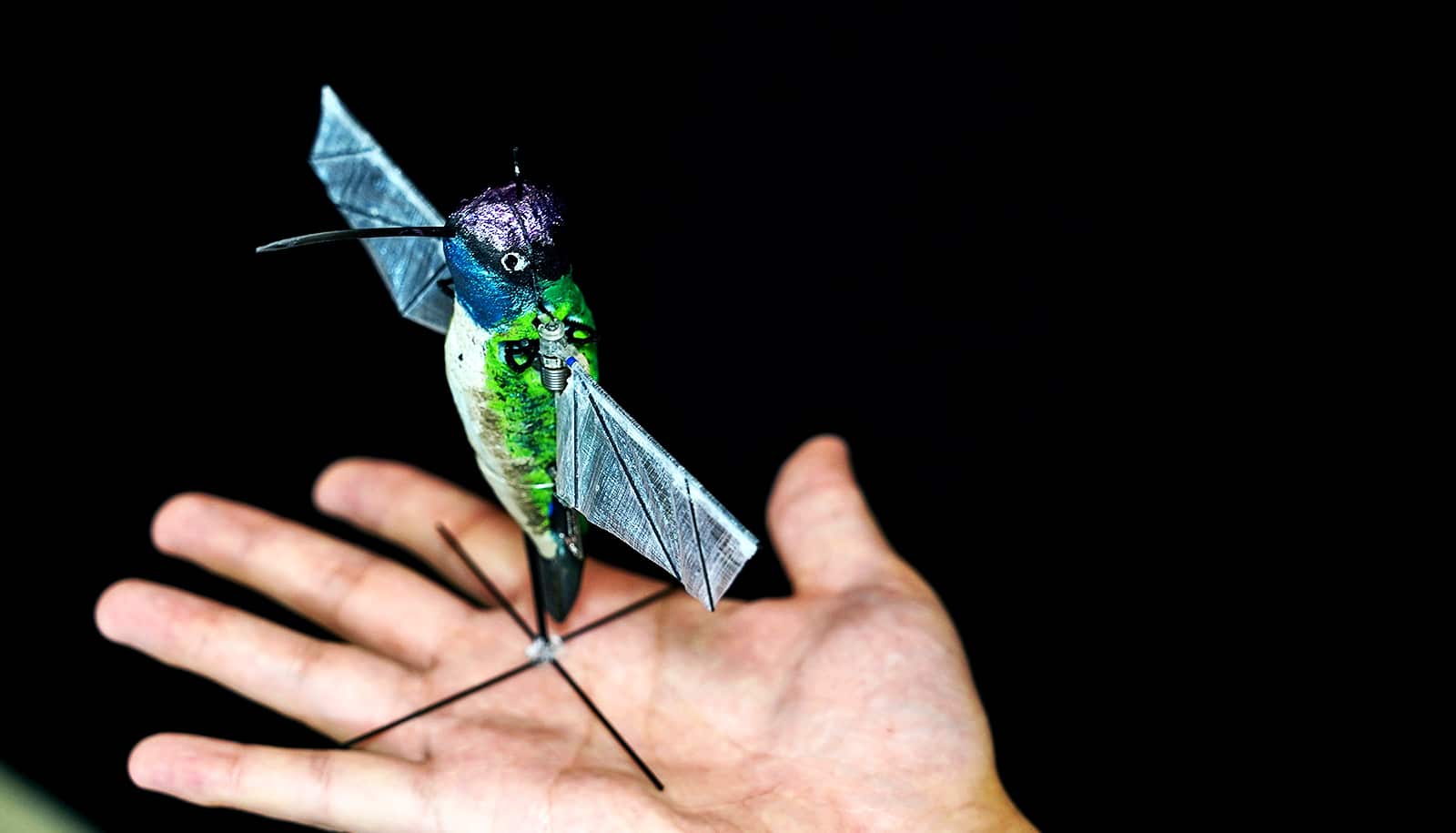
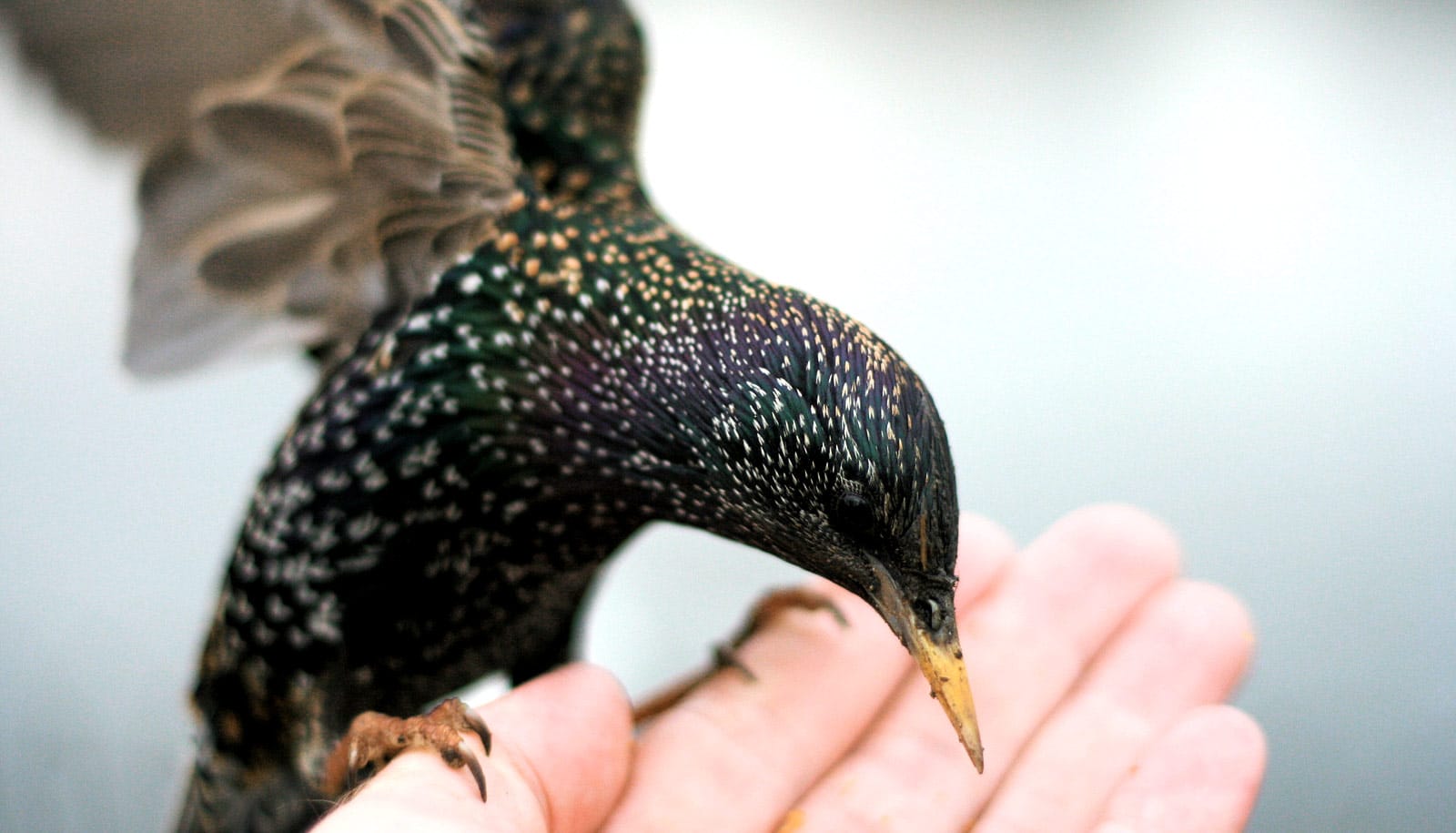
Researchers are building robotic hummingbirds that learn from computer simulations how to fly like a real hummingbird does. They encased the robot in a decorative shell. (Jared Pike/Purdue)

Researchers have engineered flying robots that behave like hummingbirds, training them with machine learning algorithms based on various techniques the bird uses naturally every day.

This means that after learning a simulation, the robot “knows” how to move around on its own like a hummingbird would.

The combination of flying like a bird and hovering like an insect could one day offer a better way to maneuver through collapsed buildings and other cluttered spaces to find trapped victims.

Artificial intelligence, combined with flexible flapping wings, also allows the robot to teach itself new tricks. Even though the robot can’t see yet, for example, it can touch surfaces to sense them. Each touch alters an electrical current, which the researchers realized they could track.

hummingbird robot gif
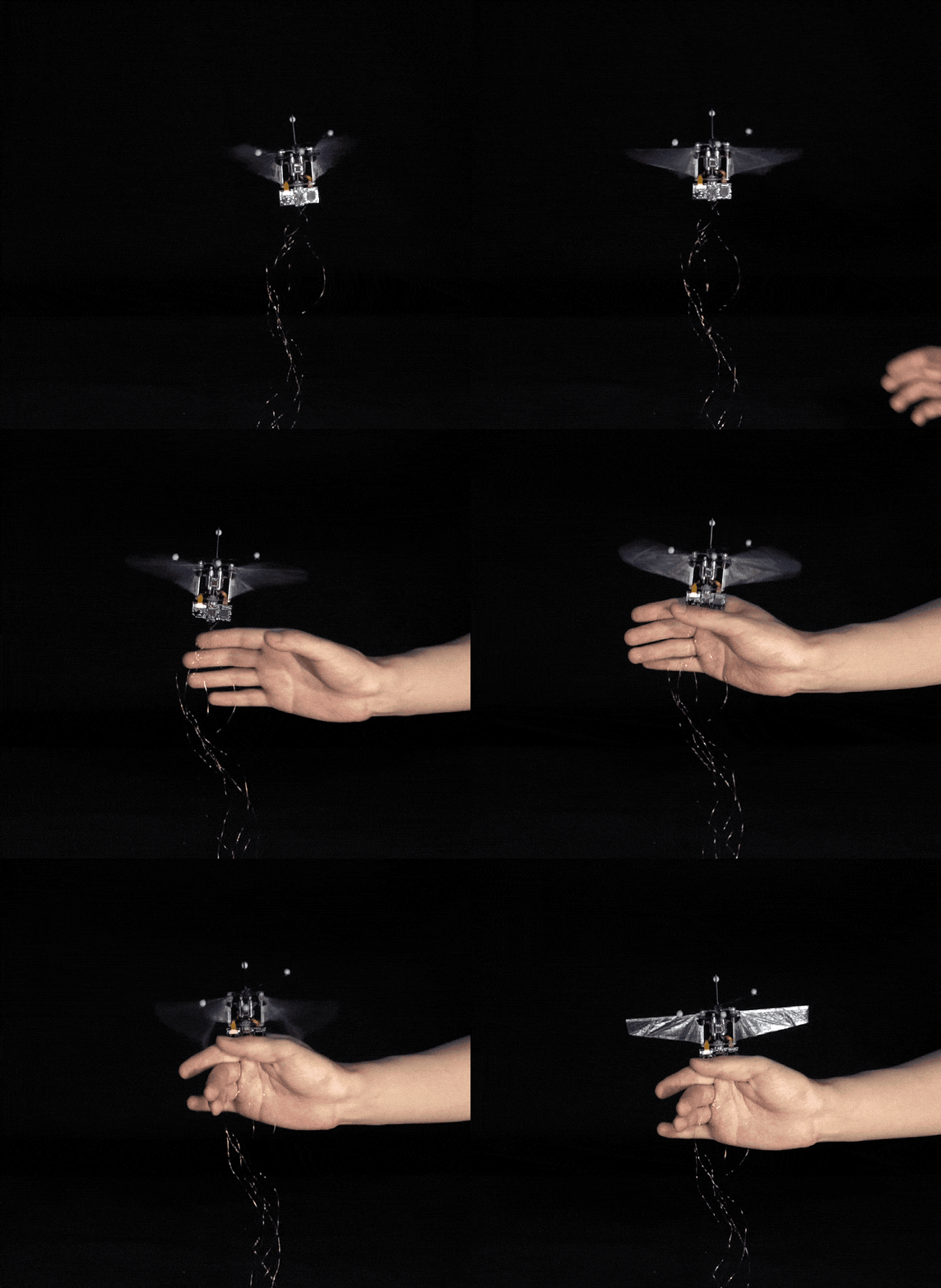
This robotic hummingbird flies on its own while tethered to an energy source. Soon, batteries will power the robot. (Credit: Bio-Robotics Lab/Purdue University)

“The robot can essentially create a map without seeing its surroundings. This could be helpful in a situation when the robot might be searching for victims in a dark place—and it means one less sensor to add when we do give the robot the ability to see,” says Xinyan Deng, an associate professor of mechanical engineering at Purdue University.

Different physics

Engineers can’t make drones infinitely smaller, due to the way conventional aerodynamics work. They wouldn’t be able to generate enough lift to support their weight. But hummingbirds don’t use conventional aerodynamics—and their wings are resilient.

“The physics is simply different; the aerodynamics is inherently unsteady, with high angles of attack and high lift. This makes it possible for smaller, flying animals to exist, and also possible for us to scale down flapping wing robots,” Deng says.

Researchers have been trying for years to decode hummingbird flight so that robots can fly where larger aircraft can’t.

In 2011, DARPA, an agency within the US Department of Defense, commissioned the company AeroVironment to build a robotic hummingbird that was heavier than a real one but not as fast, with helicopter-like flight controls and limited maneuverability. It required a human to be behind a remote control at all times.

12-gram robot

Deng’s group and her collaborators studied hummingbirds for multiple summers in Montana. They documented key hummingbird maneuvers, such as making a rapid 180-degree turn, and translated them to computer algorithms that the robot could learn from when hooked up to a simulation.

Further study on the physics of insects and hummingbirds allowed researchers to build robots smaller than hummingbirds—and even as small as insects—without compromising the way they fly. The smaller the size, the greater the wing flapping frequency, and the more efficiently they fly, Deng says.

The robots have 3D-printed bodies, wings made of carbon fiber, and laser-cut membranes. The researchers built one hummingbird robot weighing 12 grams—the weight of the average adult magnificent hummingbird—and another insect-sized robot weighing 1 gram. The hummingbird robot can lift more than its own weight, up to 27 grams.

Designing their robots with higher lift gives the researchers more wiggle room to eventually add a battery and sensing technology, such as a camera or GPS. Currently, the robot needs a tether to an energy source while it flies, but that won’t be for much longer, the researchers say.

The robots could fly silently just as a real hummingbird does, making them more ideal for covert operations. And they stay steady through turbulence, which the researchers demonstrated by testing the dynamically scaled wings in an oil tank.

The robot requires only two motors and can control each wing independently of the other, which is how flying animals perform highly agile maneuvers in nature.

“An actual hummingbird has multiple groups of muscles to do power and steering strokes, but a robot should be as light as possible, so that you have maximum performance on minimal weight,” Deng says.

Robotic hummingbirds wouldn’t only help with search-and-rescue missions, but also allow biologists to more reliably study hummingbirds in their natural environment through the senses of a realistic robot.

“We learned from biology to build the robot, and now biological discoveries can happen with extra help from robots,” Deng says.

Simulations of the technology are available open-source. Researchers, including collaborators from the University of Montana, will present the work this month at the 2019 IEEE International Conference on Robotics and Automation in Montreal.

Source: Purdue University

Play Video

Math paves the way for fleets of connected drones

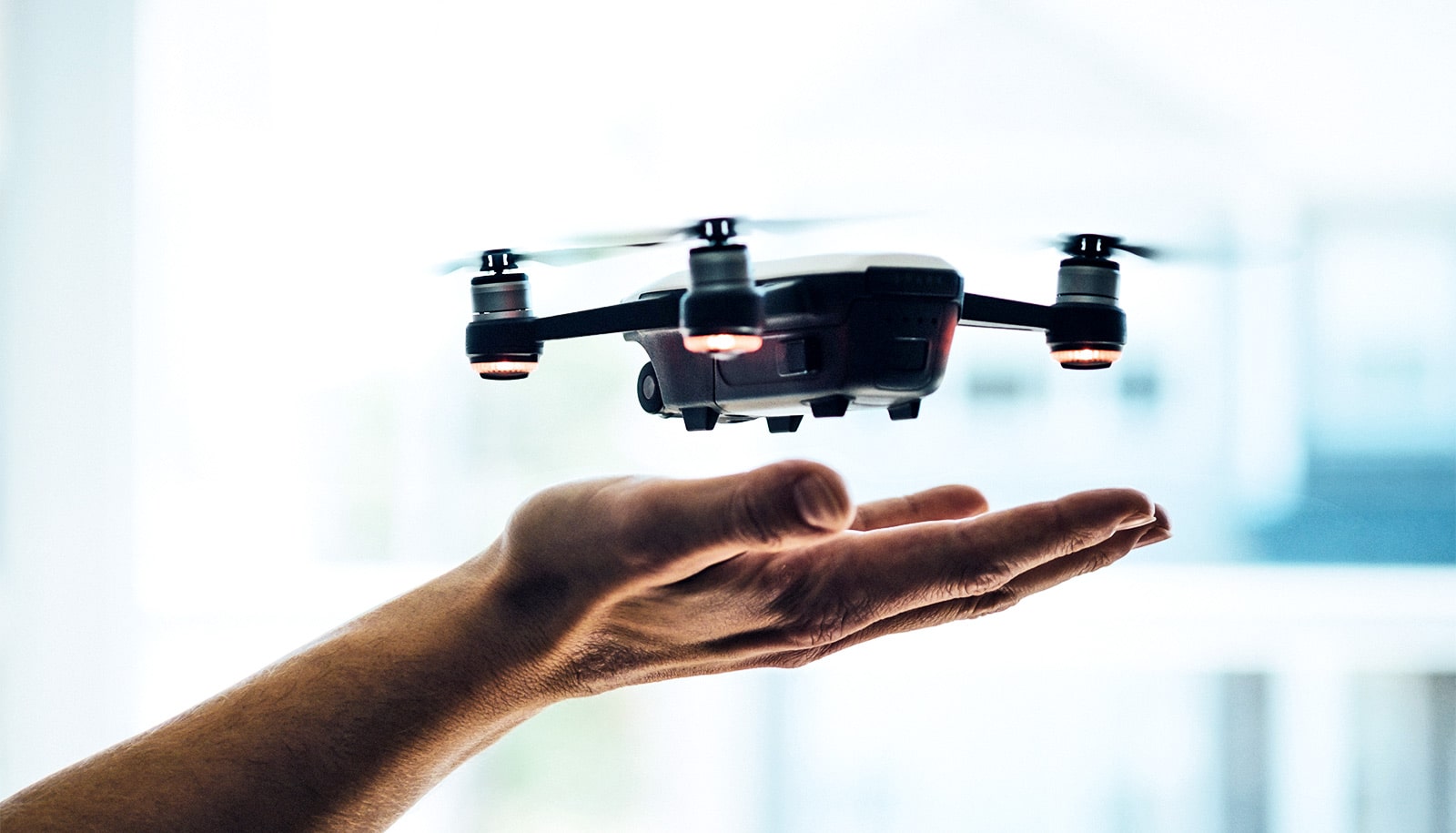
New research aims to expand drone technology by deploying fleets of drones.

But making that happen is not as simple as launching multiple aircraft at once.

Borzoo Bonakdarpour, an assistant professor of computer science, says unlike piloting a single drone by remote control, operating a fleet requires an automated system to coordinate the task, but allows drones to independently respond to weather, a crash, or unexpected events.

“The operating system must be reliable and secure. The drones need to talk to one another without a central command telling each unit where to go and what to do when conditions change,” Bonakdarpour says.

“We also want to optimize the time and energy to complete the task, because drone batteries only last around 15 or 20 minutes.”

From theory to reality

To tackle this problem, Bonakdarpour and his colleagues developed a mathematical model to calculate the cost—time and energy—to complete a task based on the number of drones and recharging stations available. The model considers the energy each drone requires to complete its portion of the task and fly to a charging station as needed.

On paper the solution is relatively simple for a team of computer scientists, but Bonakdarpour says moving from theory to implementation is not as easy.

“As we work on one problem, we actually find new problems we must solve. It’s challenging, but that’s also what makes it exciting,” he says.

For example, if a battery lasts 15 minutes in the lab, it may drop to 10 minutes on a hot or cold day outside. Locating charging stations is another issue. The optimal placement may be in the middle of a lake and inaccessible in reality.

Based on their model, Bonakdarpour and colleagues developed four operating methods—three offline optimization techniques and one online algorithm. While an offline technique is limited because the preprogrammed flight paths do not allow drones to respond to unexpected events or changing conditions, Bonakdarpour says it provides the foundation for the online algorithm to operate.

The researchers conducted a series of simulations using four drones to test for efficiency and security. They found the online algorithm successfully managed the security-energy tradeoff within the energy limits of the drones. The fleet completed all assigned tasks and more than half of the authentication checks.

Extra problems

Operating an automated fleet of drones poses security risks that are less of a concern when piloting a single drone by remote control. Bonakdarpour says automation drones need to receive GPS signal and position frequently. If the signal drops or the drones fly into an area that is GPS-denied, it can quickly become a problem.

“If you’re driving your car and lose GPS, your driving skills don’t depend on that signal. You may miss an exit, but loss of signal for a minute is usually not a big deal. However, with drones just a few seconds is not tolerable,” Bonakdarpour says.

Software bugs or errors may cause a drone to fly off course and not follow direction to complete the mission. Bonakdarpour says hackers can also send the wrong signal or operate a drone to impersonate the fleet.

While finding solutions will take time, Bonakdarpour says the technology exists to make it happen. However, it will also take industry support to build infrastructure and charging stations as well as regulatory changes to allow for the operation of a fleet of drones.

The researchers recently presented the findings at the International Conference on Cyber-Physical Systems in Canada. Additional researchers from McMaster University, Canada; and Google in Waterloo, Canada contributed to the work.

Source: Iowa State University