Archives

  • These goats and sheep are at higher risk for deadly virus
  • Play Video

    ‘E-glove’ gives prosthetic hands human touch and warmth

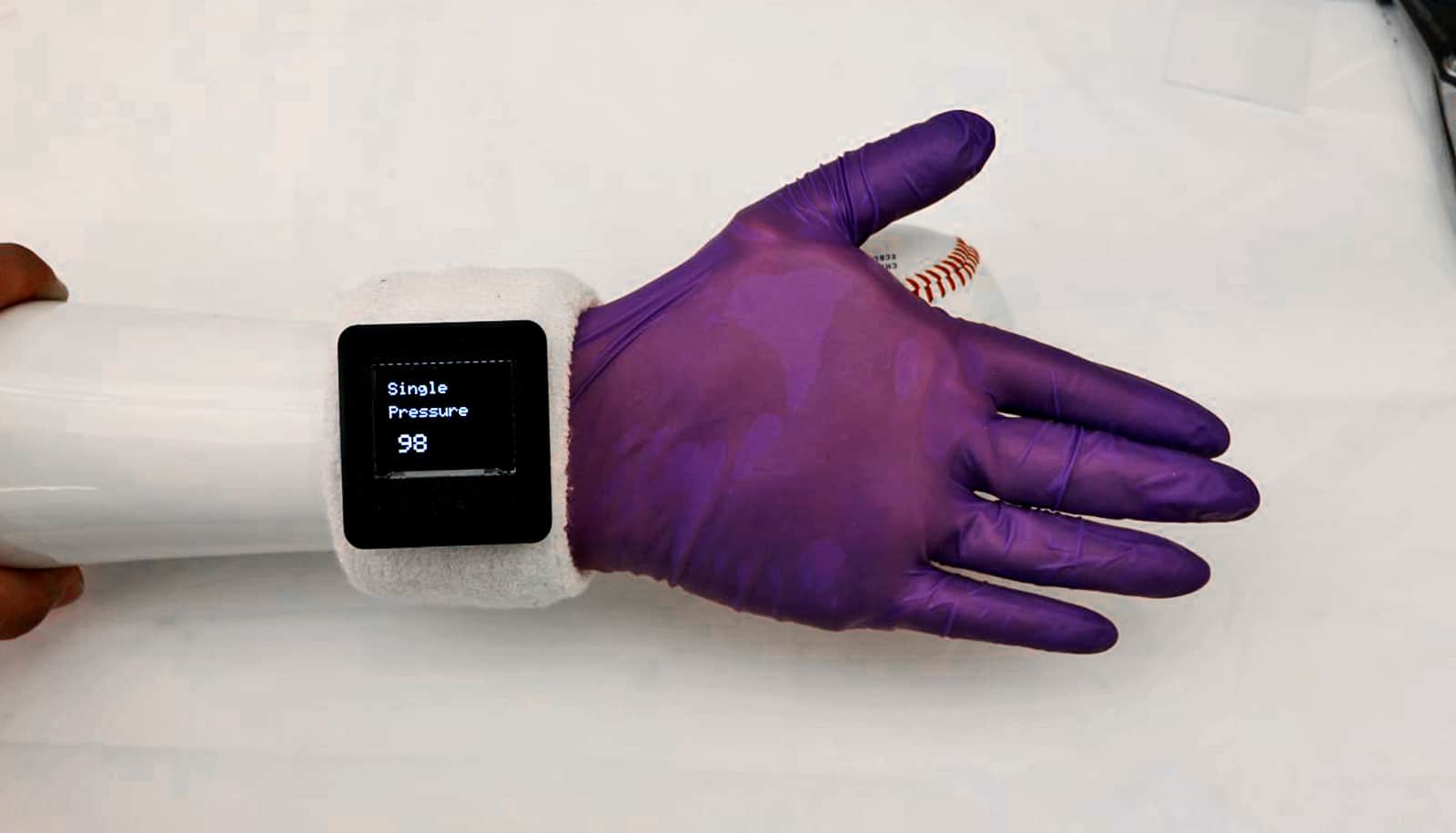
    The electronic glove offers "humanlike" features for prosthetic hand users. (Credit: Chris Adam/Purdue)

    A new electronic glove could cover a prosthetic hand to provide humanlike softness, warmth, appearance, and sensory perception, such as the ability to sense pressure, temperature, and hydration.

    While a conventional prosthetic hand helps restore mobility, the new e-glove advances the technology by offering the realistic human hand-like features in daily activities and life roles, with the potential to improve their mental health and well-being by helping them more naturally integrate into social contexts.

    The e-glove uses thin, flexible electronic sensors and miniaturized silicon-based circuit chips on the commercially available nitrile glove. The e-glove is connected to a specially designed wristwatch, allowing for real-time display of sensory data and remote transmission to the user for post-data processing.

    “We developed a novel concept of the soft-packaged, sensor-instrumented e-glove built on a commercial nitrile glove, allowing it to seamlessly fit on arbitrary hand shapes,” says Chi Hwan Lee, an assistant professor in the College of Engineering at Purdue University.

    “The e-glove is configured with a stretchable form of multimodal sensors to collect various information such as pressure, temperature, humidity, and electrophysiological biosignals, while simultaneously providing realistic human hand-like softness, appearance, and even warmth.”

    Lee and his team hope that the appearance and capabilities of the e-glove will improve the well-being of prosthetic hand users by allowing them to feel more comfortable in social contexts. The glove is available in different skin tone colors, and has lifelike fingerprints and artificial fingernails.

    “The prospective end user could be any prosthetic hand users who have felt uncomfortable wearing current prosthetic hands, especially in many social contexts,” Lee says.

    The fabrication process of the e-glove is cost-effective and manufacturable in high volume, making it an affordable option for users unlike other emerging technologies with mind, voice, and muscle control embedded within the prosthetic at a high cost. Additionally, these emerging technologies do not provide the humanlike features that the e-glove provides.

    “My group is devoted to developing various wearable biomedical devices, and my ultimate goal is to bring these technologies out of the lab and help many people in need. This research represents my continued efforts in this context,” Lee says.

    Lee and coauthor Min Ku Kim, an engineering doctoral student, have worked to patent the technology with the Purdue Research Foundation Office of Technology Commercialization. The team is seeking partners to collaborate in clinical trials or experts in the prosthetics field to validate the use of the e-glove and to continue optimizing the design of the glove.

    The technology is published in NPG Asia Materials. Additional researchers from Purdue, the University of Georgia, and the University of Texas, worked on the development of the e-glove technology.

    Source: Purdue University
    Play Video

    Neurons work together to form our sense of texture

    (Credit: Getty Images)

    As neurons in somatosensory cortex process information about texture from sensors in the skin, they each respond differently to various features of a surface, creating a high-dimensional representation of texture in the brain, researchers report.

    Our hands and fingertips are amazingly sensitive to texture. We can easily distinguish coarse sandpaper from smooth glass, but we also pick up more subtle differences across a wide range of textures, like the slick sheen of silk or the soft give of cotton. The somatosensory cortex is the part of the brain responsible for interpreting the sense of touch.

    “Objects can have textures that we can describe in simple terms like rough or soft or hard. But they can also be velvety or cottony or furry,” says Sliman Bensmaia, associate professor of organismal biology and anatomy at the University of Chicago and senior author of the study.

    wheel of textures
    A rotating drum covered with strips of different fabrics, sandpapers, and patterns to measure how the skin and nervous system respond to texture. (Credit: Matt Wood/U. Chicago)

    “The variety of different adjectives you can use to describe texture just highlights that it’s a rich sensory space. So it makes sense that you need to have a rich neural space in the brain to interpret that too.”

    Different feelings

    In a 2013 study in PNAS, Bensmaia’s lab showed how different kinds of nerve fibers respond to different aspects of texture. Some nerves respond mainly to spatial elements of coarse textures, like the raised bumps of a Braille letter that create a pattern when pressed against the skin. Others respond to vibrations created when the skin rubs across fine textures, like fabrics, which account for the vast majority of textures we encounter in the real world.

    In that study, Bensmaia and his colleagues used a rotating drum covered with strips of various coarse and fine textures, such as sandpaper, fabrics, and plastics. The drum then ran the textures across the fingertips of Rhesus macaque monkeys, whose somatosensory system is similar to humans, while the researchers recorded the responses in the nerve.

    For the new study, the researchers recorded the corresponding responses to the same textures directly from the brain, using electrodes implanted into the somatosensory cortex of the monkeys.

    The new data show that the neurons respond in a highly idiosyncratic way to different aspects of texture. Some neurons respond to coarse features of a texture. Others respond to fine features, certain patterns of indentation in the skin, or any number of combinations in between. The researchers identified at least 20 different patterns of response.

    Rich sensations

    “Some of them map onto things we understand, like roughness or the spatial pattern of a texture,” Bensmaia says. “But then it becomes combinations of skin vibration coupled with patterns of skin deformation, things that are abstract and a little harder to describe.”

    But these more abstract features of texture are what can make the difference in being able to distinguish between bedsheets with different thread counts. The researchers recorded responses to 55 different textures, and Bensmaia says he can tell which one researchers used just by looking at the pattern of activity it generated in the brain.

    “Velvet is going to excite one subpopulation of neurons more than another, and sandpaper is going to excite another overlapping population,” he says. “It’s this variety in the response that allows for the richness of the sensation.”

    Prosthetic hands

    Along with Nicho Hatsopoulos, who studies how the brain directs movement in the limbs, Bensmaia also pioneered research to build brain-controlled robotic prosthetic limbs. These devices work by implanting arrays of electrodes in the somatosensory cortex and areas of the brain that control movement. The electrodes pick up activity in neurons as the patient thinks about moving their own arm to direct the robotic arm to move accordingly. The prosthetic hand is fitted with sensors to detect sensations of touch, such as pressing on individual fingertips, which in turn generates electrical signals that stimulate the appropriate areas of the brain.

    Theoretically, the same technique could recreate sensations of texture, but Bensmaia points out that the new study shows why this could be a challenging task.

    The neurons that correspond to each fingertip are located in clearly defined areas of the somatosensory cortex, so it’s easier to stimulate the appropriate spot for a given touch. But neurons throughout the somatosensory cortex respond to texture inputs, and they’re mixed together. There’s no defined region of neurons that respond to sandpaper or the plastic keyboard of a laptop, for example.

    “It’s going to be pretty challenging to be able to create textural sensations through electrical stimulation, because you don’t have these monolithic groups of neurons working together,” he says. “It’s very heterogenous, which could make it difficult to implement in prosthetics. But that’s also how we get this rich sensation of texture in the first place.”

    The research appears in the Proceedings of the National Academy of Sciences. Funding for the work came from the National Institute of Neurological Disorders and Stroke.

    Source: University of Chicago