Archives

  • New protein boosts T cells to keep immune system in balance
  • Play Video

    Cool footage: Some Asian animals thrive near people

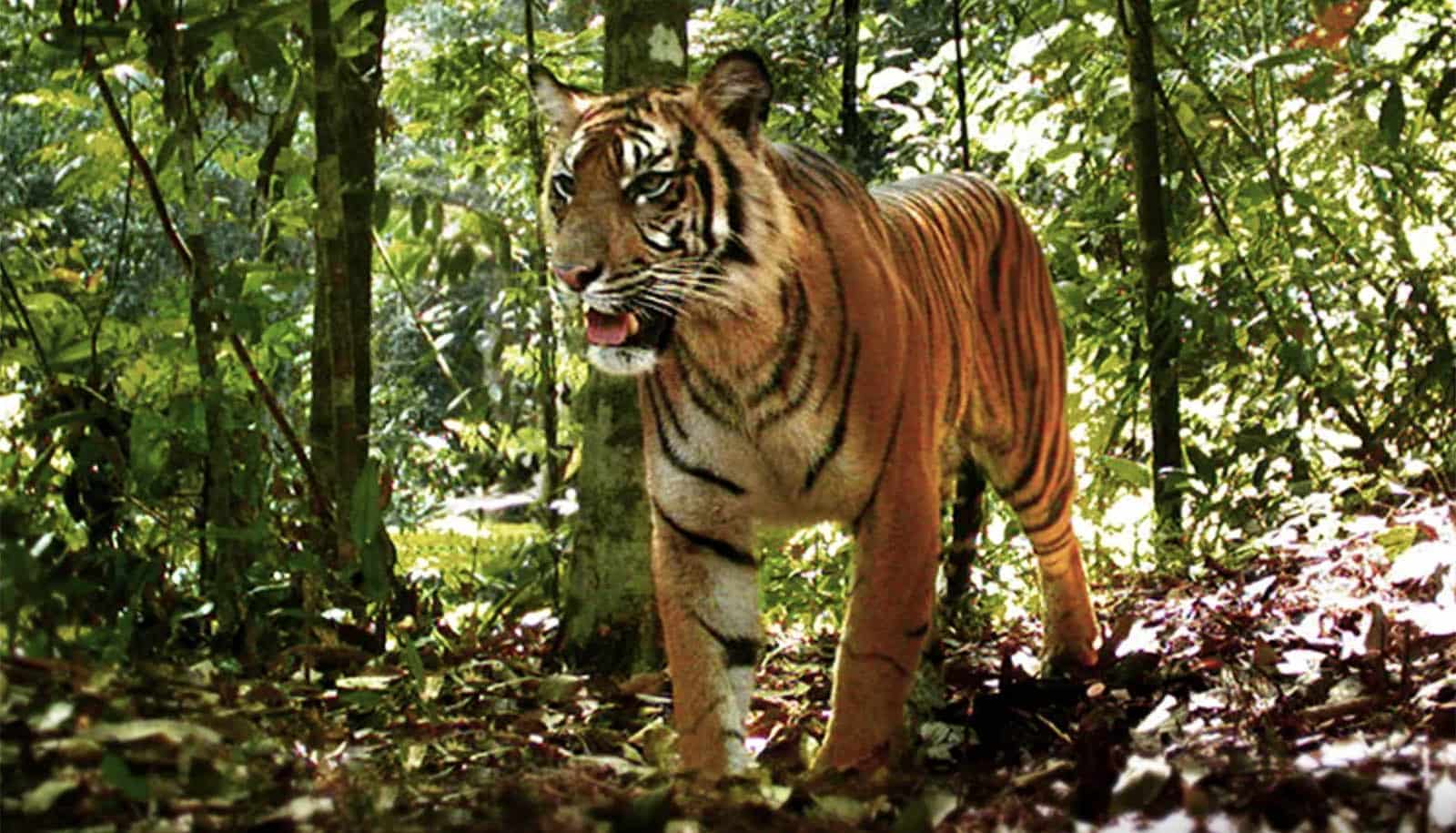
    Researchers analyzed animals across Asia using hidden cameras and captured some amazing footage. Above, a Sumatra tiger in the forest. (Credit: Matthew Luskin/U. Queensland)

    Some of Asia’s largest animals are defying 12,000 years of extinction trends by thriving alongside humans, a study finds. Others are less fortunate.

    Researchers scoured paleontological records to compare the historic distribution of Asia’s 14 largest species with their populations in present-day tropical forests.

    Four species—tigers, Asian elephants, wild boars, and clouded leopards—showed increased populations in areas with human infrastructure, says PhD candidate Zachary Amir, from the University of Queensland’s School of Biological Sciences and the Ecological Cascades Lab.

    “These results show that, under the right conditions, some large animals can live nearby humans and avoid extinction,” Amir says.

    “These results challenge the narrative within some conservation circles that humans and megafauna are incompatible. Globally there is a trend towards ‘trophic downgrading,’ a term referring to the disproportionate loss of the world’s largest animals.

    “Trophic downgrading is usually worst near humans because hunters target larger species. But in the case of tigers, elephants, wild boars, and clouded leopards, their Asian populations are higher nearby humans,” says Amir.

    “This may be the outcome of tougher anti-poaching efforts in the national parks that are closer to human settlements and are more frequently visited by tourists.”

    The study in Science Advances also finds that deforestation still affects species, and clouded leopard numbers in particular have experienced a strong decline in those areas.

    But, Amir says the research shows that if the large animal species were not hunted, they could live in relatively small habitats and near humans.

    “Previously, there have only been a few examples of large Asian species thriving in small habitats near humans, notably in Mumbai, India where leopards in an urban park prey on stray dogs,” Amir says. “Thankfully, we found that a wider range of animals can coexist with humans.”

    At one of their study sites in Singapore, where poaching has been eliminated and there are considerable forest restoration efforts, two large animal species are thriving again.

    “Singapore has actually experienced the natural re-wilding of sambar deer and wild boars, which are now frequently observed in an urban forest, the Bukit Timah Nature Reserve,” says Amir.

    “If we replicate those protection efforts in larger forests and other counties, we may see positive impacts right around the world. But before this can happen, humans need to get our act together and limit poaching.”

    While there are some positive results, research fellow and study coauthor Matthew Luskin says the study also notes strong declines in tapirs, Sumatran rhinoceros, sun bears, guar, and other large animals.

    “The key innovation of this work was to systematically investigate the population trends of many different wildlife species across the region,” says Luskin. “Then we tested if all species showed consistent trends and if similar parks retained similar species.

    “Remarkably, we found no two forests currently possess the same group of wildlife compared to thousands of years ago.”

    Luskin says the research offered an opportunity to shape the future of nature.

    “These results provide hope for wildlife in forests previously considered too far degraded or too close to cities,” he says. “Now we’re exploring new conservation strategies for these surprising places.”

    Source: University of Queensland
    Play Video

    Elephant trunks suck stuff up at 330 miles per hour

    "An elephant eats about 400 pounds of food a day, but very little is known about how they use their trunks to pick up lightweight food and water for 18 hours, every day," says Andrew Schulz. "It turns out their trunks act like suitcases, capable of expanding when necessary." (Credit: David Clode/Unsplash)

    The way an elephant manipulates its trunk to eat and drink could lead to better robots, researchers say.

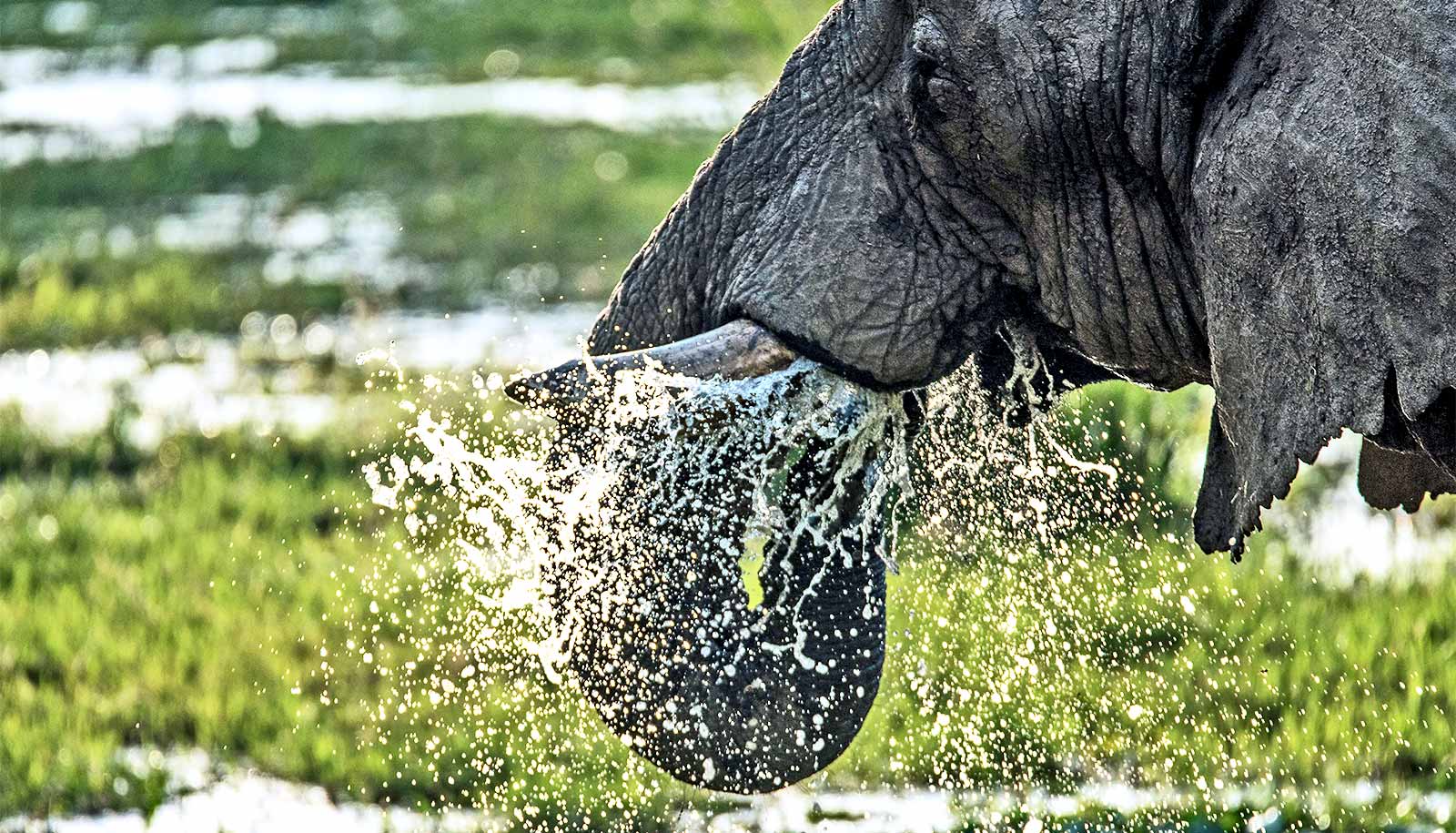
    Elephants dilate their nostrils to create more space in their trunks, allowing them to store up to 5.5 liters (1.45 gallons) of water, according to their new study.

    They can also suck up three liters (0.79 gallons) per second—a speed 30 times faster than a human sneeze (150 meters per second/330 mph), the researchers found.

    The researchers wanted to better understand the physics of how elephants use their trunks to move and manipulate air, water, food, and other objects. They also wanted to learn if the mechanics could inspire the creation of more efficient robots that use air motion to hold and move things.

    While octopuses use jets of water to propel themselves and archer fish shoot water above the surface to catch insects, elephants are the only animals able to use suction both on land and underwater.

    “An elephant eats about 400 pounds of food a day, but very little is known about how they use their trunks to pick up lightweight food and water for 18 hours, every day,” says lead author Andrew Schulz, a mechanical engineering PhD student at the Georgia Institute of Technology. “It turns out their trunks act like suitcases, capable of expanding when necessary.”

    An elephant trunk grabbing for pieces of apples
    An elephant uses its trunk to grab apples underwater. (Credit: Georgia Tech)

    Sucking up tortilla chips without breaking them

    Schulz and his colleagues worked with veterinarians at Zoo Atlanta, studying elephants as they ate various foods. For large rutabaga cubes, for example, the animal grabbed and collected them. It sucked up smaller cubes and made a loud vacuuming sound, like the sound of a person slurping noodles, before transferring the vegetables to its mouth.

    To learn more about suction, the researchers gave elephants a tortilla chip and measured the applied force. Sometimes the animal pressed down on the chip and breathed in, suspending the chip on the tip of its trunk without breaking it, similar to a person inhaling a piece of paper onto their mouth. Other times the elephant applied suction from a distance, drawing the chip to the edge of its trunk.

    Elephants inhale at speeds comparable to Japan’s 300-mph bullet trains.

    “An elephant uses its trunk like a Swiss Army knife,” says David Hu, Schulz’s advisor and a professor in Georgia Tech’s School of Mechanical Engineering. “It can detect scents and grab things. Other times it blows objects away like a leaf blower or sniffs them in like a vacuum.”

    By watching elephants inhale liquid from an aquarium, the team was able to time the durations and measure volume. In just 1.5 seconds, the trunk sucked up 3.7 liters (just shy of 1 gallon), the equivalent of 20 toilets flushing simultaneously.

    Soft robots and elephant conservation

    The researchers used an ultrasonic probe to take trunk wall measurements and see how the trunk’s inner muscles work. By contracting those muscles, the animal dilates its nostrils up to 30%. This decreases the thickness of the walls and expands nasal volume by 64%.

    “At first it didn’t make sense: an elephant’s nasal passage is relatively small and it was inhaling more water than it should,” Schulz says. “It wasn’t until we saw the ultrasonographic images and watched the nostrils expand that we realized how they did it. Air makes the walls open, and the animal can store far more water than we originally estimated.”

    Based on the pressures applied, Schulz and the team suggest that elephants inhale at speeds comparable to Japan’s 300-mph bullet trains.

    Schulz says these unique characteristics have applications in soft robotics and conservation efforts.

    “By investigating the mechanics and physics behind trunk muscle movements, we can apply the physical mechanisms—combinations of suction and grasping—to find new ways to build robots,” Schulz says.

    “In the meantime, the African elephant is now listed as endangered because of poaching and loss of habitat. Its trunk makes it a unique species to study. By learning more about them, we can learn how to better conserve elephants in the wild.”

    The paper appears in the Journal of the Royal Society Interface. The US Army Research Laboratory and the US Army Research Office 294 Mechanical Sciences Division, Complex Dynamics and Systems Program, funded the work. Any opinions, findings, and conclusions or recommendations expressed in this material are those of the authors and do not necessarily reflect the view of the sponsoring agency.

    Source: Georgia Tech