Archives

  • Wind turbines don’t really affect US property values
  • Play Video

    Origami modules could build bridges, shelters, and stuff in space

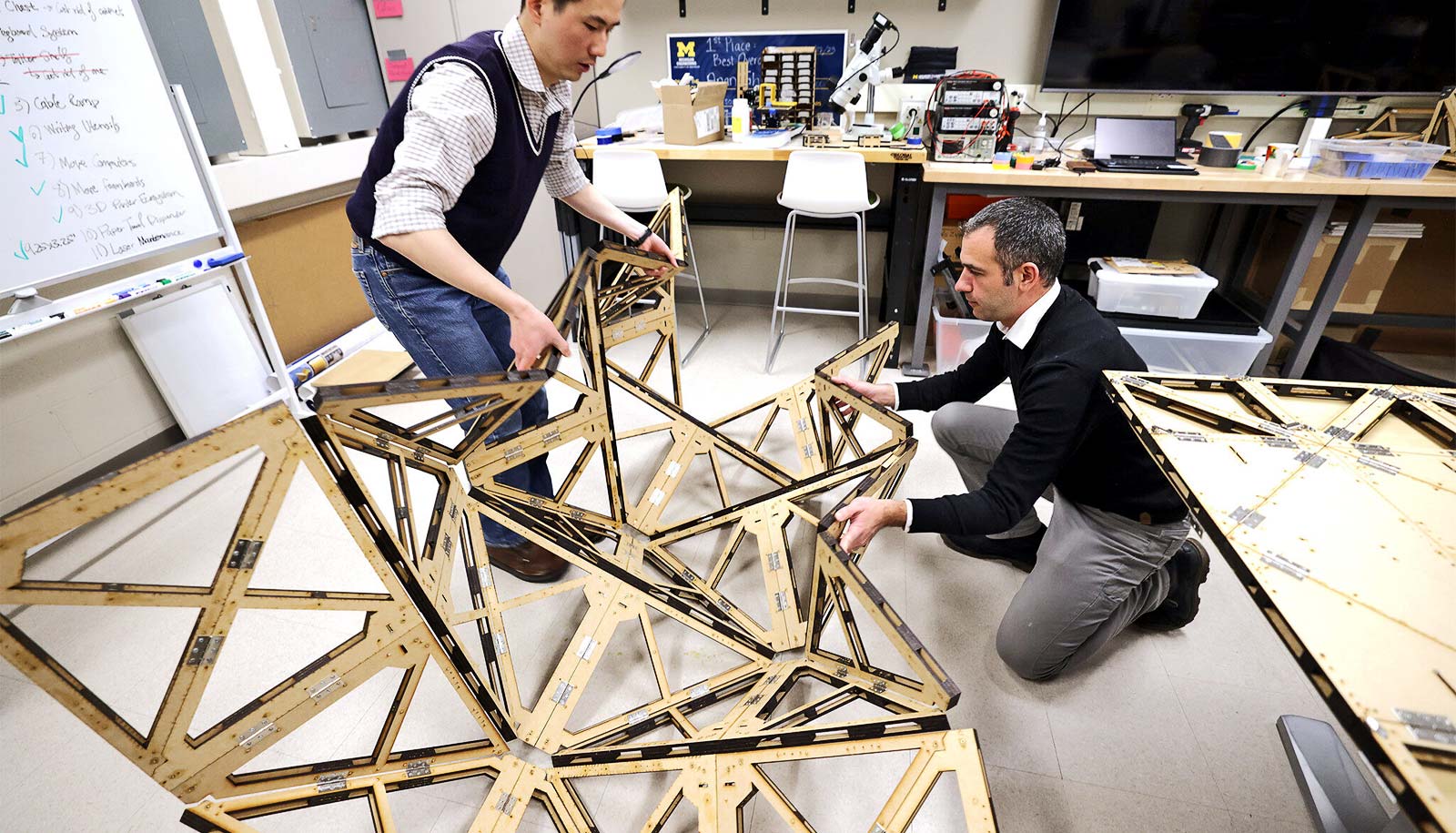
    From left, Yi Zhu, a research fellow in mechanical engineering, and Evgueni Filipov, an associate professor in both civil and environmental engineering and mechanical engineering, working in his lab. (Credit: Brenda Ahearn/Michigan Engineering)

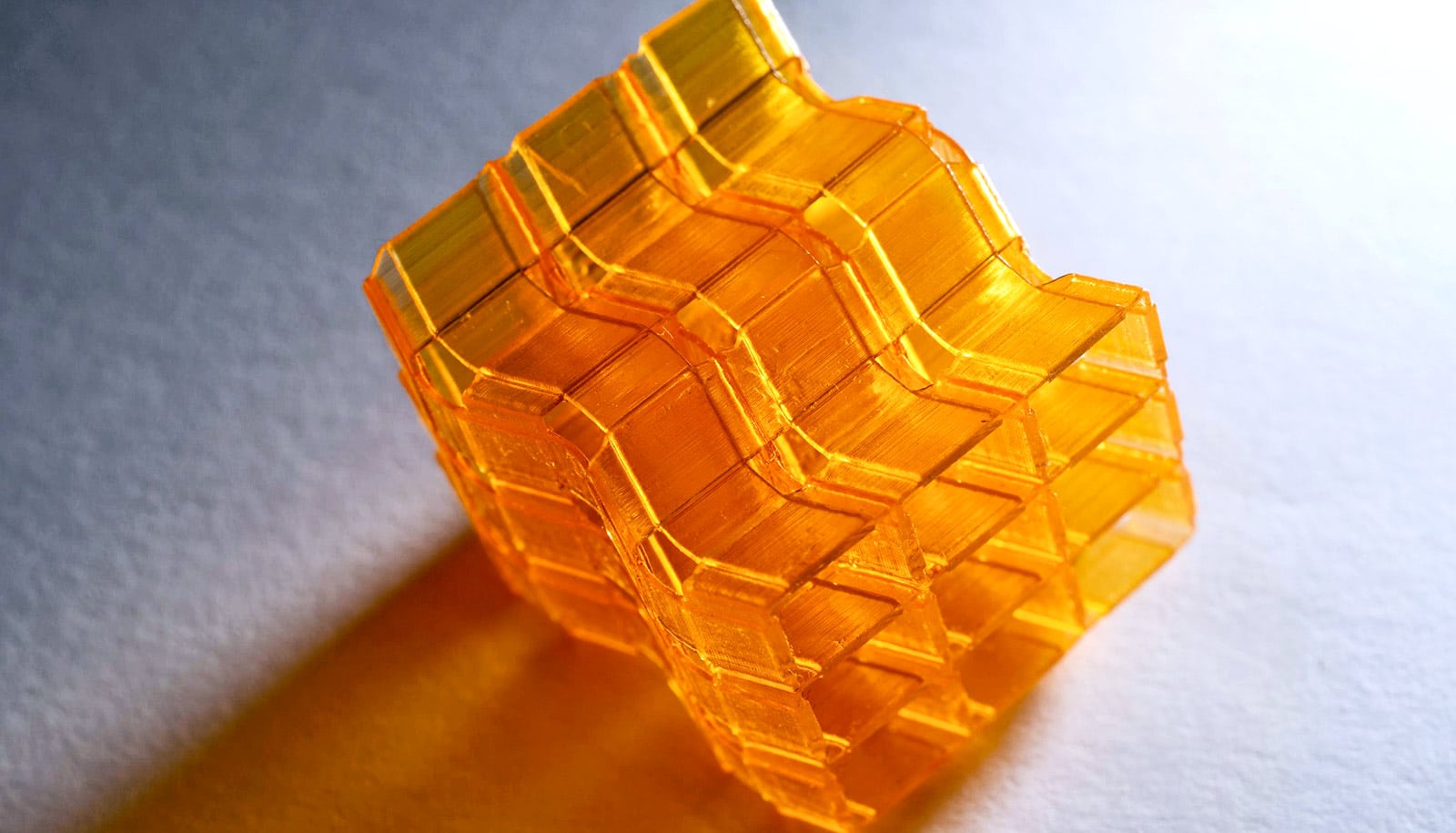
    For the first time, load-bearing structures like bridges and shelters can be made with origami modules—versatile components that can fold compactly and adapt into different shapes, a new study shows.

    It’s an advance that could enable communities to quickly rebuild facilities and systems damaged or destroyed during natural disasters, or allow for construction in places that were previously considered impractical, including outer space. The technology could also be used for structures that need to be built and then disassembled quickly, such as concert venues and event stages.

    “With both the adaptability and load-carrying capability, our system can build structures that can be used in modern construction,” says Evgueni Filipov, an associate professor of civil and environmental engineering and of mechanical engineering at the University of Michigan and a corresponding author of the study in Nature Communications.

    Principles of the origami art form allow for larger materials to be folded and collapsed into small spaces. And with modular building systems gaining wider acceptance, the applications for components that can be stored and transported with ease have grown.

    Researchers have struggled for years to create origami systems with the necessary weight capacities while keeping the ability to quickly deploy and reconfigure. The University of Michigan engineers have created an origami system that solves that problem. Examples of what the system can create include:

    • A 3.3-foot-tall column that can support 2.1 tons of weight while itself weighing just over 16 pounds, and with a base footprint of less than 1 square foot.
    • A package that can unfold from a 1.6-foot-wide cube to deploy into different structures, including: a 13-foot-long walking bridge, a 6.5-foot-tall bus stop, and a 13-foot-tall column.

    A key to the breakthrough came in the form of a different design approach provided by first author Yi Zhu, a research fellow in mechanical engineering.

    “When people work with origami concepts, they usually start with the idea of thin, paper-folded models—assuming your materials will be paper-thin,” Zhu says. “However, in order to build common structures like bridges and bus stops using origami, we need mathematical tools that can directly consider thickness during the initial origami design.”

    To bolster weight-bearing capacity, many researchers have attempted to thicken their paper-thin designs in varying spots. The University of Michigan team, however, found that uniformity is key.

    “What happens is you add one level of thickness here, and a different level of thickness there, and it becomes mismatched,” Filipov says. “So when the load is carried through these components, it starts to cause bending.

    “That uniformity of the component’s thickness is what’s key and what’s missing from many current origami systems. When you have that, together with appropriate locking devices, the weight placed upon a structure can be evenly transferred throughout.”

    In addition to carrying a large load, this system—known as the Modular and Uniformly Thick Origami-Inspired Structure system—can adapt its shapes to become bridges, walls, floors, columns, and many other structures.

    The new research was helped along by use of its Sequentially Working Origami Multi-Physics Simulator (SWOMPS), a simulator that accurately predicts the behaviors or large-scale origami systems. Developed at the University of Michigan, the system has been available to the public since 2020.

    The National Science Foundation and the Automotive Research Center funded the work.

    Source: University of Michigan
    Play Video

    Super strong 3D-printed structure unfolds when hot

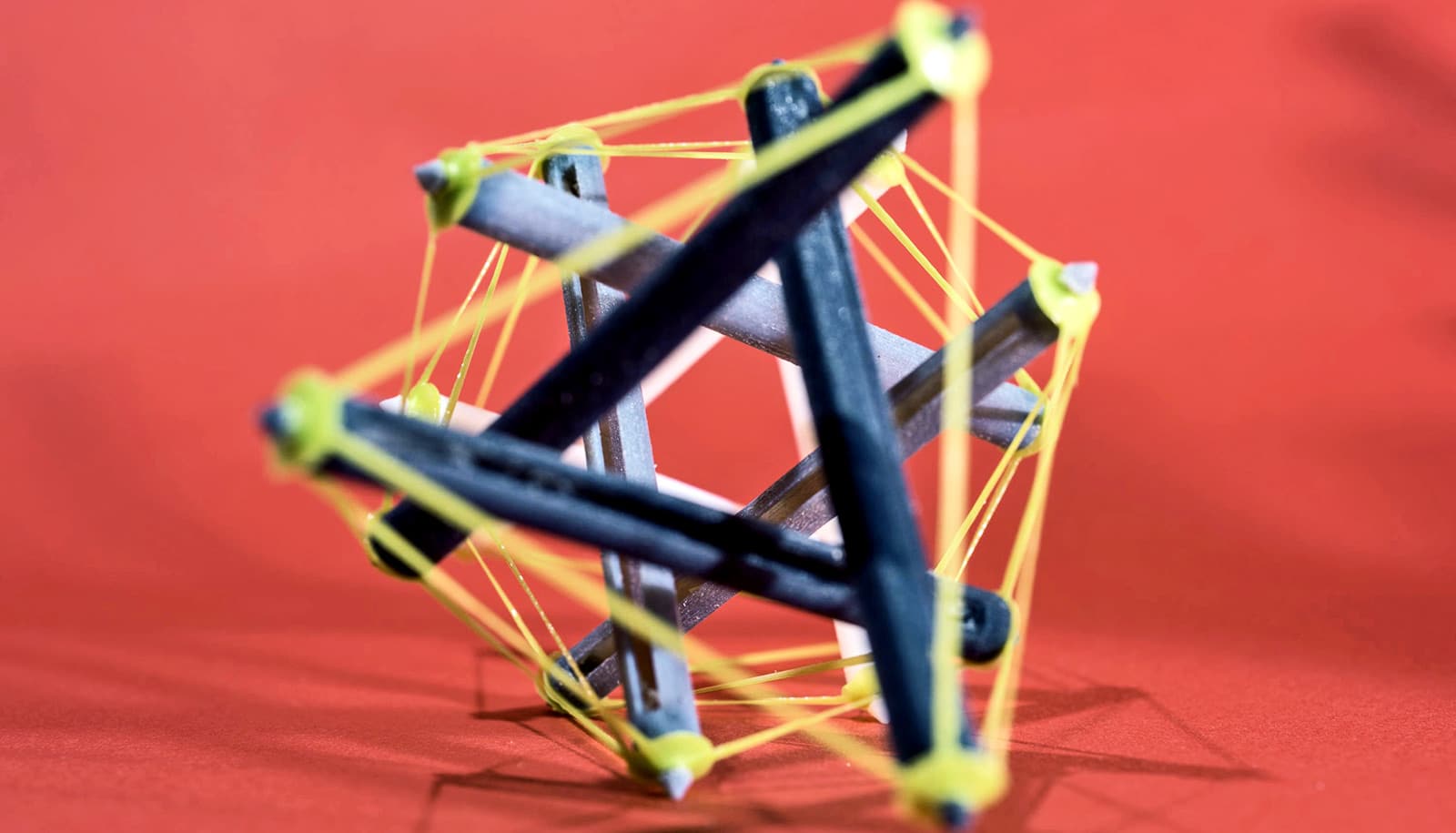
    The 3D printed object researchers designed with tensegrity, a structural system of floating rods in compression and cables in continuous tension. (Credit: Rob Felt/Georgia Tech)

    Researchers have developed a way to use 3D printers to create objects that expand when heated. They have potential uses in space exploration or medical devices.

    The new objects use tensegrity, a structural system of floating rods in compression and cables in continuous tension. The researchers fabricated the struts from shape memory polymers that unfold when heated.

    “Tensegrity structures are extremely lightweight while also being very strong,” says Glaucio Paulino, a professor in the Georgia Institute of Technology’s School of Civil and Environmental Engineering.

    “That’s the reason there’s a heavy amount of interest right now in researching the use of tensegrity structures for outer space exploration. The goal is to find a way to deploy a large object that initially takes up little space.”

    expanded tensegrity structure
    The 3D printed tensegrity structure expanded. (Credit: Rob Felt/Georgia Tech.)

    The researchers used 3D printers to create the struts that make up one of the primary components of the tensegrity structure. To enable the struts to be temporarily folded flat, the researchers designed them to be hollow with a narrow opening that runs the length of the tube. Each strut has an attachment point on each end to connect to a network of elastic cables, which are also made with 3D printers.

    Once the struts were heated to 65 degrees Celsius, the researchers could partially flatten and fold them into a shape resembling the letter W. The cooled structures then retain the temporary shape.

    With all cables attached, the objects can be reheated to initiate the transformation into tensegrity structures.

    “We believe that you could build something like an antenna that initially is compressed and takes up little space, but once it’s heated, say just from the heat of the sun, would fully expand,” says Jerry Qi, a professor in the George W. Woodruff School of Mechanical Engineering at Georgia Tech.

    Secret flaws keep 3D-printing safe from hackers

    A key component of making 3D-printed objects that can transform into tensegrity structures was controlling the rate and sequence of expansion. The shape memory polymers enable the researchers to fine-tune how quickly each strut expands by adjusting at which temperature the expansion occurs. That enables structures to be designed with struts that expand sequentially.

    “For bigger and more complicated structures, if you don’t control the sequence that these struts expand, it tangles and you have a mess,” Paulino says. “By controlling the temperature at which each strut expands, we can have a phased deployment and avoid this entanglement.”

    The term “tensegrity” comes from a combination of the words “tensional integrity,” and the concept has been used as the structural basis for several notable projects through the years, including a large pedestrian bridge in Brisbane, Australia, and stadium roofs such as the Georgia Dome stadium in Atlanta and the Olympic Gymnastics Arena in Seoul, South Korea.

    The researchers envision that the new 3- printed structures could be used for super light-weight structures needed for space exploration or even shape-change soft robots.

    Watch 4D-printed object become a sturdy dome

    “These active tensegrity objects are very elegant in design and open up a range of possibilities for deployable 3D structures,” Paulino says.

    The research appears in the journal Scientific Reports. The National Science Foundation and the Air Force Office of Scientific Research sponsored the research. The content is the responsibility of the authors and does not necessarily represent the official views of the sponsoring agencies.

    Source: Georgia Tech