Archives

Play Video

Jellyfish-inspired electronic skin can heal itself while wet

(Credit: Pexels)

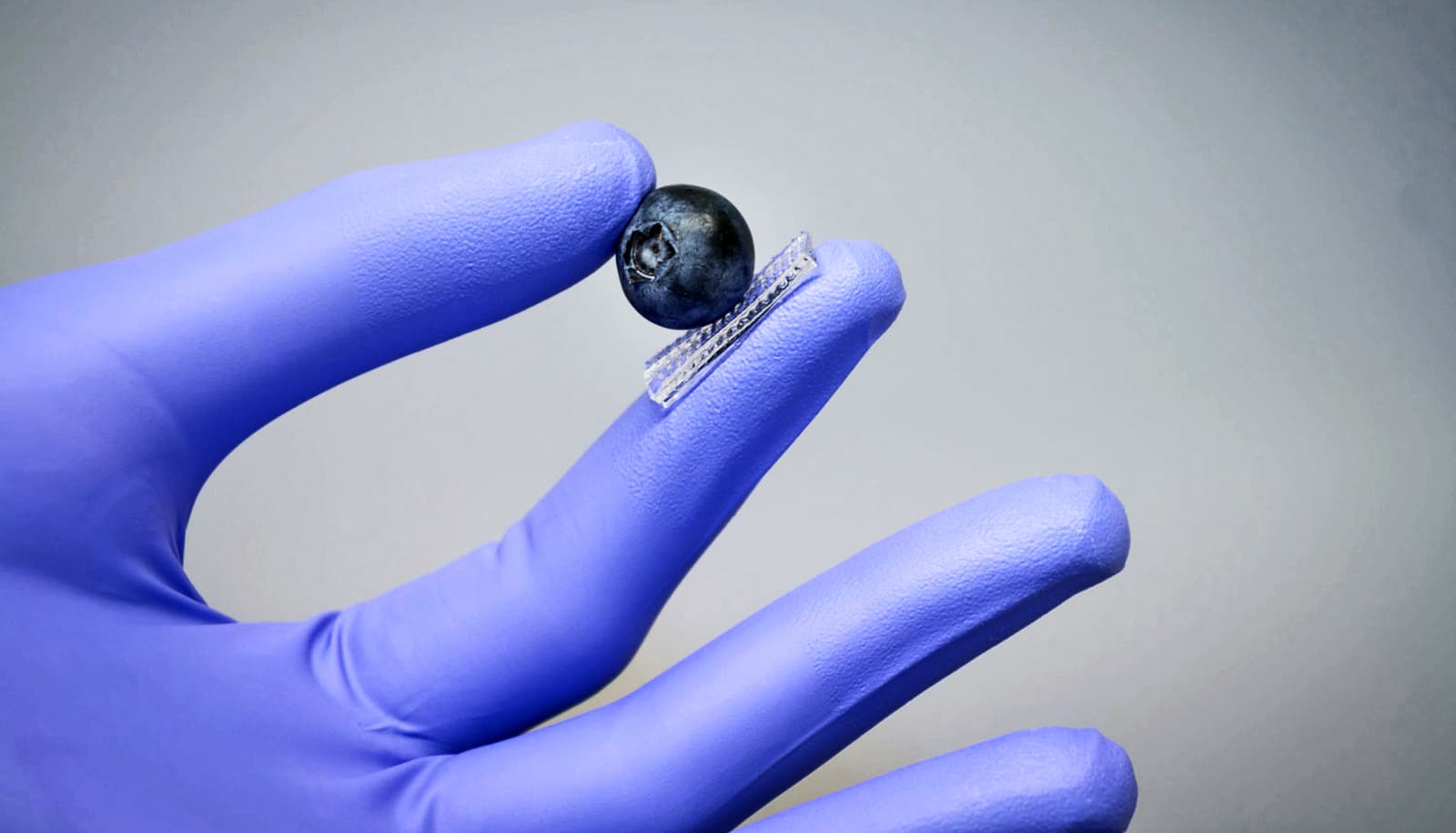
A new electronic skin that is transparent, stretchable, touch-sensitive, and self-healing in aquatic environments gets its inspiration from jellyfish.

“One of the challenges with many self-healing materials today is that they are not transparent and they do not work efficiently when wet,” says Benjamin Tee, assistant professor of materials science and engineering at the National University of Singapore.

“These drawbacks make them less useful for electronic applications such as touchscreens which often need to be used in wet weather conditions.

“With this idea in mind, we began to look at jellyfishes—they are transparent, and able to sense the wet environment. So, we wondered how we could make an artificial material that could mimic the water-resistant nature of jellyfishes and yet also be touch sensitive,” says Tee, who has worked on electronic skins for many years and was part of the team that developed the first ever self-healing electronic skin sensors in 2012.

“We are hoping to create a future where electronic devices… can perform self-repair functions to reduce the amount of electronic waste in the world.”

The researchers created a gel consisting of a fluorocarbon-based polymer with a fluorine-rich ionic liquid. When researchers combine the two, the polymer network interacts with the ionic liquid via highly reversible ion-dipole interactions, which allows it to self-heal.

“Most conductive polymer gels such as hydrogels would swell when submerged in water or dry out over time in air,” Tee says. “What makes our material different is that it can retain its shape in both wet and dry surroundings. It works well in sea water and even in acidic or alkaline environments.”

To create the electronic skin, the team printed the material into electronic circuits. As a soft and stretchable material, its electrical properties change when touched, pressed, or strained.

“We can then measure this change, and convert it into readable electrical signals to create a vast array of different sensor applications,” says Tee, who is also from the NUS Biomedical Institute for Global Health Research and Technology.

“The 3D printability of our material also shows potential in creating fully transparent circuit boards that could be used in robotic applications. We hope that this material can be used to develop various applications in emerging types of soft robots.”

Soft robots, and soft electronics in general, aim to mimic biological tissues to make them more mechanically compliant for human-machine interactions. In addition to conventional soft robot applications, the material’s waterproof technology enables the design of amphibious robots and water-resistant electronics.

Another advantage of the skin is its potential to reduce waste.

“Millions of tonnes of electronic waste from devices like broken mobile phones or tablets are generated globally every year. We are hoping to create a future where electronic devices made from intelligent materials can perform self-repair functions to reduce the amount of electronic waste in the world,” Tee says.

Tee and his team are hoping to explore further possibilities of the material. “Currently, we are making use of the comprehensive properties of the material to make novel optoelectronic devices, which could be utilized in many new human-machine communication interfaces,” he says.

The study appears in Nature Electronics. Additional coauthors are from Tsinghua University and the University of California, Riverside.

Source: National University of Singapore
Play Video

‘E-skin’ lets prosthetic hands sense touch and pain

(Image credit: Getty Images. Video credit: Science Robotics/AAAS)

A new electronic “skin” may restore a sense of touch for amputees who use prosthetic hands.

The skin’s inventors say that when the “e-dermis” is layered on top of a prosthetic, it brings back feeling through the fingertips.

“After many years, I felt my hand, as if a hollow shell got filled with life again,” says the anonymous amputee who served as the team’s principal volunteer tester.

Made of fabric and rubber laced with sensors to mimic nerve endings, e-dermis recreates a sense of touch as well as pain by sensing stimuli and relaying the impulses back to the peripheral nerves.

“We’ve made a sensor that goes over the fingertips of a prosthetic hand and acts like your own skin would,” says lead researcher Luke Osborn, a biomedical engineering graduate student at Johns Hopkins University. “It’s inspired by what is happening in human biology, with receptors for both touch and pain.

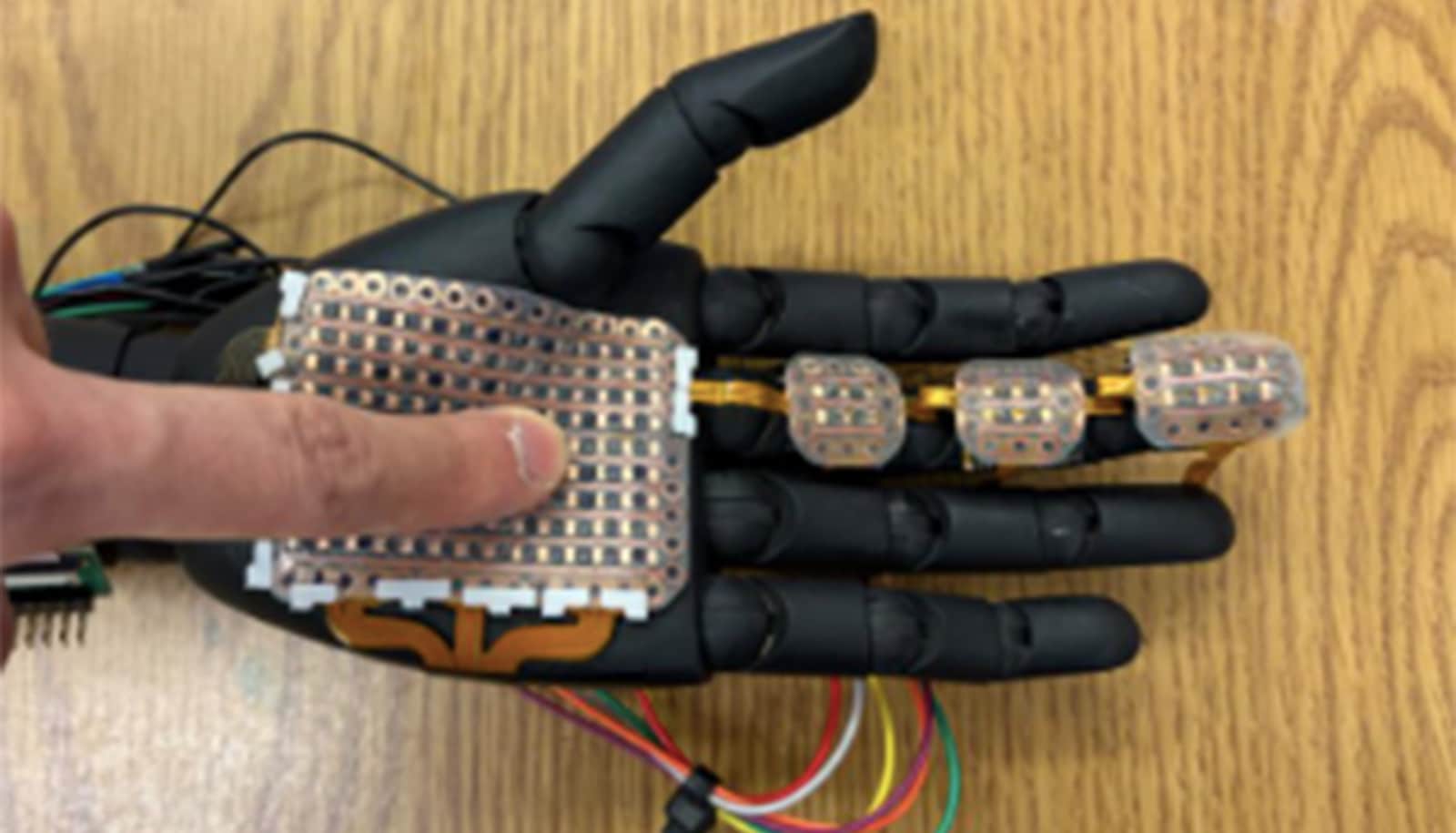
e-dermis on prosthetic hand
(Credit: Larry Canner/Johns Hopkins)

“This is interesting and new,” Osborn adds, “because now we can have a prosthetic hand that is already on the market and fit it with an e-dermis that can tell the wearer whether he or she is picking up something that is round or whether it has sharp points.”

The work, which appears in Science Robotics, shows it’s possible to restore a range of natural, touch-based feelings to amputees who use prosthetic limbs. The ability to detect pain could be useful, for instance, not only in prosthetic hands but also in lower limb prostheses, alerting the user to potential damage to the device.

Bringing a more human touch to modern prosthetic designs is critical, especially when it comes to incorporating the ability to feel pain, Osborn says.

“Pain is, of course, unpleasant, but it’s also an essential, protective sense of touch that is lacking in the prostheses that are currently available to amputees. Advances in prosthesis designs and control mechanisms can aid an amputee’s ability to regain lost function, but they often lack meaningful, tactile feedback or perception.”

That is where the e-dermis comes in, conveying information to the amputee by stimulating peripheral nerves in the arm. The device does this by electrically stimulating the amputee’s nerves in a non-invasive way, through the skin, says the paper’s senior author, Nitish Thakor, professor of biomedical engineering and director of the Neuroengineering and Biomedical Instrumentation Laboratory.

“For the first time, a prosthesis can provide a range of perceptions, from fine touch to noxious to an amputee, making it more like a human hand,” says Thakor, cofounder of Infinite Biomedical Technologies, the Baltimore-based company that provided the prosthetic hardware used in the study.

The researchers connected the e-dermis output to the volunteer by using a noninvasive method known as transcutaneous electrical nerve stimulation, or TENS. In a pain-detection task, the team determined that the test subject and the prosthesis were able to experience a natural, reflexive reaction to both pain while touching a pointed object and non-pain when touching a round object.

This artificial skin can sense ladybug footsteps

The e-dermis is not sensitive to temperature—for this study, the team focused only on detecting object curvature (for touch and shape perception) and sharpness (for pain perception).

The e-dermis technology could make robotic systems more human, and it could also expand or extend to astronaut gloves and space suits, Osborn says.

‘Skin’ sensor gives robots better sense of touch

The researchers plan to further develop the technology and better understand how to provide meaningful sensory information to amputees in the hopes of making the system ready for widespread patient use.

Other researchers from the Johns Hopkins departments of biomedical engineering, electrical and computer engineering, and neurology, and from the Singapore Institute of Neurotechnology contributed to the work. Space@Hopkins, the Applied Physics Laboratory, and the National Institute of Biomedical Imaging and Bioengineering funded the work.

Source: Johns Hopkins University