Researchers have bred corals to make them better able to cope with our changing climate—rising sea temperatures and increased acidity.
They’re now growing in experimental field conditions on the Great Barrier Reef, to see if they can also thrive in the wild.
“Most corals in the wild are living at the very top of their survival limit in terms of temperature,” says Madeleine van Oppen, an Australian Research Council laureate fellow at the University of Melbourne and the Australian Institute of Marine Science who is leading the project.
“The Great Barrier Reef lost half its coral cover during the back-to-back heat-induced mass bleaching events of 2016 and 2017.”
She notes that the Great Barrier Reef has warmed by around 0.6 °C since the 1950s, contributing to more extreme and frequent marine heat waves.
“Without a curb on greenhouse gas emissions, tropical sea temperatures are predicted to rise by 2–3 °C by the end of the century compared to pre-industrial times. So it is vital we help corals adapt,” van Oppen says.
‘Speeding up evolution’
During summer heat waves, corals become stressed and lose the microalgae that normally reside inside them in a mutually beneficial, or symbiotic, relationship. Corals receive most of their nutrition from the algae, so without them they starve and often die, turning white—coral bleaching.
Climate change also means that oceans absorb more carbon dioxide from the atmosphere, which makes seawater more acidic. When combined with rising temperatures, increased acidity can make coral more sensitive to bleaching—making it more difficult for them to form their calcium skeletons.
In an effort to develop coral that can better withstand these harsher conditions, van Oppen’s team is breeding corals using in vitro fertilization or IVF.
“We are speeding up evolution to help them adapt,” says van Oppen.
The techniques the team are using have traditionally been used to improve crops, livestock, and aquaculture species, as well as in wood production, and are based on accelerating naturally occurring evolutionary processes, she says.
Scientists call this “assisted evolution.” Assisted evolution doesn’t create genetically modified organisms, instead it accentuates and optimizes characteristics already present in some corals.
One assisted evolution method is hybridization, where individuals from two genetically different lineages (or ancestry) mate successfully to form a hybrid. This can be between different species or between distantly related populations of the same species.
“We chose to focus on Acropora corals because they are among the most important corals responsible for building the immense substructure that supports the Great Barrier Reef,” van Oppen says.
Spawning by moonlight
The team collected corals from the reef and brought them back to the National Sea Simulator at the Australian Institute of Marine Science. As the corals spawned by moonlight, which is the trigger for their annual spawning, researchers collected sperm and eggs.
Working with a system of color-coded bowls to keep track of the sperm and eggs from each species, they then used IVF to create hybrid embryos, as well as enabling the sperm and egg from individual species to fertilize itself, creating purebreds.
The baby corals then grew in the ocean simulator for seven months so researchers could study how they coped under predicted future ocean conditions of increased temperature and acidity.
The team examined if the corals survived at all, if they took up food-producing algae from their environment, and measured their size to determine growth and good health.
“We were excited to find that some of these coral hybrids grew and survived better under elevated temperatures and acidity levels, compared to their parents,” says van Oppen.
“Because the corals are resilient in the lab, we now want to see how they will grow on the reef, in the natural environment where their parents were collected.”
Field test in the Great Barrier Reef
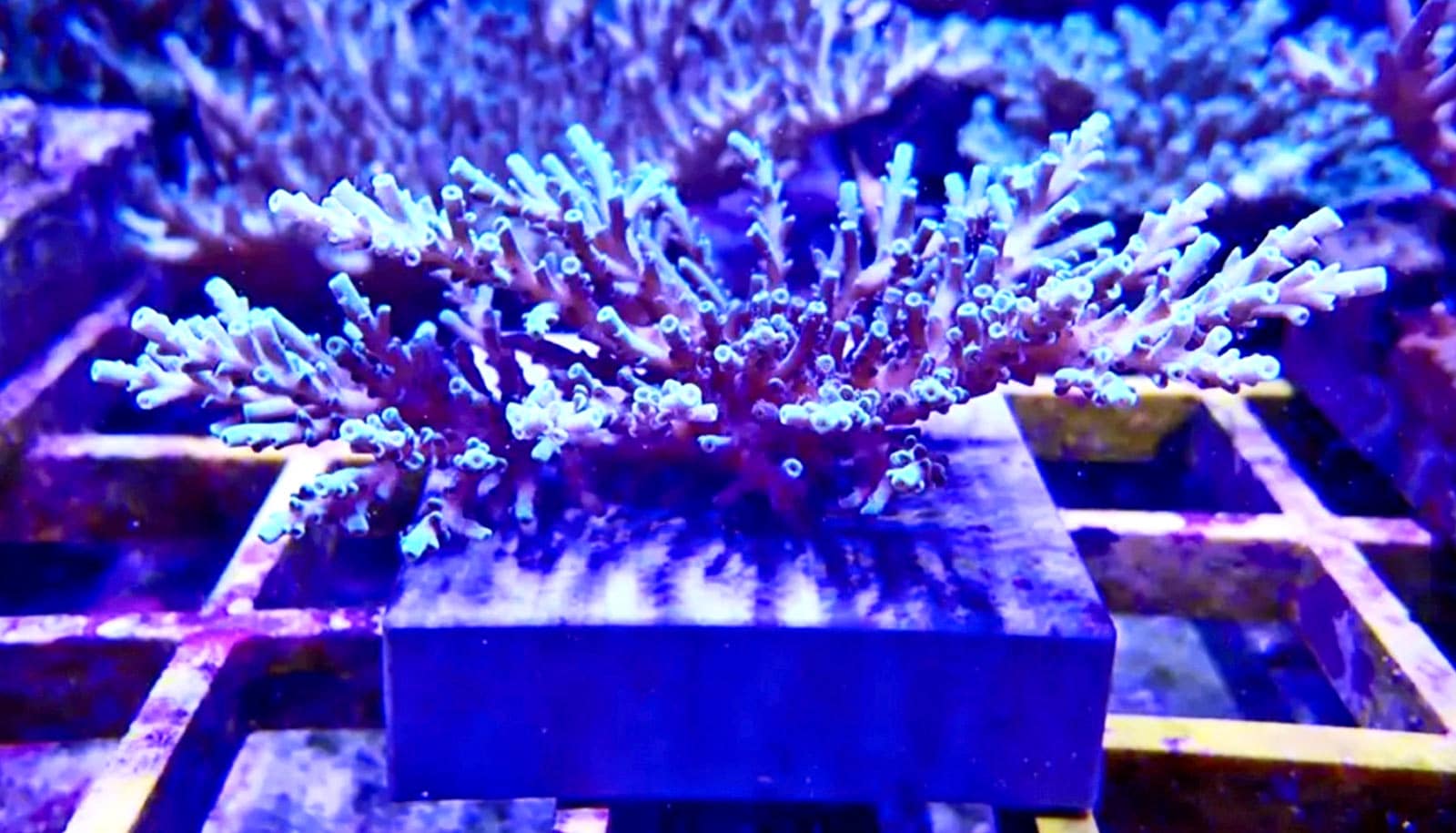
Using the first experiment as a guide to the best species, the team created seven types of IVF coral embryos (three hybrid and four purebred types) and placed some of these at a Great Barrier Reef field site.
Researchers set the corals onto terracotta tiles that represent the seabed, and label them with their species details.
“This controlled field testing is an important next step when assessing the benefits and risks of intervention methods aimed at increasing resilience to climate change, and for future coral reef restoration,” van Oppen says.
“We will see how the IVF corals do this summer, and whether the hybrids perform better compared to the purebreds in the field.”
Funding for the five-year coral hybrids project comes from a grant from Paul G. Allen Philanthropies, and additional funding from the Australian Institute of Marine Science.
Source: University of Melbourne