Archives

  • Americans would rather drive than commute in self-driving cars
  • Play Video

    Robot made with smaller bots has a funky way of getting around

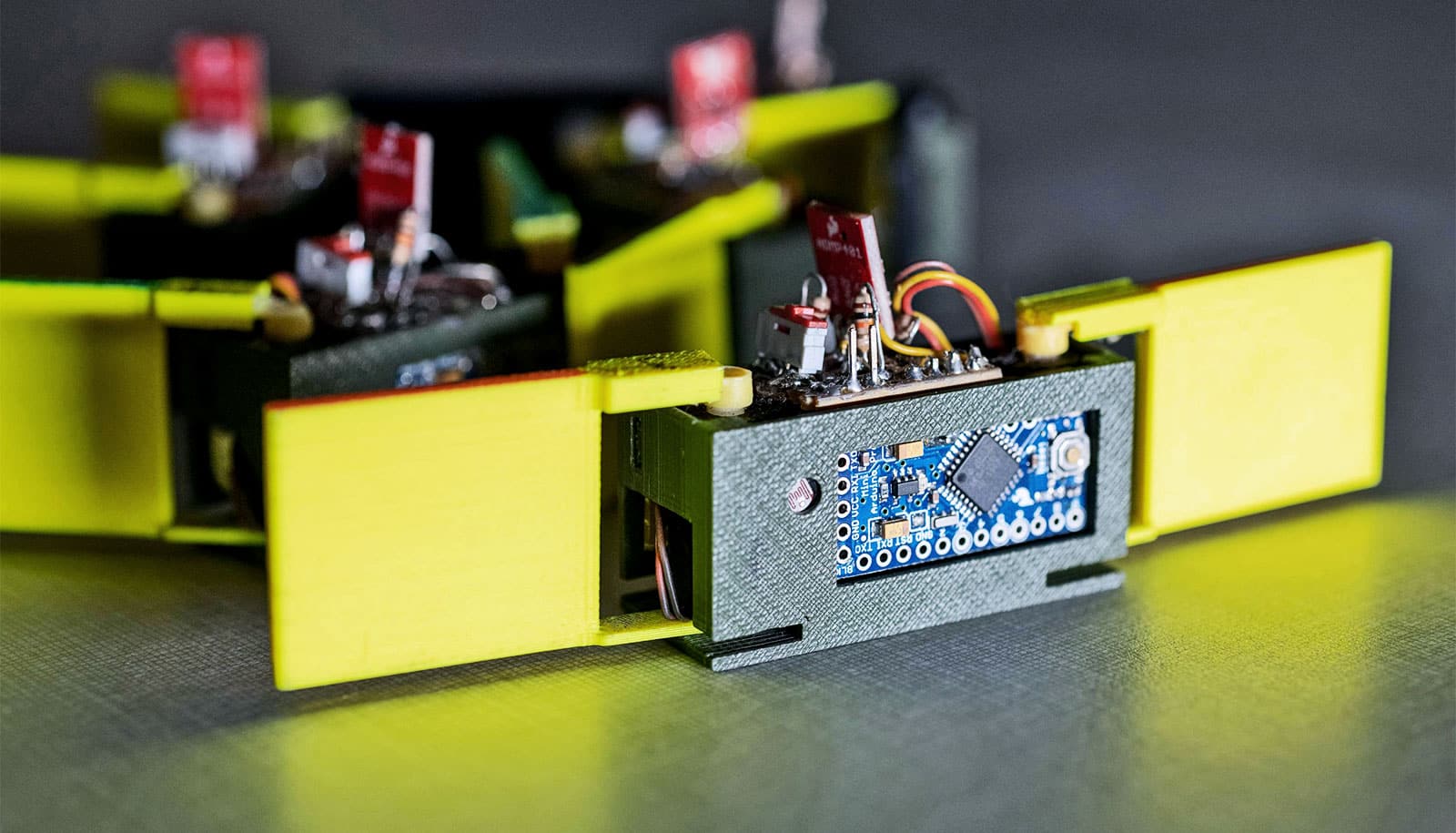
    Close-up of a smarticle—smart active particle—showing the two 3D-printed arms, light sensor, and motor. (Credit: Rob Felt/Georgia Tech)

    Researchers have made a new robot entirely of smaller robots known as “smarticles” to unlock the principles of a potentially new locomotion technique.

    Building conventional robots typically requires carefully combining components like motors, batteries, actuators, body segments, legs, and wheels.

    The 3D-printed smarticles—short for smart active particles—can do just one thing: flap their two arms. But when researchers confined five of these smarticles in a circle, they begin to nudge one another, forming a robophysical system known as a “supersmarticle” that can move by itself. Adding a light or sound sensor allows the supersmarticle to move in response to the stimulus—and even be controlled well enough to navigate a maze.

    The smarticles robots sit in their plastic ring on a metal-looking surface
    Five identical smarticles—smart active particles—interact with one another in an enclosure. By nudging each other, the group — dubbed a “supersmarticle”—can move in random ways. (Credit: Rob Felt/Georgia Tech)

    Though rudimentary now, the notion of making robots from smaller robots—and taking advantage of the group capabilities that arise by combining individuals—could provide mechanically based control over very small robots. Ultimately, the emergent behavior of the group could provide a new locomotion and control approach for small robots that could potentially change shapes.

    “These are very rudimentary robots whose behavior is dominated by mechanics and the laws of physics,” says Dan Goldman, a professor in the School of Physics at the Georgia Institute of Technology. “We are not looking to put sophisticated control, sensing, and computation on them all. As robots become smaller and smaller, we’ll have to use mechanics and physics principles to control them because they won’t have the level of computation and sensing we would need for conventional control.”

    From staples to smarticles

    The foundation for the research came from an unlikely source: a study of construction staples. By pouring these heavy-duty staples into a container with removable sides, former PhD student Nick Gravish—now a faculty member at the University of California, San Diego—created structures that would stand by themselves after researchers removed the container’s walls.

    Shaking the staple towers eventually caused them to collapse, but the observations led to a realization that simple entangling of mechanical objects could create structures with capabilities well beyond those of the individual components.

    “A robot made of other rudimentary robots became the vision,” Goldman says. “You could imagine making a robot in which you would tweak its geometric parameters a bit and what emerges is qualitatively new behaviors.”

    Out of many, one

    To explore the concept, graduate research assistant Will Savoie used a 3D printer to create battery-powered smarticles, which have motors, simple sensors, and limited computing power. The devices can change their location only when they interact with other devices while enclosed by a ring.

    “Even though no individual robot could move on its own, the cloud composed of multiple robots could move as it pushed itself apart and shrink as it pulled itself together,” Goldman explains. “If you put a ring around the cloud of little robots, they start kicking each other around, and the larger ring—what we call a supersmarticle—moves around randomly.”

    The researchers noticed that if one small robot stopped moving, perhaps because its battery died, the group of smarticles would begin moving in the direction of that stalled robot. Graduate student Ross Warkentin learned he could control the movement by adding photo sensors to the robots that halt the arm flapping when a strong beam of light hits one of them.

    “If you angle the flashlight just right, you can highlight the robot you want to be inactive, and that causes the ring to lurch toward or away from it, even though no robots are programmed to move toward the light,” Goldman says. “That allowed steering of the ensemble in a very rudimentary, stochastic way.”

    Kurt Wiesenfeld, a professor in the School of Physics, and graduate student Zack Jackson modeled the movement of the these smarticles and supersmarticles to understand how the nudges and mass of the ring affected overall movement. Researchers from Northwestern University studied how the interactions between the smarticles provided directional control.

    ‘Chaos of wiggling’

    “For many robots, we have electrical current move motors that generate forces on parts that collectively move a robot reliably,” says Todd Murphey, a professor of mechanical engineering. “We learned that although individual smarticles interact with each other through a chaos of wiggling impacts that are each unpredictable, the whole robot composed of those smarticles moves predictably and in a way that we can exploit in software.”

    In future work, Goldman envisions more complex interactions that utilize the simple sensing and movement capabilities of the smarticles. “People have been interested in making a certain kind of swarm robots that are composed of other robots,” he says. “These structures could be reconfigured on demand to meet specific needs by tweaking their geometry.”

    The project is of interest to the US Army because it could lead to new robotic systems capable of changing their shapes, modalities, and functions, says Sam Stanton. He is program manager of complex dynamics and systems at the Army Research Office, an element of US Army Combat Capabilities Development Command’s Army Research Laboratory.

    “Future Army unmanned systems and networks of systems are imagined to be capable of transforming their shape, modality, and function. For example, a robotic swarm may someday be capable of moving to a river and then autonomously forming a structure to span the gap,” Stanton says. “Dan Goldman’s research is identifying physical principles that may prove essential for engineering emergent behavior in future robot collectives as well as new understanding of fundamental tradeoffs in system performance, responsiveness, uncertainty, resiliency, and adaptivity.”

    The research appears in the journal Science Robotics.

    The Army Research Office and the National Science Foundation helped support the work. Any opinions, findings, and conclusions or recommendations expressed in this material are those of the author(s) and do not necessarily reflect the views of the sponsoring agencies.

    Additional researchers from Northwestern University and Georgia Tech also contributed to the project.

    Source: Georgia Tech
    Play Video

    Tiny robotic fly gets power from laser beam

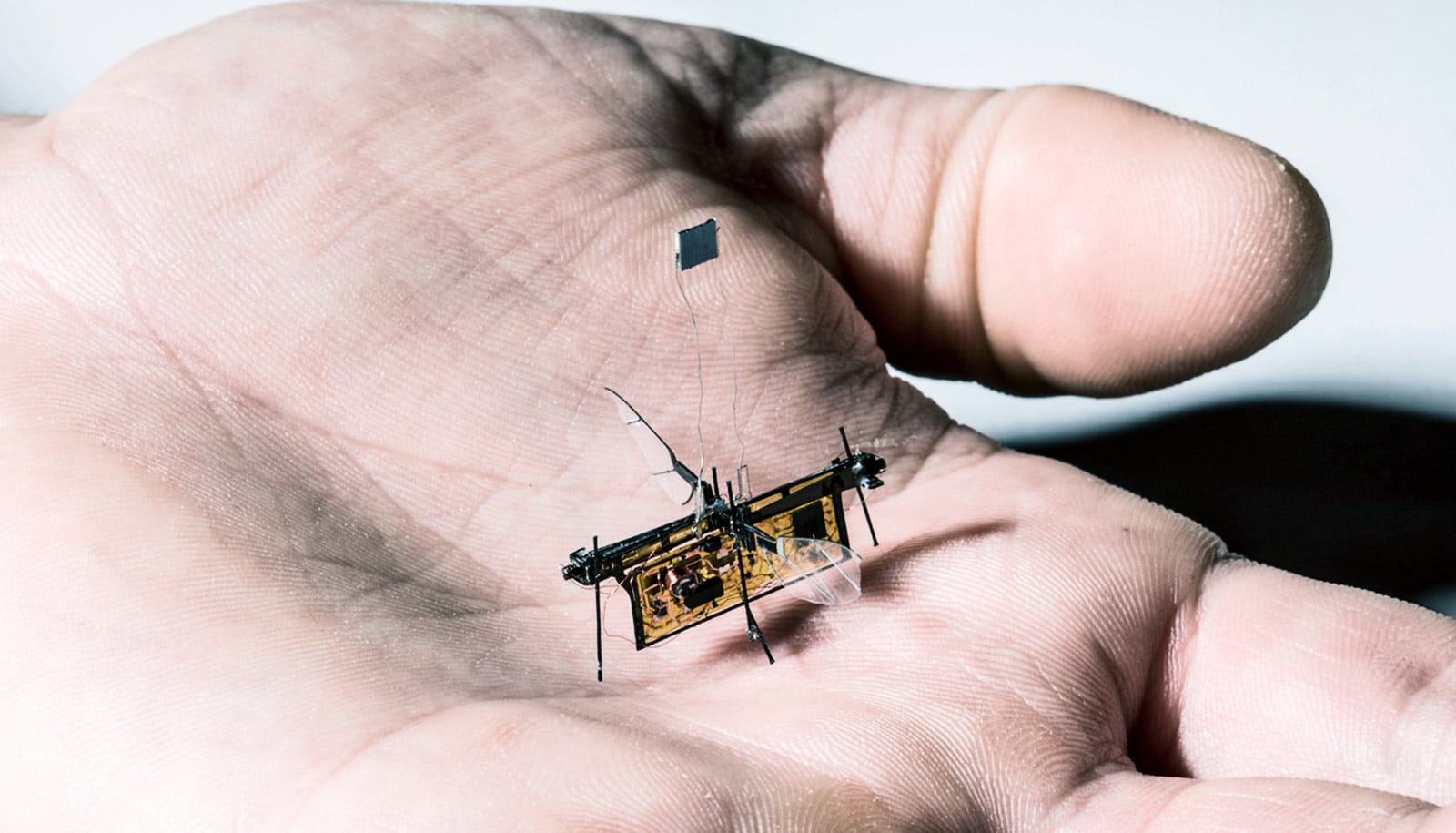
    RoboFly is slightly heavier than a toothpick. (Credit: Mark Stone/U. Washington)

    A new kind of robotic fly, called RoboFly, receives power from a laser beam. This cuts the cord between the robot and the ground and lets it take off on its own.

    “Before now, the concept of wireless insect-sized flying robots was science fiction.”

    Insect-sized flying robots could help with time-consuming tasks like surveying crop growth on large farms or sniffing out gas leaks. These robots soar by fluttering tiny wings because they are too small to use propellers, like those seen on their larger drone cousins. Small size is advantageous: These robots are cheap to make and can easily slip into tight places that are inaccessible to big drones.

    But current flying robo-insects are still tethered to the ground. The electronics they need to power and control their wings are too heavy for these miniature robots to carry.

    RoboFly’s laser-based power source may be one small flap for a robot, but it’s one giant leap for robot-kind.

    RoboFly laser
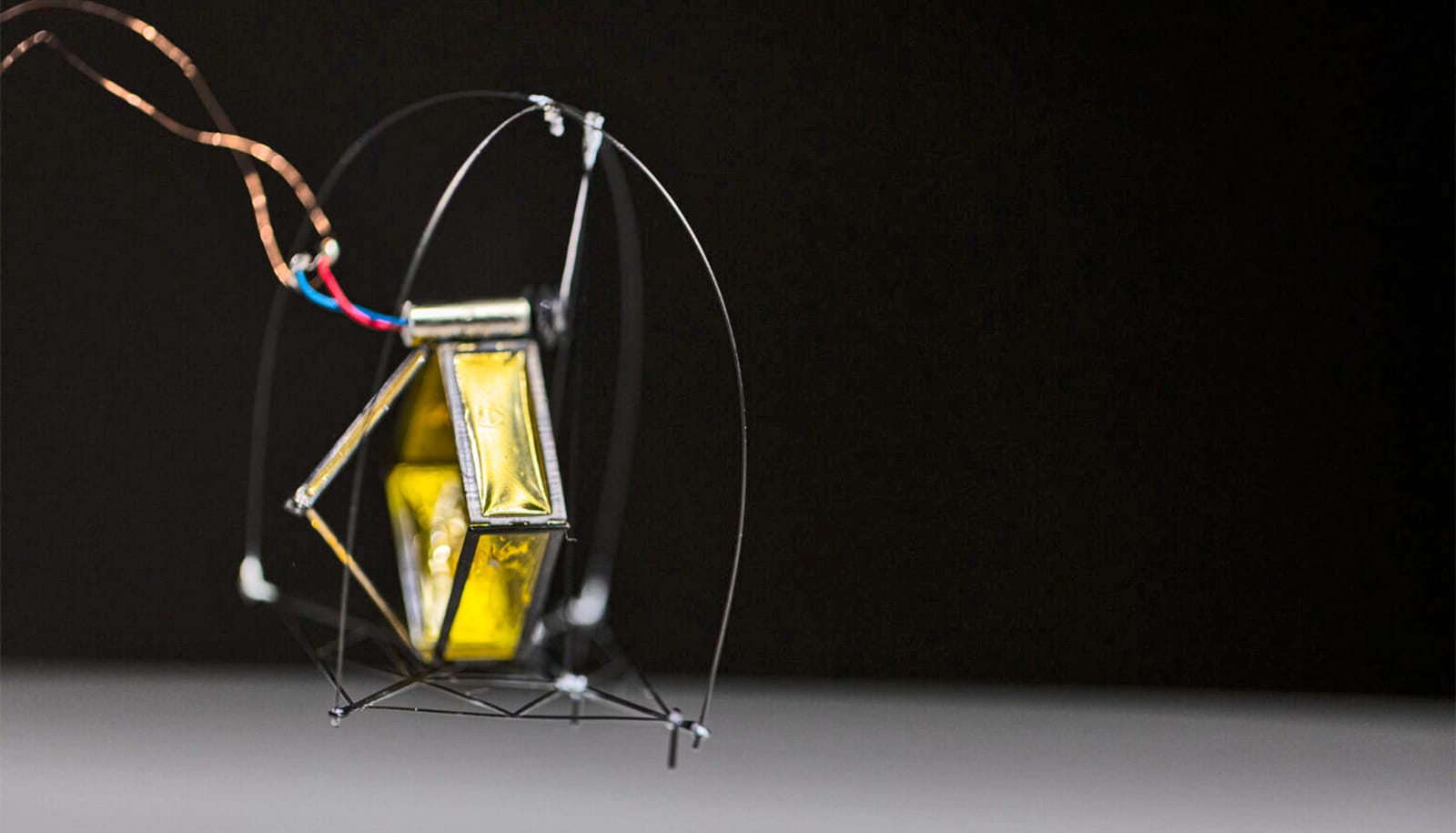
    To power RoboFly, the engineers pointed an invisible laser beam (shown here in red laser) at a photovoltaic cell, which is attached above the robot and converts the laser light into electricity. (Credit: Mark Stone/U. of Washington)

    The robotic fly is slightly heavier than a toothpick and gets power through a laser beam. It uses a tiny onboard circuit that converts the laser energy into enough electricity to operate its wings.

    “Before now, the concept of wireless insect-sized flying robots was science fiction. Would we ever be able to make them work without needing a wire?” says coauthor Sawyer Fuller, an assistant professor in the mechanical engineering department of the University of Washington. “Our new wireless RoboFly shows they’re much closer to real life.”

    The engineering challenge is the flapping. Wing flapping is a power-hungry process, and both the power source and the controller that directs the wings are too big and bulky to ride aboard a tiny robot. So Fuller’s previous robo-insect, the RoboBee, had a leash—it received power and control through wires from the ground.

    But a flying robot should be able to operate on its own. Fuller and team decided to use a narrow invisible laser beam to power their robot. They pointed the laser beam at a photovoltaic cell, which is attached above RoboFly and converts the laser light into electricity.

    RoboFly circuit
    To make RoboFly wireless, the engineers designed a flexible circuit (yellow) with a boost converter (copper coil and black boxes at left) that boosts the seven volts coming from the photovoltaic cell into the 240 volts needed for flight. This circuit also has a microcontroller brain (black square box in the top right) that lets RoboFly control its wings. (Credit: Mark Stone/U. of Washington)

    “It was the most efficient way to quickly transmit a lot of power to RoboFly without adding much weight,” says coauthor Shyam Gollakota, an associate professor in the Paul G. Allen School of Computer Science & Engineering.

    Still, the laser alone does not provide enough voltage to move the wings. That’s why the team designed a circuit that boosted the seven volts coming out of the photovoltaic cell up to the 240 volts needed for flight.

    To give RoboFly control over its own wings, the engineers provided a brain: They added a microcontroller to the same circuit.

    “The microcontroller acts like a real fly’s brain telling wing muscles when to fire,” says coauthor Vikram Iyer, a doctoral student in the electrical engineering department. “On RoboFly, it tells the wings things like ‘flap hard now’ or ‘don’t flap.'”

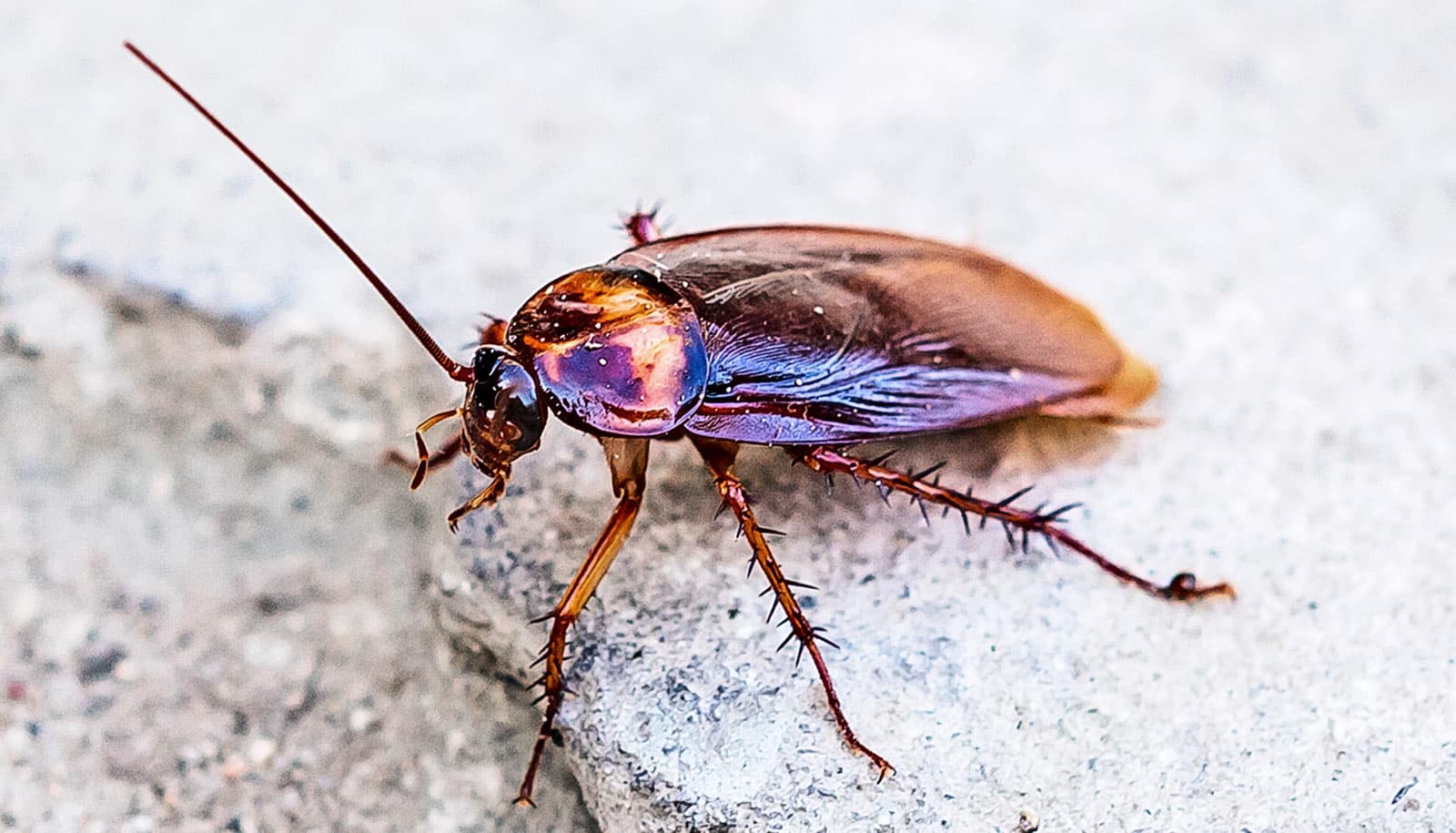
    Cockroaches teach robots to clamber and scurry

    Specifically, the controller sends voltage in waves to mimic the fluttering of a real insect’s wings.

    “It uses pulses to shape the wave,” says Johannes James, the lead author and a mechanical engineering doctoral student. “To make the wings flap forward swiftly, it sends a series of pulses in rapid succession and then slows the pulsing down as you get near the top of the wave. And then it does this in reverse to make the wings flap smoothly in the other direction.”

    For now, RoboFly can only take off and land. Once its photovoltaic cell is out of the direct line of sight of the laser, the robot runs out of power and lands. But the team hopes to soon be able to steer the laser so that RoboFly can hover and fly around.

    RoboFly size comparison
    RoboFly is slightly larger than a real fly. (Credit: Mark Stone/U. Washington)

    While RoboFly is currently powered by a laser beam, future versions could use tiny batteries or harvest energy from radio frequency signals, Gollakota says. That way, their power source can be modified for specific tasks.

    Future RoboFlies can also look forward to more advanced brains and sensor systems that help the robots navigate and complete tasks on their own, Fuller says.

    “I’d really like to make one that finds methane leaks,” he says. “You could buy a suitcase full of them, open it up, and they would fly around your building looking for plumes of gas coming out of leaky pipes. If these robots can make it easy to find leaks, they will be much more likely to be patched up, which will reduce greenhouse emissions.

    “This is inspired by real flies, which are really good at flying around looking for smelly things. So we think this is a good application for our RoboFly.”

    Robots still can’t outdo nature’s tiny speedsters

    The team will present its findings at the International Conference on Robotics and Automation in Brisbane, Australia.

    The University of Washington and a Microsoft student fellowship funded the research.

    Source: University of Washington