Archives

Play Video

New engine would use an explosion to blast spacecraft into orbit

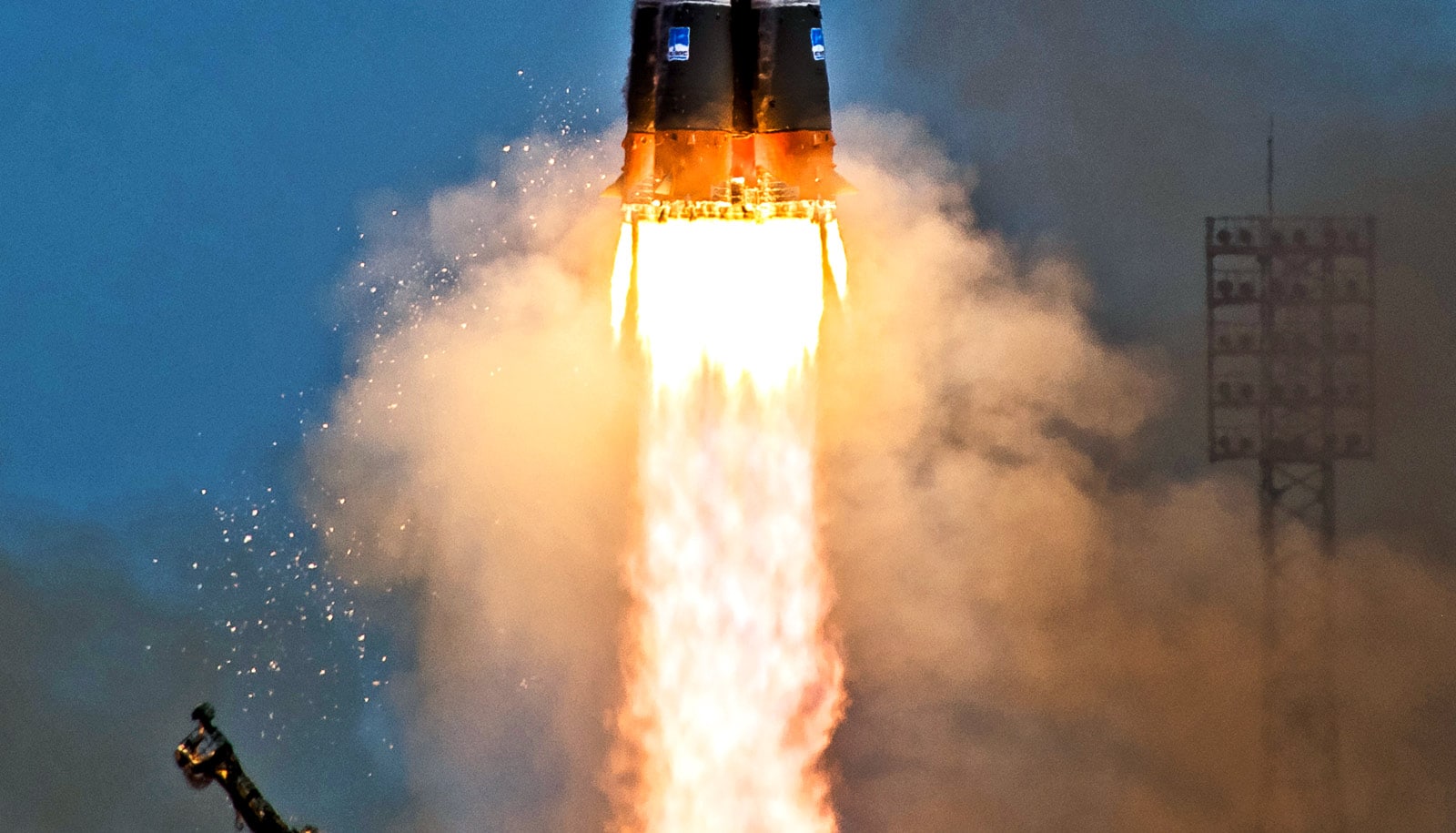
A rocket launches using a conventional, fuel-intensive engine. In the video, propellant flows in the gap between the cylinders to start the reaction, and, after ignition, the rapid heat release forms a shock wave (starts at 11 seconds). After this start-up phase, a number of stable combustion pulses form that continue to consume available propellant. (Video credit: James Koch/U. Washington) (Image credit: Gytis B./Flickr)

A new mathematical model describes how a type of rocket engine known as a rotating detonation engine would work, researchers report.

The new engine promises to make rockets not only more fuel-efficient but also more lightweight and less complicated to construct. There’s just one problem: Right now this engine is too unpredictable to be used in an actual rocket.

With the new model, engineers can, for the first time, develop tests to improve these engines and make them more stable.
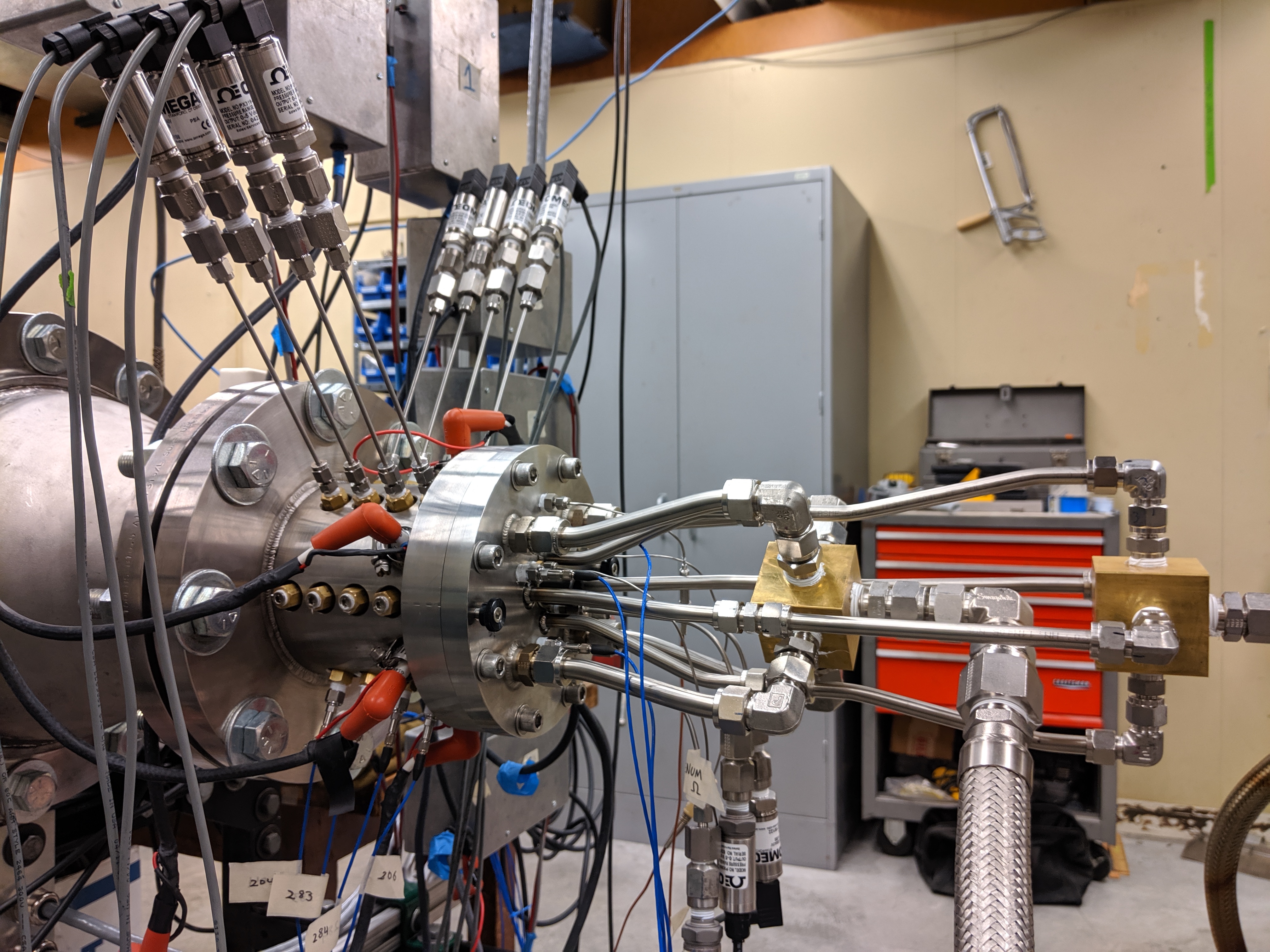
The engine is a metallic cylindrical chamber with many metal tubes coming out of the back and feeding into the sides
The researchers developed an experimental rotating detonation engine (shown here) where they could control different parameters, such as the size of the gap between the cylinders. The feed lines (right) direct the propellant flow into the engine. On the inside, there is another cylinder concentric to the outside piece. Sensors sticking out of the top of the engine (left) measure pressure along the length of the cylinder. The camera would be on the left-hand side, looking from the back end of the engine. (Credit: James Koch/U. Washington)

“The rotating detonation engine field is still in its infancy. We have tons of data about these engines, but we don’t understand what is going on,” says lead author James Koch, a doctoral student in aeronautics and astronautics at the University of Washington.

“I tried to recast our results by looking at pattern formations instead of asking an engineering question—such as how to get the highest performing engine—and then boom, it turned out that it works.”

A conventional rocket engine works by burning propellant and then pushing it out of the back of the engine to create thrust.

“A rotating detonation engine takes a different approach to how it combusts propellant,” Koch says. “It’s made of concentric cylinders. Propellant flows in the gap between the cylinders, and, after ignition, the rapid heat release forms a shock wave, a strong pulse of gas with significantly higher pressure and temperature that is moving faster than the speed of sound.

“This combustion process is literally a detonation—an explosion—but behind this initial start-up phase, we see a number of stable combustion pulses form that continue to consume available propellant. This produces high pressure and temperature that drives exhaust out the back of the engine at high speeds, which can generate thrust.”

https://youtu.be/gEYFy3qRNdo

After the initial shock wave, stable pulses of combustion continue to consume available propellant. Previously researchers didn’t understand how a specific number of pulses formed and why they can sometimes merge into one pulse, but this mathematical model can help explain the underlying physics. (Credit: Koch et al./Physical Review E)

Conventional engines use a lot of machinery to direct and control the combustion reaction so that it generates the work needed to propel the engine. But in a rotating detonation engine, the shock wave naturally does everything without needing additional help from engine parts.

“The combustion-driven shocks naturally compress the flow as they travel around the combustion chamber,” Koch says. “The downside of that is that these detonations have a mind of their own. Once you detonate something, it just goes. It’s so violent.”

To try to be able to describe how these engines work, the researchers first developed an experimental rotating detonation engine where they could control different parameters, such as the size of the gap between the cylinders. Then they recorded the combustion processes with a high-speed camera. Each experiment took only 0.5 seconds to complete, but the researchers recorded these experiments at 240,000 frames per second so they could see what was happening in slow motion.

From there, the researchers developed a mathematical model to mimic what they saw in the videos.

“This is the only model in the literature currently capable of describing the diverse and complex dynamics of these rotating detonation engines that we observe in experiments,” says coauthor J. Nathan Kutz, a professor of applied mathematics.

The model allowed the researchers to determine for the first time whether an engine of this type would be stable or unstable. It also allowed them to assess how well a specific engine was performing.

“This new approach is different from conventional wisdom in the field, and its broad applications and new insights were a complete surprise to me,” says coauthor Carl Knowlen, a research associate professor in aeronautics and astronautics.

Right now the model is not quite ready for engineers to use.

“My goal here was solely to reproduce the behavior of the pulses we saw—to make sure that the model output is similar to our experimental results,” Koch says. “I have identified the dominant physics and how they interplay. Now I can take what I’ve done here and make it quantitative. From there we can talk about how to make a better engine.”

The research appears in Physical Review E. Funding came from the US Air Force Office of Scientific Research and the Office of Naval Research.

Source: University of Washington
Play Video

Little nozzles could propel nano satellites

(Credit: Jinho Jung/Flickr)

Researchers have developed a new type of micropropulsion system for miniature satellites (called CubeSats) that uses tiny nozzles that release precise bursts of water vapor to maneuver the spacecraft.

Low-cost “microsatellites” and “nanosatellites” far smaller than conventional spacecraft, have become increasingly prevalent. Thousands of the miniature satellites might be launched to perform a variety of tasks, from high-resolution imaging and internet services, to disaster response, environmental monitoring, and military surveillance.

“They offer an opportunity for new missions, such as constellation flying and exploration that their larger counterparts cannot economically achieve,” says Alina Alexeenko, leader of the research, which is detailed in a paper being presented during the 31st AIAA/USU Conference on Small Satellites in Logan, Utah, and a professor in Purdue University’s School of Aeronautics and Astronautics.

cubesat
A close-up shot of CubeSat. (Credit: Purdue)

To achieve their full potential, however, CubeSats will require micropropulsion devices to deliver precise low-thrust “impulse bits” for scientific, commercial, and military space applications. To this end, Alexeenko’s team developed a new micropropulsion system that uses ultra-purified water.

“Water is thought to be abundant on the Martian moon Phobos,” she says. “making it potentially a huge gas station in space. Water is also a very clean propellant, reducing risk of contamination of sensitive instruments by the backflow from thruster plumes.”

The new system, called a Film-Evaporation MEMS Tunable Array, or FEMTA thruster, uses capillaries small enough to harness the microscopic properties of water. Because the capillaries are only about 10 micrometers in diameter, the surface tension of the fluid keeps it from flowing out, even in the vacuum of space.

Activating small heaters located near the ends of the capillaries creates water vapor and provides thrust. In this way, the capillaries become valves that can be turned on and off by activating the heaters. The technology is similar to an inkjet printer, which uses heaters to push out droplets of ink.

cubesat thrust cells
One CubeSat thrust cell, separated from the satellite. (Credit: Purdue)

CubeSats are made up of several units, each measuring 10-centimeters cubed. Researchers integrated four FEMTA thrusters loaded with about a teaspoon of water into a one-unit CubeSat prototype and tested in a vacuum.

The prototype, which weighs 2.8 kilograms, or about six pounds, contained electronics and an inertial measurement unit sensor to monitor the performance of the thruster system, which rotates the satellite using short-lived bursts of water vapor.

Typical satellites are about the size of a school bus, weigh thousands of pounds, and sometimes cost hundreds of millions of dollars. And while conventional satellites require specialized electronics that can withstand the harsh conditions of space, CubeSats can be built with low-cost, off-the-shelf components. Constellations of many inexpensive, disposable satellites might be launched, minimizing the impact of losing individual satellites.

However, improvements are needed in micropropulsion systems to mobilize and precisely control the satellites.

“There have been substantial improvements made in micropropulsion technologies, but further reductions in mass, volume, and power are necessary for integration with small spacecraft,” Alexeenko says.

Shoebox-sized satellites bring African crops into focus

The FEMTA technology is a micro-electromechanical system, or a MEMS, which are tiny machines that contain components measured on the scale of microns, or millionths of a meter. The thruster demonstrated a thrust-to-power ratio of 230 micronewtons per watt for impulses lasting 80 seconds.

“This is a very low power,” Alexeenko says. “We demonstrate that one 180-degree rotation can be performed in less than a minute and requires less than a quarter watt, showing that FEMTA is a viable method for attitude control of CubeSats.”

The FEMTA thrusters are microscale nozzles manufactured on silicon wafers using nanofabrication techniques common in industry. The model was tested in a large vacuum chamber.

Although the researchers used four thrusters, which allow the satellite to rotate on a single axis, a fully functional satellite would require 12 thrusters for 3-axis rotation.

The team built the system with inexpensive, commercially available devices that are integral for the “internet of things,” an emerging phenomenon in which many everyday objects such as appliances and cars have their own internet addresses.

The inertial measurement unit handles 10 different types of measurements needed to maneuver and control the satellite. An onboard computer wirelessly receives signals to fire the thruster and transmits motion data using this IMU chip.

“What we really want to do next is integrate our system into a satellite for an actual space mission,” she says.

The research involved a collaboration with NASA’s Goddard Space Flight Center through the space agency’s SmallSat Technology Partnership program, which provided critical funding since the concept inception in 2013.

How propulsion keeps satellites in the same spot

A patent application for the concept has been filed through the Purdue Research Foundation’s Office of Technology Commercialization. The nozzles for the system were fabricated in the Scifres Nanofabrication Laboratory in the Birck Nanotechnology Center in Purdue’s Discovery Park.

Source: Purdue University