Archives

Play Video

Spongy crystals grab drinkable water from thin air

(Credit: Getty Images)

Highly absorbent materials called metal-organic frameworks can extract drinkable water out of thin air, research finds.

The discovery could potentially lead to technologies that supply potable water to the driest areas on the planet. For many of the world’s poor, one of the greatest environmental threats to health remains lack of access to safe water.

The new research leverages metal-organic frameworks (MOFs), materials with the largest known surface areas per gram. A single gram of the MOF can soak up a football field’s worth of material, when the material is in a single layer across the field.

The sponge-like crystals can capture, store, and release chemical compounds—like water—and the large surface area offers more space for chemical reactions and adsorption of molecules, the researchers say.

MOFs have shown promise for water harvesting, but researchers have done little to determine the best properties for fast and efficient production of water.

“Initial experiments have proved that the concept can work,” says Zhiyong Xia from Johns Hopkins Applied Physics Laboratory. “But the problem has been capacity.

“Other research teams have been able to produce as much as about 1.3 liters of water per day per kilogram of sorbent under arid conditions—enough only for one person. To create an optimal water-harvesting device requires a better understanding of the structure property relationship controlling absorption and delivery.”

Xia and his team studied a series of MOFs—unraveling the fundamental material properties that govern the kinetics of water sequestration in this class of materials as well as investigating how much water they can absorb. They also explored the potential impact of temperature, humidity, and powder bed thickness on the adsorption-desorption process to see which one achieved optimal operational parameters.

“We identified a MOF that could produce 8.66 liters of water per day per kilogram of MOF under ideal conditions, an extraordinary finding.” Xia says. “This will help us deepen our understanding of these materials and guide the discovery of next-generation water-harvesting methods.”

The researchers are now exploring other MOFs with low relative humidity influx points, high surface areas, and polar functional properties to see how they perform in very dry environments. They are also exploring different configurations of MOFs to determine which allow for optimal absorption.

The researchers drew on APL’s ongoing efforts in water purification methods. APL has developed a new way to remove highly toxic perfluoroalkyl substances—an ever-expanding group of manufactured chemicals widely used to make various types of everyday products—from drinking water. A separate effort yielded a cost-effective method to remove toxic heavy metal ions from drinking water.

“Our scientists’ and engineers’ collective strengths and expertise in materials and chemistry have positioned APL to make extraordinary impact and invent the future of clean drinking water for deployed warfighters, as well as for citizens around the world,” says Ally Bissing-Gibson, APL’s Biological and Chemical Sciences program manager. “We look forward to saving the planet, one drop at a time.”

Source: Johns Hopkins University

Play Video

Solar refinery turns light and air into liquid fuel

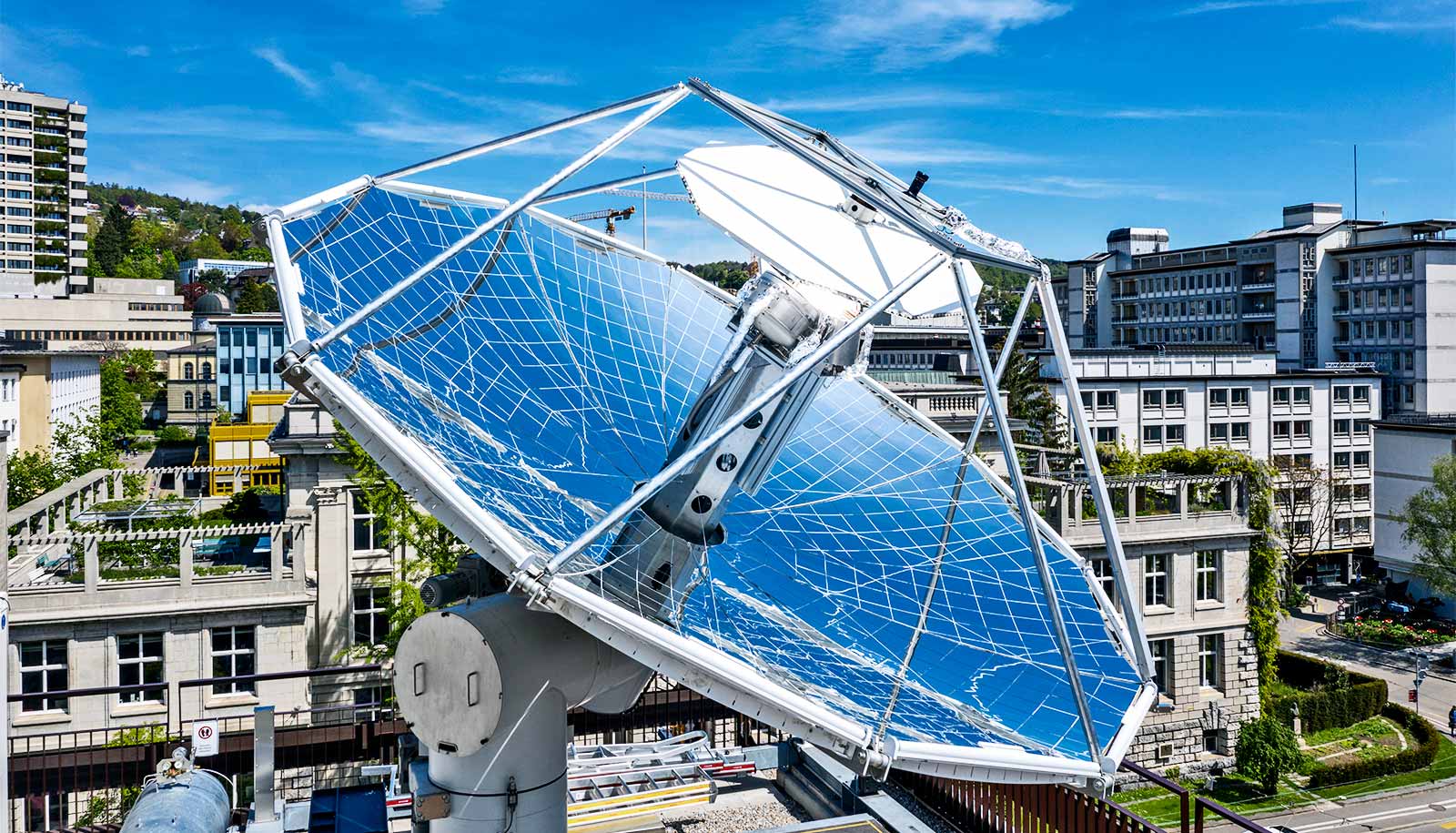
The research plant is located on the roof of a ETH Zurich building. (Credit: Alessandro Della Bella/ETH Zurich)

A new technology produces liquid hydrocarbon fuels exclusively from sunlight and air.

Carbon-neutral fuels are crucial for making aviation and maritime transport sustainable. The new solar plant produces synthetic liquid fuels that release as much CO2 during their combustion as previously extracted from the air for their production.

The system extracts CO2 and water directly from ambient air and splits them using solar energy. This process yields syngas, a mixture of hydrogen and carbon monoxide, which is subsequently processed into kerosene, methanol, or other hydrocarbons. These drop-in fuels are ready for use in the existing global transport infrastructure.

solar refinery
The parabolic reflector bundles the light and directs it to the two reactors in the middle of the plant. (Credit: Alessandro Della Bella/ETH Zurich)

Proof of concept

“This plant proves that carbon-neutral hydrocarbon fuels can be made from sunlight and air under real field conditions,” explains Aldo Steinfeld, a professor of renewable energy carriers at ETH Zurich whose research group developed the technology. “The thermochemical process utilizes the entire solar spectrum and proceeds at high temperatures, enabling fast reactions and high efficiency.”

The solar mini-refinery on a Zurich roof proves that the technology is feasible, even under the climate conditions prevalent in the city. It produces around one deciliter of fuel per day (a little less than half a cup).

solar refinery fuel
The fuel that the solar refinery produces. (Credit: Alessandro Della Bella/ETH Zurich)

Steinfeld and his group are already working on a large-scale test of their solar reactor in a solar tower near Madrid, carried out within the scope of the EU’s Sun-to-Liquid project.

The next goal is to scale the technology for industrial implementation and make it economically competitive.

“A solar plant spanning an area of one square kilometer could produce 20,000 liters of kerosene a day,” says Philipp Furler, director of Synhelion and a former doctoral student in Steinfeld’s group. “Theoretically, a plant the size of Switzerland—or a third of the Californian Mojave Desert—could cover the kerosene needs of the entire aviation industry. Our goal for the future is to efficiently produce sustainable fuels with our technology and thereby mitigate global CO2 emissions.”

solar refinery
The research plant produces syngas, which can be processed into liquid hydrocarbon fuels through conventional methanol or Fischer–Tropsch synthesis. (Credit: Alessandro Della Bella/ETH Zurich)

How the solar refinery works

The process chain of the new system combines three thermochemical conversion processes:

  • The extraction of CO2 and water from the air.
  • The solar-thermochemical splitting of CO2 and water.
  • Their subsequent liquefaction into hydrocarbons.

An adsorption/desorption process extracts CO2 and water directly from ambient air. Both then enter the solar reactor at the focus of a parabolic reflector. Solar radiation is concentrated by a factor of 3,000, generating heat at a temperature of 1,500 degrees Celsius inside the solar reactor.

At the heart of the solar reactor is a ceramic structure made of cerium oxide, which enables a two-step reaction—the redox cycle—to split water and CO2 into syngas. This mixture of hydrogen and carbon monoxide can then be processed into liquid hydrocarbon fuels through conventional methanol or Fischer-Tropsch synthesis.

Two spin-offs have already emerged from Steinfeld’s research group: Synhelion, founded in 2016, which commercializes the solar fuel production technology, and Climeworks, founded already in 2010, which commercializes the technology for CO2 capture from air.

Source: ETH Zurich

Play Video

Method converts plastic trash into clean fuel

(Credit: Getty Images)

A new chemical conversion process could transform the world’s polyolefin waste, a form of plastic, into useful products, such as clean fuels.

The United Nations estimates that more than 8 million tons of plastics flow into the oceans each year.

“Our strategy is to create a driving force for recycling by converting polyolefin waste into a wide range of valuable products, including polymers, naphtha (a mixture of hydrocarbons), or clean fuels,” says Linda Wang, a professor in the Davidson School of Chemical Engineering at Purdue University and leader of the research team developing this technology.

By 2050, estimates suggest the oceans will hold more plastic waste than fish.

“Our conversion technology has the potential to boost the profits of the recycling industry and shrink the world’s plastic waste stock.”

The technology can convert more than 90 percent of polyolefin waste into different products, including pure polymers, naphtha, fuels, or monomers. Now, the team is working to optimize the conversion process to produce high-quality gasoline or diesel fuels.

The conversion process incorporates selective extraction and hydrothermal liquefaction. Once researchers convert the plastic into naphtha, they can use it as a feedstock for other chemicals or further separate it into specialty solvents or other products. The clean fuels derived from the polyolefin waste generated each year can satisfy 4 percent of the annual demand for gasoline or diesel fuels.

“Plastic waste disposal, whether recycled or thrown away, does not mean the end of the story…”

Reading about the plastic waste pollution of the oceans, ground water, and the environment inspired Wang to pursue this technology.

Of all the plastics produced over the past 65 years (8.3 billion tons), about 12 percent have been incinerated and only 9 percent have been recycled. The remaining 79 percent have gone into landfills or the oceans. The World Economic Forum predicts that by 2050 the oceans will hold more plastic waste than fish if people continue dumping the waste into bodies of water.

“Plastic waste disposal, whether recycled or thrown away, does not mean the end of the story,” Wang says. “These plastics degrade slowly and release toxic microplastics and chemicals into the land and the water. This is a catastrophe, because once these pollutants are in the oceans, they are impossible to retrieve completely.”

Wang says she hopes her technology will stimulate the recycling industry to reduce the rapidly rising amount of plastic waste. She and her team are looking for investors or partners to assist with demonstrating this technology at a commercial scale.

Some results of Wang’s study appear in ACS Sustainable Chemistry and Engineering.

Wang’s technology is patented through the Purdue Research Foundation’s Office of Technology Commercialization.

Source: Purdue University