Archives

Play Video

Plastic-eating enzyme could gobble up tons and tons of waste

An enzyme variant has the potential to supercharge recycling on a large scale that would allow major industries to reduce their environmental impact by recovering and reusing plastics at the molecular level.(Credit: Getty Images)

Researchers have created an enzyme variant that can break down environmentally damaging plastics, which typically take centuries to degrade, in just a matter of hours to days.

This discovery could help solve one of the world’s most pressing environmental problems: what to do with the billions of tons of plastic waste piling up in landfills and polluting our natural lands and water.

The enzyme has the potential to supercharge recycling on a large scale that would allow major industries to reduce their environmental impact by recovering and reusing plastics at the molecular level.

“The possibilities are endless across industries to leverage this leading-edge recycling process,” says Hal Alper, professor in the chemical engineering department at the University of Texas at Austin.

“Beyond the obvious waste management industry, this also provides corporations from every sector the opportunity to take a lead in recycling their products. Through these more sustainable enzyme approaches, we can begin to envision a true circular plastics economy.”

“Through these more sustainable enzyme approaches, we can begin to envision a true circular plastics economy.”

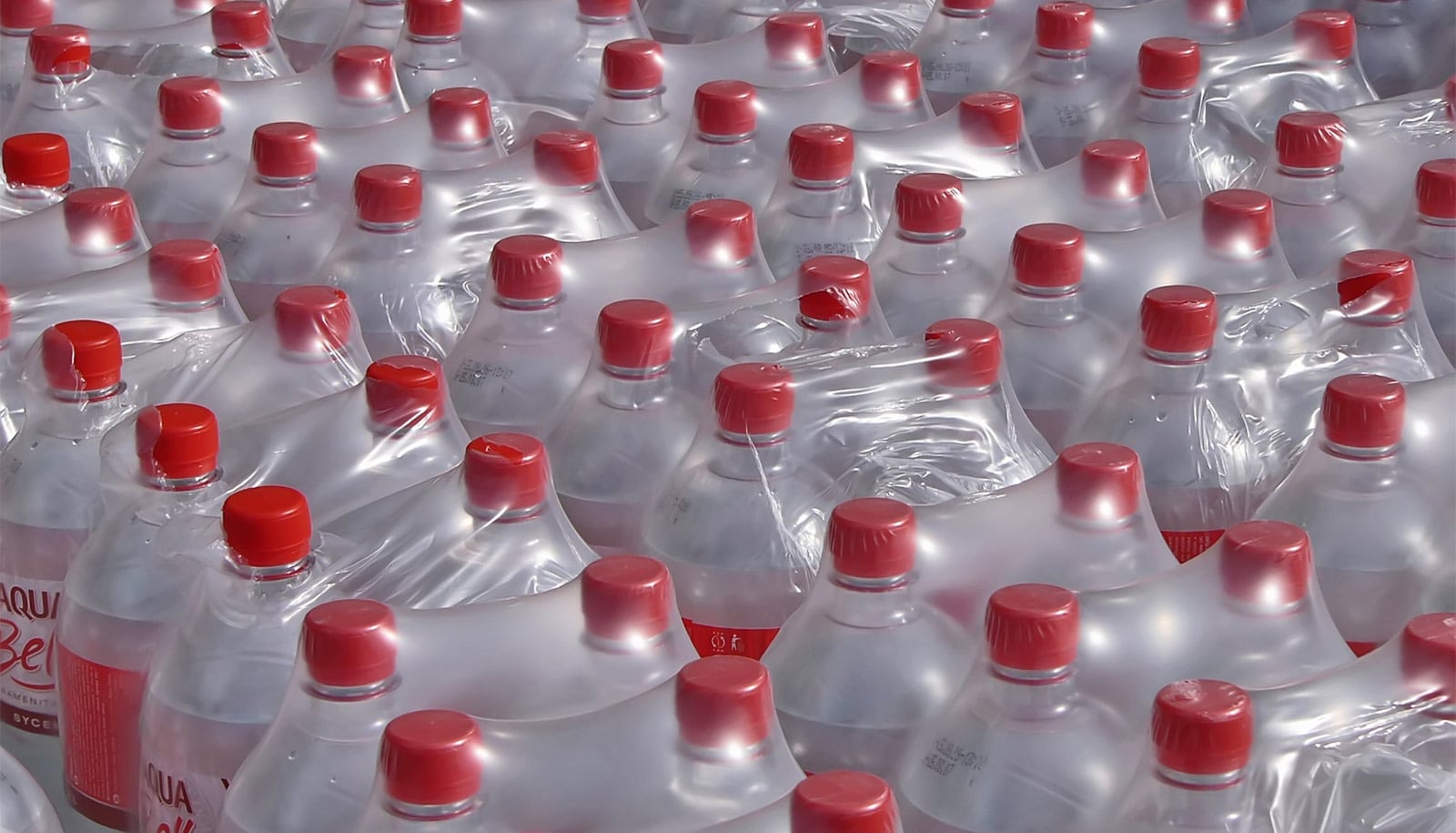
The project focuses on polyethylene terephthalate (PET), a significant polymer found in most consumer packaging, including cookie containers, soda bottles, fruit and salad packaging, and certain fibers and textiles. It makes up 12% of all global waste.

The enzyme was able to complete a “circular process” of breaking down the plastic into smaller parts (depolymerization) and then chemically putting it back together (repolymerization). In some cases, these plastics can be fully broken down to monomers in as little as 24 hours.

Researchers used a machine learning model to generate novel mutations to a natural enzyme called PETase that allows bacteria to degrade PET plastics. The model predicts which mutations in these enzymes would accomplish the goal of quickly depolymerizing post-consumer waste plastic at low temperatures.

Through this process, which included studying 51 different post-consumer plastic containers, five different polyester fibers, and fabrics and water bottles all made from PET, the researchers proved the effectiveness of the enzyme, which they call FAST-PETase (functional, active, stable, and tolerant PETase).

Recycling is the most obvious way to cut down on plastic waste. But globally, less than 10% of all plastic has been recycled. The most common method for disposing of plastic, besides throwing it in a landfill, is to burn it, which is costly, energy intensive, and spews noxious gas into the air. Other alternative industrial processes include very energy-intensive processes of glycolysis, pyrolysis, and/or methanolysis.

Biological solutions take much less energy. Research on enzymes for plastic recycling has advanced during the past 15 years. However, until now, no one had been able to figure out how to make enzymes that could operate efficiently at low temperatures to make them both portable and affordable at large industrial scale. FAST-PETase can perform the process at less than 50 degrees Celsius (122 degrees Fahrenheit).

Up next, the team plans to work on scaling up enzyme production to prepare for industrial and environmental application. The researchers have filed a patent application for the technology and are eying several different uses. Cleaning up landfills and greening high waste-producing industries are the most obvious. But another key potential use is environmental remediation. The team is looking at a number of ways to get the enzymes out into the field to clean up polluted sites.

“When considering environmental cleanup applications, you need an enzyme that can work in the environment at ambient temperature. This requirement is where our tech has a huge advantage in the future,” Alper says.

Alper, Andrew Ellington, professor in the Center for Systems and Synthetic Biology, Nathaniel Lynd, associate professor of chemical engineering, and Hongyuan Lu, a postdoctoral researcher in Alper’s lab, led the development of the machine learning model. Raghav Shroff, a former member of Ellington’s lab and now a research scientist at the Houston Methodist Research Institute, created the 3DCNN machine learning model used to engineer the plastic-eating enzyme. Danny Diaz, a current member of Ellington’s lab, adapted the model and created a web platform, MutCompute, to make it available for wider academic use.

ExxonMobil’s research and engineering division as part of an ongoing research agreement with UT Austin, funded the work.

Source: UT Austin
Play Video

5 myths about single-use plastic

"Efforts to reduce the use of single-use plastics and to increase recycling may distract from less visible and often more damaging environmental impacts associated with energy use, manufacturing, and resource extraction," says Shelie Miller. "We need to take a much more holistic view that considers larger environmental issues."(Credit: KatherineDavis/Flickr)

Most of the environmental impacts of many consumer products, including soft drinks, are tied to the products inside, not the packaging, according to University of Michigan environmental engineer Shelie Miller.

Stand in the soda pop aisle at the supermarket, surrounded by rows of brightly colored plastic bottles and metal cans, and it’s easy to conclude that the main environmental problem here is an overabundance of single-use containers: If we simply recycled more of them, we’d go a long way toward minimizing impacts.

When it comes to single-use plastics in particular, the production and disposal of packaging often represents only a few percent of a product’s lifetime environmental impacts, Miller says.

“Consumers tend to focus on the impact of the packaging, rather than the impact of the product itself,” says Miller, an associate professor at the School for Environment and Sustainability and director of the University of Michigan’s Program in the Environment. “But mindful consumption that reduces the need for products and eliminates wastefulness is far more effective at reducing overall environmental impact than recycling.

“Nevertheless, it is fundamentally easier for consumers to recycle the packaging of a product than to voluntarily reduce their demand for that product, which is likely one reason why recycling efforts are so popular.”

The mistaken belief about the central role of plastic packaging is one of five myths that Miller attempts to debunk in her new research. The five common misperceptions, along with Miller’s insights about them, are:

  1. Plastic packaging is the largest contributor to a product’s environmental impact. In reality, the product inside the package usually has a much greater environmental impact.
  2. The environmental impacts of plastics are greater than any other packaging material. Actually, plastic generally has lower overall environmental impacts than single-use glass or metal in most impact categories.
  3. Reusable products are always better than single-use plastics. Actually, reusable products have lower environmental impacts only when they are reused enough times to offset the materials and energy used to make them.
  4. Recycling and composting should be the highest priority. Truth be told, the environmental benefits associated with recycling and composting tend to be small when compared with efforts to reduce overall consumption.
  5. “Zero waste” efforts that eliminate single-use plastics minimize the environmental impacts of an event. In reality, the benefits of diverting waste from the landfill are small. Waste reduction and mindful consumption, including a careful consideration of the types and quantities of products consumed, are far larger factors dictating the environmental impact of an event.

In her review article, Miller challenges beliefs unsupported by current scientific knowledge while urging other environmental scientists and engineers to broaden the conversation—in their own research and in discussions that shape public policy.

“Efforts to reduce the use of single-use plastics and to increase recycling may distract from less visible and often more damaging environmental impacts associated with energy use, manufacturing, and resource extraction,” she says. “We need to take a much more holistic view that considers larger environmental issues.”

Miller stresses that she is not trying to downplay environmental concerns associated with plastics and plastic waste. But to place the plastic-waste problem in proper context, it’s critical to examine the environmental impacts that occur at every stage of a product’s lifetime—from the extraction of natural resources and the energy needed to make the item to its ultimate disposal or reuse.

Life-cycle assessment, or LCA, is a tool that researchers like Miller use to quantify lifetime environmental impacts in multiple categories, including climate change and energy use, water and resource depletion, biodiversity loss, solid waste generation, and human and ecological toxicity.

It’s easy for consumers to focus on packaging waste because they see boxes, bottles, and cans every day, while a wide range of other environmental impacts are largely invisible to them. But LCA analyses systematically evaluate the entire supply chain, measuring impacts that might otherwise be overlooked, Miller says.

Packaged food products, for example, embody largely invisible impacts that can include intensive agricultural production, energy generation, and refrigeration and transportation throughout the supply chain, along with the processing and manufacturing associated with the food and its packaging, she says.

Miller points out that the well-worn adage “reduce, reuse, recycle,” commonly known as the 3Rs, was created to provide an easy-to-remember hierarchy of the preferable ways to lessen environmental impact.

Yet most environmental messaging does not emphasize the inherent hierarchy of the 3Rs—the fact that reducing and reusing are listed ahead of recycling. As a result, consumers often over-emphasize the importance of recycling packaging instead of reducing product consumption to the extent possible and reusing items to extend their lifetime.

“Although the use of single-use plastics has created a number of environmental problems that need to be addressed, there are also numerous upstream consequences of a consumer-oriented society that will not be eliminated, even if plastic waste is drastically reduced,” she says.

“The resource extraction, manufacturing, and use phases generally dominate the environmental impacts of most products. So, reduction in materials consumption is always preferable to recycling, since the need for additional production is eliminated.”

The research is scheduled for publication in the journal Environmental Science & Technology.

The National Science Foundation’s Environmental Sustainability program funded the work.

Source: University of Michigan

  • There’s more to plastic waste than bottles and bags