Archives

Play Video

Edible QR code reveals if whiskey is fake

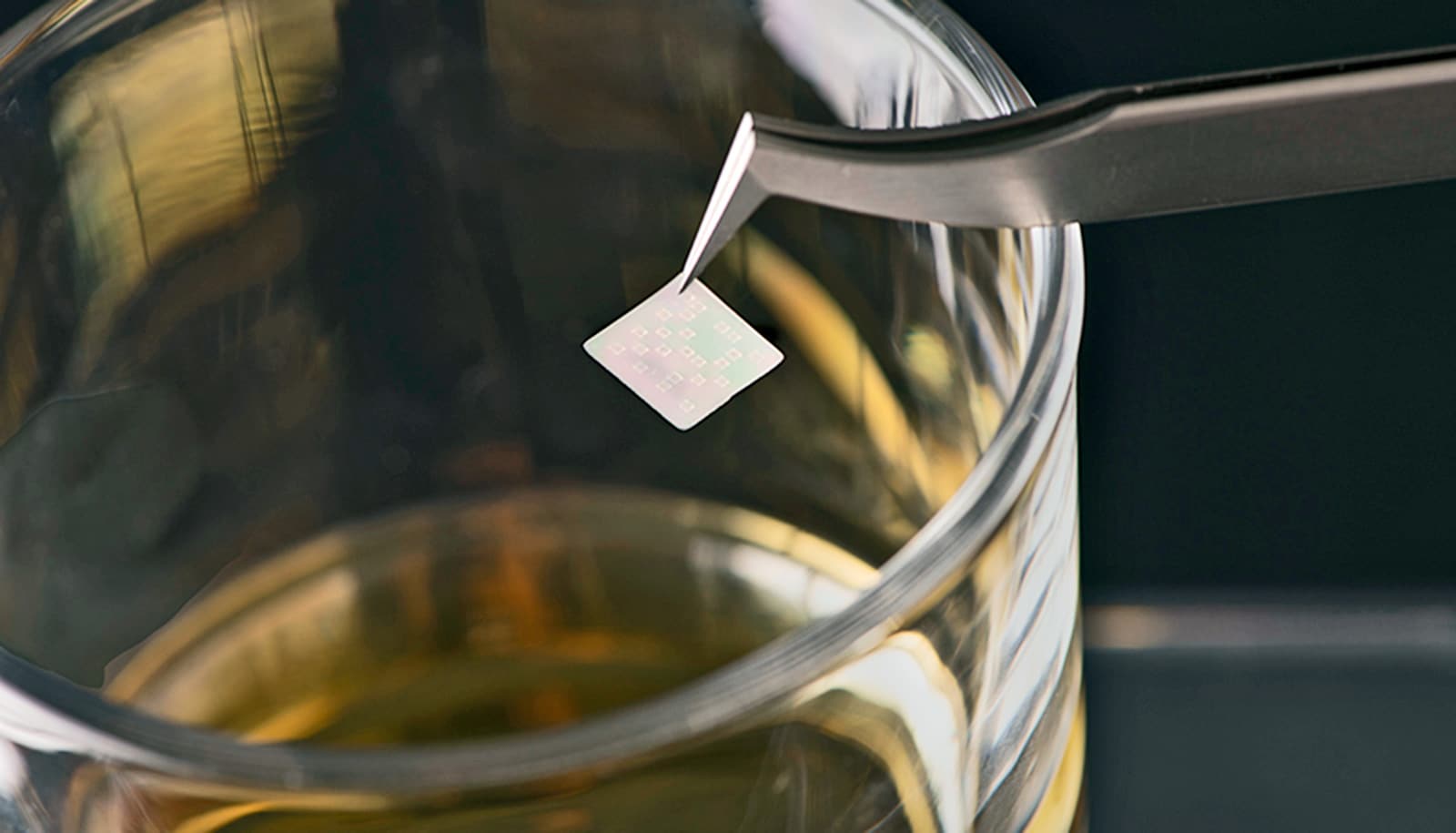
Manufacturers can place the QR code on an edible silk tag that in bottles of whiskey and then consumers can use a smartphone app to confirm the whiskey’s authenticity. (Credit: John Underwood/Purdue)

An edible silk tag with a QR code could one day serve as a security measure that reveals if the whiskey you’re buying is fake.

Simply using a smartphone to scan the tag could confirm the drink’s authenticity.

“Alcohol spirits are vulnerable to counterfeiting. There are a lot of fake whiskeys being sold.”

There are, of course, no tags currently placed in bottles of whiskey. But this new anticounterfeiting technology could be a step toward not only finding a solution for the alcohol industry but also addressing fake medications.

“Some liquid medicines contain alcohol. We wanted to test this first in whiskey because of whiskey’s higher alcohol content,” says Young Kim, associate head for research and an associate professor in Purdue University’s Weldon School of Biomedical Engineering. “Researchers apply alcohol to silk proteins to make them more durable. Because they tolerate alcohol, the shape of the tag can be maintained for a long time.”

Kim has worked on anticounterfeit measures including cyberphysical watermarks and tags made of fluorescent silk proteins. The tags have a code that a consumer or patient can activate with a smartphone to confirm authenticity of a product.

The code on the fluorescent silk tag is the equivalent of a barcode or QR code and is not visible to the naked eye. The tags are also edible, causing no issues if a person swallowed it while downing a shot of whiskey. The tags have not affected the taste of the whiskey.

Kim and Jungwoo Leem, a postdoctoral research associate, say making the tags involves processing fluorescent silk cocoons from specialized silkworms to create a biopolymer, which can be formed into a variety of patterns to encode the information.

“Alcohol spirits are vulnerable to counterfeiting. There are a lot of fake whiskeys being sold,” says Leem, referencing other studies mentioned in the journal article about the economic cost and loss of purchasing fake alcoholic spirits, including how 18% of adults in the United Kingdom experienced purchasing counterfeit alcoholic spirits.

“Counterfeit items, such as medicines and alcohol, are big issues around the world. There are numerous examples of large amounts of fake medications sold throughout the world, which, in some instances, kill people,” Kim says.

“Online pharmacies sell controlled substances to teens. People can buy counterfeit opioids easily. This work is extremely important for patients and buyers in addressing this issue,” Kim says. “If you have this technology on or in your medicines, you can use your smartphone to authenticate. We want to empower patients to be aware of this issue. We want to work with pharmaceutical companies and alcohol producers to help them address this issue.”

Kim and Leem placed tags in various brands and price points of whiskey (80 proof, 40% alcohol per volume) over a 10-month period and were able to continually activate the tags and codes with a smartphone app.

One of the ways of bringing this issue to light is to literally shine a light on the tags. The team developed ways and methods for a smartphone to activate the tags in a variety of light settings.

The tags are an additional authentication mechanism for marked safety seals on bottles or pills and could help by being placed in high-dollar bottles of alcohol or on expensive medications individually, Kim says.

The study appears in ACS Central Science. Additional coauthors are from Kumoh National Institute of Technology and the National Institute of Agricultural Sciences, both in South Korea, and Purdue.

Funding came from the Cooperative Research Program for Agriculture Science and Technology Development, the Rural Development Administration of the Republic of Korea, the US Air Force Office of Scientific Research, the National Institutes of Health, and the Trask Innovation Fund from Purdue University.

The technology was disclosed to the Purdue Research Foundation Office of Technology Commercialization.

Source: Purdue University
Play Video

Self-erasing chips could thwart counterfeit tech

"It's very hard to detect whether a device has been tampered with. It may operate normally, but it may be doing more than it should, sending information to a third party," says Parag Deotare. (Credit: mbanere6/Flickr)

Self-erasing chips could help stop counterfeit electronics or provide alerts if sensitive shipments are tampered with, researchers report.

The chips rely on a new material that temporarily stores energy, changing the color of the light it emits. It self-erases in a matter of days, or users can erase it on demand with a flash of blue light.

“It’s very hard to detect whether a device has been tampered with. It may operate normally, but it may be doing more than it should, sending information to a third party,” says Parag Deotare, assistant professor of electrical engineering and computer science at the University of Michigan.

The letters U and M appear in yellow, green, and blue against a dark blue background
This message will self-destruct in seven days, or it can be erased with a flash of blue light. Written with UV light, the letters are marked out by molecules that shrink by storing energy, stretching the atoms of the semiconductor above. This shifts the light emitted by the semiconductor to longer wavelengths, represented in the visible spectrum by yellow on a blue background. (Credit: Che-Hsuan Cheng, Excitonics and Photonics Lab/U. Michigan.

With a self-erasing bar code printed on the chip inside the device, the owner could get a hint if someone had opened it to secretly install a listening device. Alternatively, a bar code could be written and placed on integrated circuit chips or circuit boards, for instance, to prove that they hadn’t been opened or replaced on their journey.

Likewise, if the lifespan of the bar codes was extended, they could be written into devices as hardware analogues of software authorization keys.

Secret messages

The self-erasing chips are built from a three-atom-thick layer of semiconductor laid atop a thin film of molecules based on azobenzenes—a kind of molecule that shrinks in reaction to UV light. Those molecules tug on the semiconductor in turn, causing it to emit slightly longer wavelengths of light.

To read the message, you have to look at it with the right kind of light. Che-Hsuan Cheng, a doctoral student in material science and engineering in Deotare’s group and the first author of the study in Advanced Optical Materials, is most interested in its application as self-erasing invisible ink for sending secret messages.

The stretched azobenzene naturally gives up its stored energy over the course of about seven days in the dark—a time that can be shortened with exposure to heat and light, or lengthened if stored in a cold, dark place.

Whatever was written on the chip, be it an authentication bar code or a secret message, would disappear when the azobenzene stopped stretching the semiconductor. Alternatively, it can be erased all at once with a flash of blue light. Once erased, the chip can record a new message or bar code.

‘Scotch tape method’

The semiconductor itself is a “beyond graphene” material, says Deotare, as it has many similarities with the Nobel Prize-winning nanomaterial. But it can also do something graphene can’t: It emits light in particular frequencies.

Da Seul Yang, a doctoral student in macromolecular science and engineering, designed and made the molecules. Cheng then floated a single layer of the molecules on water and dipped a silicon wafer into the water to coat it with the molecules.

Then, the chip went to Deotare’s lab where scientists layered it with the semiconductor. Using the “Scotch tape” method, Cheng essentially put sticky tape on a chunk of the semiconductor, tungsten diselenide, and used it to draw off single layers of the material: a sandwich of a single layer of tungsten atoms between two layers of selenium atoms. He used a kind of stamp to transfer the semiconductor onto the azobenzene-coated chip.

The researchers will next extend the amount of time that the material can keep the message intact for use as an anti-counterfeit measure.

The Air Force Office of Scientific Research funded the work. The University of Michigan has applied for patent protection and is seeking commercial partners to help bring the technology to market.

Source: University of Michigan

  • Cybercriminals gang up to pull off a job, then disband