Archives

  • Protein’s role in fragile X is more complex than thought
  • Play Video

    This crafty tool can eavesdrop on 6G wireless signals

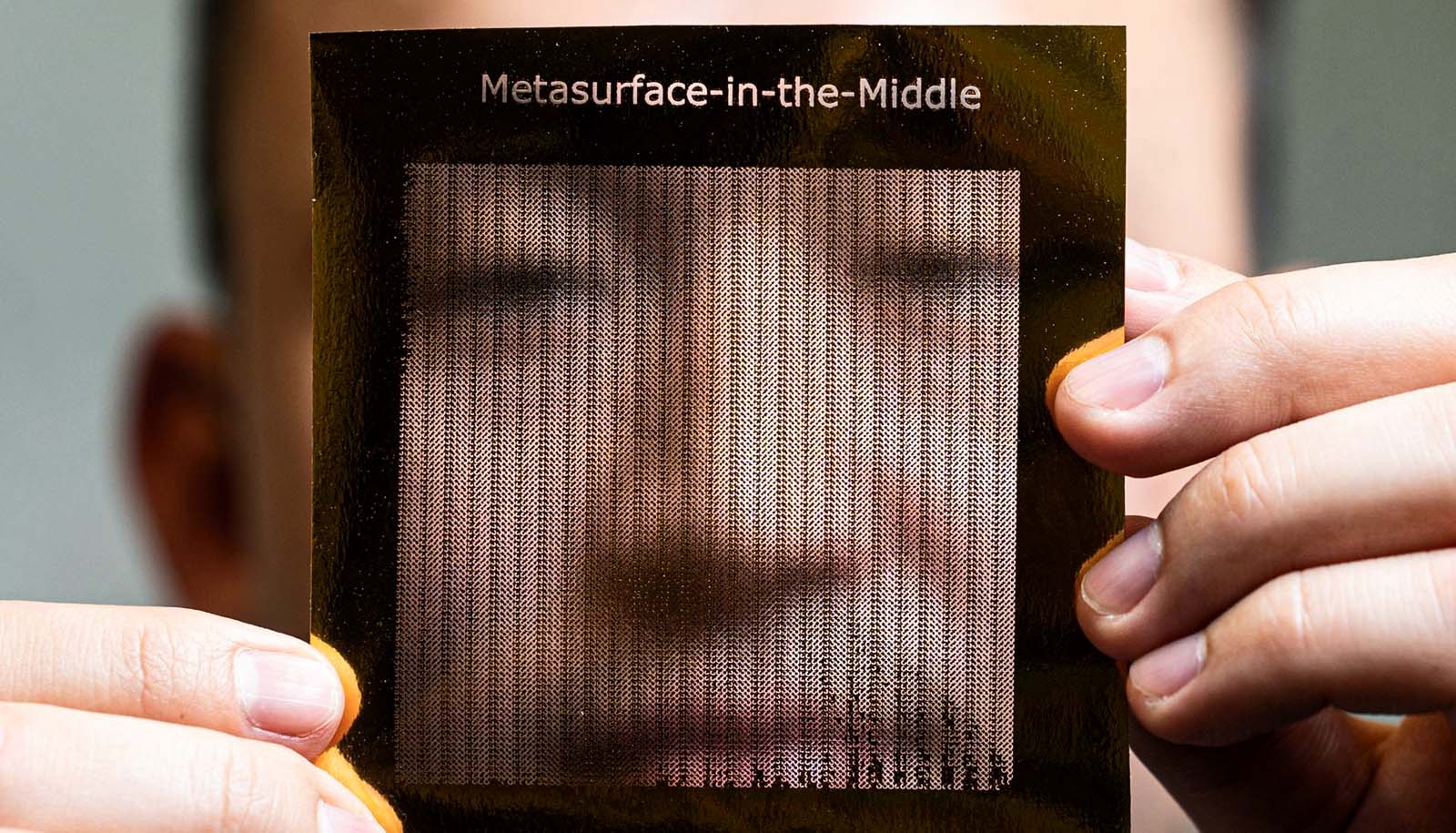
    Zhambyl Shaikhanov holds a foil sheet he used to create a “metasurface”—a paper sheet covered with a 2D foil pattern—that an eavesdropper could use in a “Metasurface-in-the-Middle” attack to redirect part of a high-frequency "pencil beam" transmission like those planned for 6G wireless networks. (Credit: Jeff Fitlow/Rice)

    Hackers could make a tool to eavesdrop on some 6G wireless signals with just office paper, an inkjet printer, a metallic foil transfer, and a laminator.

    The researchers who discovered the wireless security hack will present their findings and demonstrate the attack this week in San Antonio at ACM WiSec 2022, the Association for Computing Machinery’s annual conference on security and privacy in wireless and mobile networks.

    “Awareness of a future threat is the first step to counter that threat,” says study coauthor Edward Knightly, professor of electrical and computer engineering at Rice University. “The frequencies that are vulnerable to this attack aren’t in use yet, but they are coming and we need to be prepared.”

    ‘Metasurface in the middle’

    In the study, Knightly, Brown University engineering professor Daniel Mittleman, and colleagues showed an attacker could easily make a sheet of office paper covered with 2D foil symbols—a metasurface—and use it to redirect part of a 150 gigahertz” pencil beam” transmission between two users.

    They dubbed the attack “Metasurface-in-the-Middle” as a nod to both the hacker’s tool and the way it is wielded. Metasurfaces are thin sheets of material with patterned designs that manipulate light or electromagnetic waves.” Man-in-the-middle” is a computer security industry classification for attacks in which an adversary secretly inserts themself between two parties.

    The 150 gigahertz frequency is higher than is used in today’s 5G cellular or Wi-Fi networks. But Knightly says wireless carriers are looking to roll out 150 gigahertz and similar frequencies known as terahertz waves or millimeter waves over the next decade.

    “Next-generation wireless will use high frequencies and pencil beams to support wide-band applications like virtual reality and autonomous vehicles,” says Knightly, who will present the research with coauthor Zhambyl Shaikhanov, a graduate student in his lab.

    How the attack would work

    In the study, the researchers use the names Alice and Bob to refer to the two people whose communications are hacked. The eavesdropper is called Eve.

    To mount the attack, Eve first designs a metasurface that will diffract a portion of the tight-beam signal to her location. For the demonstration, the researchers designed a pattern with hundreds of rows of split rings. Each looks like the letter C, but they are not identical. The open part of each ring varies in size and orientation.

    “Those openings and orientations are very specifically done to get the signal to diffract in the exact direction Eve wants,” Shaikhanov says. “After she designs the metasurface, she prints it on a regular laser printer, and then she uses a hot stamping technique that’s used in crafting. She places a metal foil on the printed paper, feeds it through a laminator and the heat and pressure create a bond between the metal and the toner.”

    Mittleman and study coauthor Hichem Guerboukha, a postdoctoral research fellow at Brown, show in a 2021 study that the hot-stamping method could be used to make split-ring metasurfaces with resonances up to 550 GHz.

    “We developed this approach in order to lower the barrier for fabrication of metasurfaces, so that researchers could test many different designs quickly and inexpensively,” Mittleman says. “Of course, this lowers the barrier for eavesdroppers too.”

    Better to know this now than later

    The researchers say they hope the study will dispel a common misperception in the wireless industry that higher frequencies are inherently secure.

    “People have been quoted saying millimeter-wave frequencies are ‘covert’ and ‘highly confidential’ and that they ‘provide security,'” Shaikhanov says. “The thinking is, ‘If you have a super narrow beam, nobody can eavesdrop on the signal because they would have to physically get between the transmitter and the receiver.’ What we’ve shown is that Eve doesn’t have to be obtrusive to mount this attack.”

    The research shows that the attack would be difficult for Alice or Bob to detect today. And while the metasurface must be placed between Alice and Bob, “it could be hidden in the environment,” Knightly says. “You could conceal it with other sheets of paper, for instance.”

    Knightly says now that wireless researchers and equipment manufacturers know about the attack, they can further study it, develop detection systems, and build those into terahertz networks up front.

    “If we had known from day one, when the internet first came out, that there would be denial-of-service attacks and attempts to take down web servers, we would have designed it differently,” Knightly says. “If you build first, wait for attacks, and then try to repair, that is a much more costly and expensive path than designing securely up front.”

    “Millimeter-wave frequencies and metasurfaces are new technologies that can each be used to advance communication, but any time we get a new capability for communication we have to ask the question, ‘What if the adversary has this technology? What new capabilities will it give them that they didn’t have in the past? And how can we realize a secure network against a strong adversary?'”

    Support for the research came from Cisco, Intel, the National Science Foundation, and the Army Research Laboratory.

    Source: Rice University

    Play Video

    Wireless power from 5G networks could replace batteries

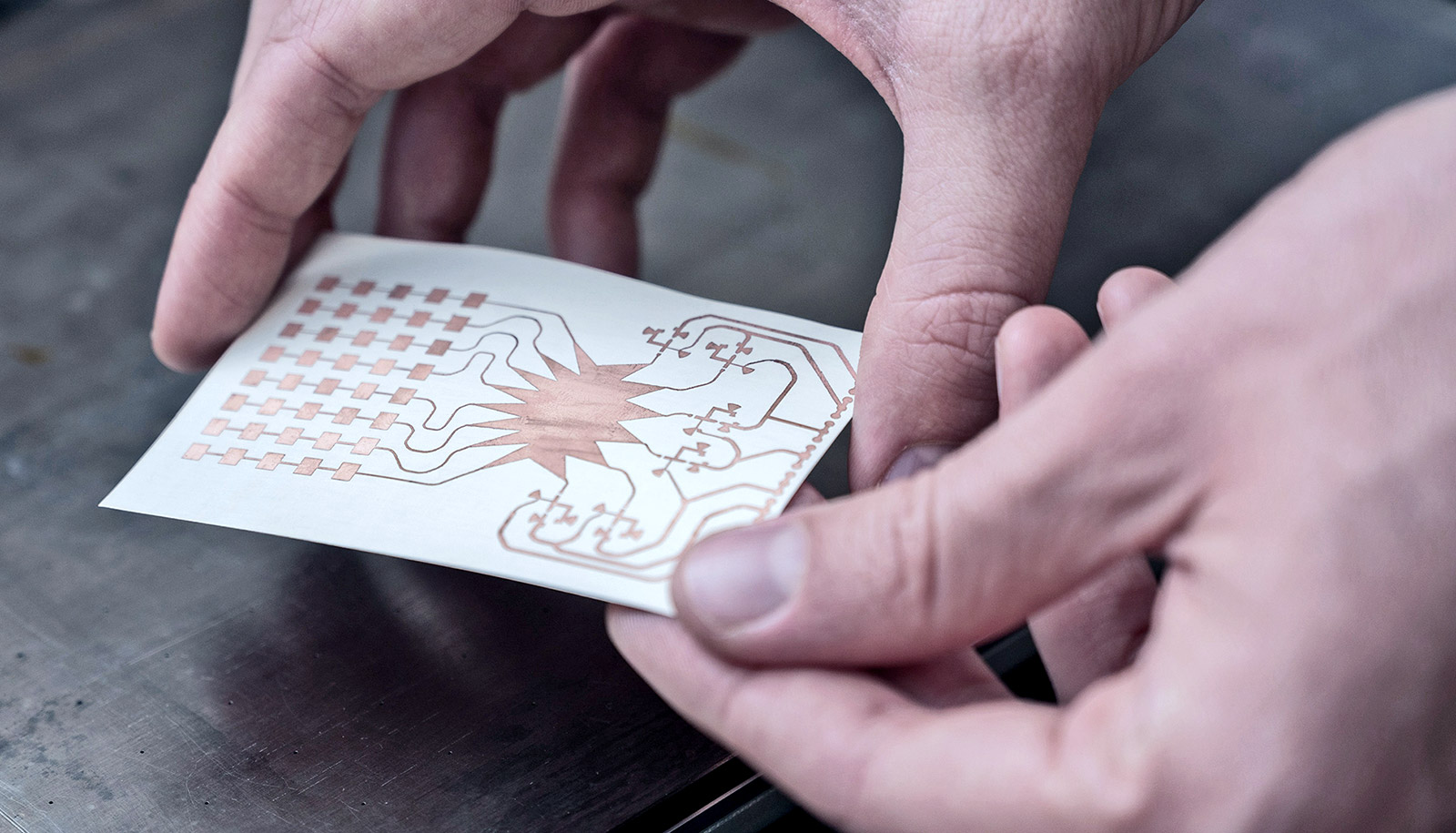
    An ATHENA group member holds an inkjet-printed prototype of a mm-wave harvester. The researchers envision a future where IoT devices will be powered wirelessly over 5G networks. (Credit: Christopher Moore/Georgia Tech)

    Researchers have uncovered an innovative way to tap into the over-capacity of 5G networks, turning them into “a wireless power grid” for powering Internet of Things (IoT) devices that today need batteries to operate.

    The researchers have developed a flexible Rotman lens-based rectifying antenna (rectenna) system capable, for the first time, of millimeter-wave harvesting in the 28-GHz band. The Rotman lens is key for beamforming networks and is frequently used in radar surveillance systems to see targets in multiple directions without physically moving the antenna system.

    To harvest enough power to supply low-power devices at long ranges, however, large aperture antennas are necessary. The problem with large antennas is they have a narrowing field of view. This limitation prevents their operation if the antenna is widely dispersed from a 5G base station.

    “We’ve solved the problem of only being able to look from one direction with a system that has a wide angle of coverage,” says senior researcher Aline Eid in the ATHENA lab in the Georgia Institute of Technology’s School of Electrical and Computer Engineering to advance and develop novel technologies for electromagnetic, wireless, RF, millimeter-wave, and sub-terahertz applications.

    The FCC has authorized 5G to focalize power much more densely compared with previous generations of cellular networks. While today’s 5G was built for high-bandwidth communication, the high-frequency network holds rich opportunity to “harvest” unused power that would otherwise be wasted.

    “With this innovation, we can have a large antenna, which works at higher frequencies and can receive power from any direction. It’s direction-agnostic, which makes it a lot more practical,” notes Jimmy Hester, senior lab advisor and the CTO and cofounder of Atheraxon, a Georgia Tech spinoff developing 5G radio-frequency identification (RFID) technology.

    With the new solution, all the electromagnetic energy collected by the antenna arrays from one direction is combined and fed into a single rectifier, which maximizes its efficiency.

    “People have attempted to do energy harvesting at high frequencies like 24 or 35 Gigahertz before,” Eid says, but such antennas only worked if they had line of sight to the 5G base station; there was no way to increase their angle of coverage until now.

    Operating just like an optical lens, the Rotman lens provides six fields of view simultaneously in a pattern shaped like a spider. Tuning the shape of the lens results in a structure with one angle of curvature on the beam-port side and another on the antenna side. This enables the structure to map a set of selected radiation directions to an associated set of beam-ports. The lens is then used as an intermediate component between the receiving antennas and the rectifiers for 5G energy harvesting.

    This approach addresses the tradeoff between rectenna angular coverage and turn-on sensitivity with a structure that merges unique radio frequency (RF) and direct current (DC) combination techniques, thereby enabling a system with both high gain and large beamwidth.

    In demonstrations, the technology achieved a 21-fold increase in harvested power compared with a referenced counterpart, while maintaining identical angular coverage.

    This robust system may open the door for new passive, long-range, mm-wave 5G-powered RFID for wearable and ubiquitous IoT applications. The researchers used in-house additive manufacturing to print the palm-sized mm-wave harvesters on a multitude of everyday flexible and rigid substrates. Providing 3D and inkjet printing options will make the system more affordable and accessible to a broad range of users, platforms, frequencies, and applications.

    “The fact is 5G is going to be everywhere, especially in urban areas. You can replace millions, or tens of millions, of batteries of wireless sensors, especially for smart city and smart agricultural applications,” says Emmanouil (Manos) Tentzeris, professor in flexible electronics in the School of Electrical and Computer Engineering.

    Tentzeris predicts that power as a service will be the next big application for the telecom industry, just as data overtook voice services as a major revenue producer.

    The research team is most excited by the prospect of service providers embracing this technology to offer power on demand “over the air,” eliminating the need for batteries.

    “I’ve been working on energy harvesting conventionally for at least six years, and for most of this time it didn’t seem like there was a key to make energy harvesting work in the real world, because of FCC limits on power emission and focalization,” Hester says.

    “With the advent of 5G networks, this could actually work and we’ve demonstrated it. That’s extremely exciting—we could get rid of batteries.”

    The research appears in Scientific Reports.

    Support for the work came from the Air Force Research Laboratory and the National Science Foundation’s Emerging Frontiers in Research and Innovation program. The work was performed in part at the Georgia Tech Institute for Electronics and Nanotechnology, a member of the National Nanotechnology Coordinated Infrastructure, which is supported by the National Science Foundation.

    Source: Georgia Tech