Archives

  • Blue crabs face dire threat thanks to climate change
  • Play Video

    Watch an explosive showdown between lab-made lava and water

    Ingo Sonder stirs the molten rock as it melts inside the furnace. (Credit: Douglas Levere/U. Buffalo)

    Explosive experiments with human-made lava are helping to answer the question “What happens when lava and water meet?”

    By cooking up 10-gallon batches of molten rock and injecting them with water, scientists are shedding light on the basic physics of lava-water interactions, which are common in nature but poorly understood.

    The scientists caution that the number of tests so far is small, so the team will need to conduct more experiments to draw firm conclusions.

    ‘Powerful forces’

    The research shows that lava-water encounters can sometimes generate spontaneous explosions when there is at least about a foot of molten rock above the mixing point.

    In prior, smaller-scale studies that used about a coffee cup’s worth of lava, scientists in Germany found that they needed to apply an independent stimulus—in essence pricking the water within the lava—to trigger a blast.
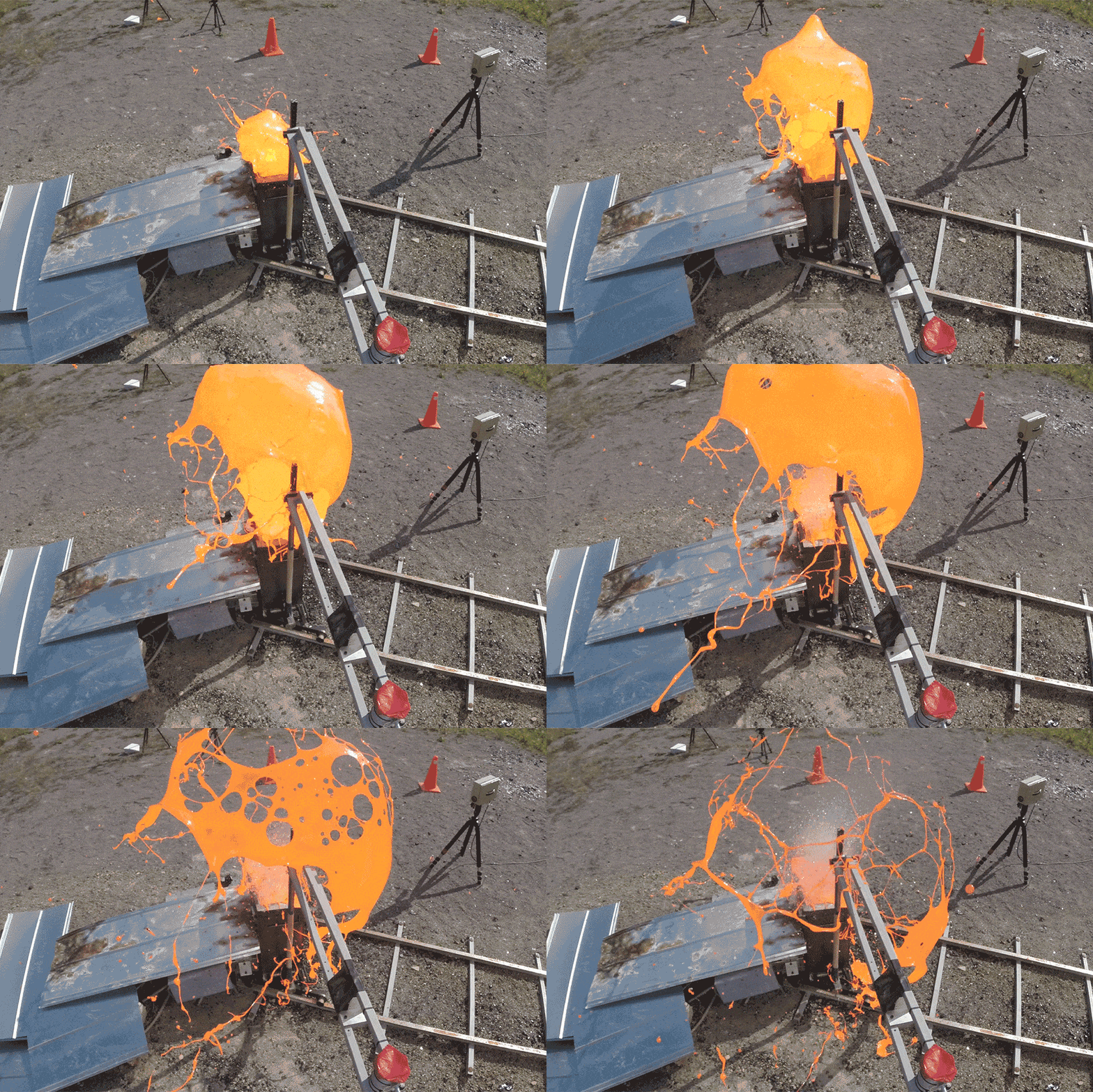
    Lava + water reaction
    An intense reaction occurs after researchers inject water into molten rock. (Credit: Douglas Levere/U. Buffalo)

    The results also point to some preliminary trends, showing that in a series of tests, larger, more brilliant reactions tended to occur when water rushed in more quickly and when lava was held in taller containers. (The team ran a total of 12 experiments in which water injection speeds ranged from about 6 to 30 feet per second, and in which lava was held in insulated steel boxes that ranged in height from about 8 to 18 inches.)

    “If you think about a volcanic eruption, there are powerful forces at work, and it’s not a gentle thing,” says lead investigator Ingo Sonder, research scientist in the Center for Geohazards Studies at the University at Buffalo.

    “Our experiments are looking at the basic physics of what happens when water gets trapped inside molten rock.”

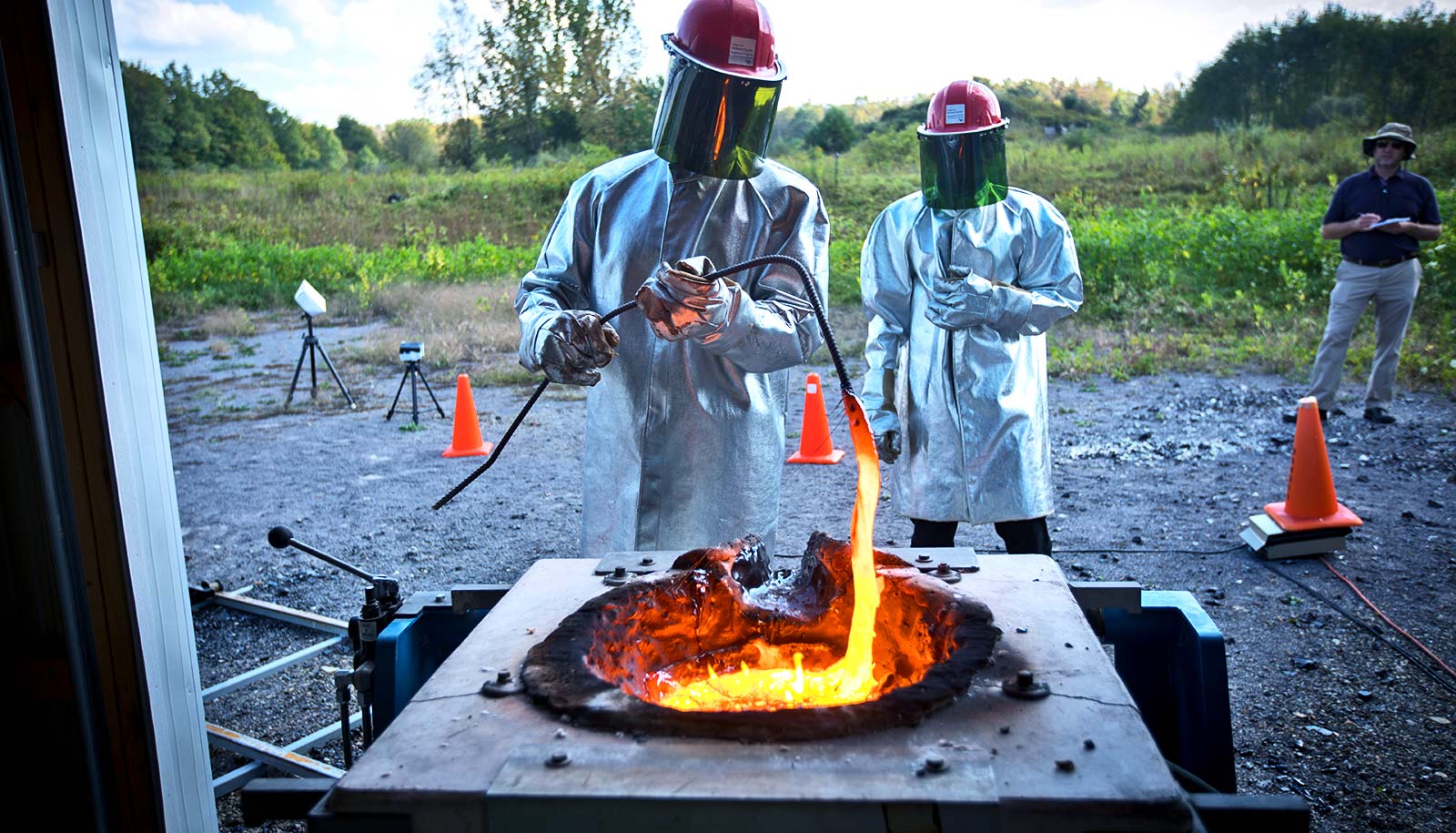
    Pouring lava
    Researchers pour lava from the furnace after the melt is complete. Credit: Douglas Levere/U. Buffalo)

    Volcanic meeting

    In nature, the presence of water can make volcanic activity more dangerous, such as during past eruptions of Hawaii’s Kilauea and Iceland’s Eyjafjallajökull. But in other cases, the reaction between the two materials is subdued.

    Sonder wants to understand why: “Sometimes, when lava encounters water, you see huge, explosive activity. Other times, there is no explosion, and the lava may just cool down and form some interesting shapes. What we are doing is trying to learn about the conditions that cause the most violent reactions.”

    Eventually, findings from the long-term project could improve scientists’ ability to assess the risk that volcanoes near ice, lakes, oceans, and underground water sources pose to people who live in surrounding communities.

    Cleaning lava furnace
    Andrew Harp chips residue off of the lava-making furnace before beginning the day’s work. (Credit: Charlotte Hsu/U. Buffalo)

    “The research is still in the very early stages, so we have several years of work ahead of us before we’ll able to look at the whole range and combination of factors that influence what happens when lava or magma encounters water,” says Valentine, study coauthor and director of the Center for Geohazards Studies.

    “However, everything we do is with the intention of making a difference in the real world,” he says. “Understanding basic processes having to do with volcanoes will ultimately help us make better forecasting calls when it comes to eruptions.”

    Making lava

    Lava-water interactions are associated with a phenomenon known as a molten fuel coolant interaction, in which a liquid fuel (a heat source) reacts violently with a liquid coolant. Much of the experimental work in this field has been done in the context of industrial safety, with a focus on understanding potential dangers in nuclear power plants and metal production sites.

    The lava-water experiments build on previous research in this area, while focusing on molten rock.

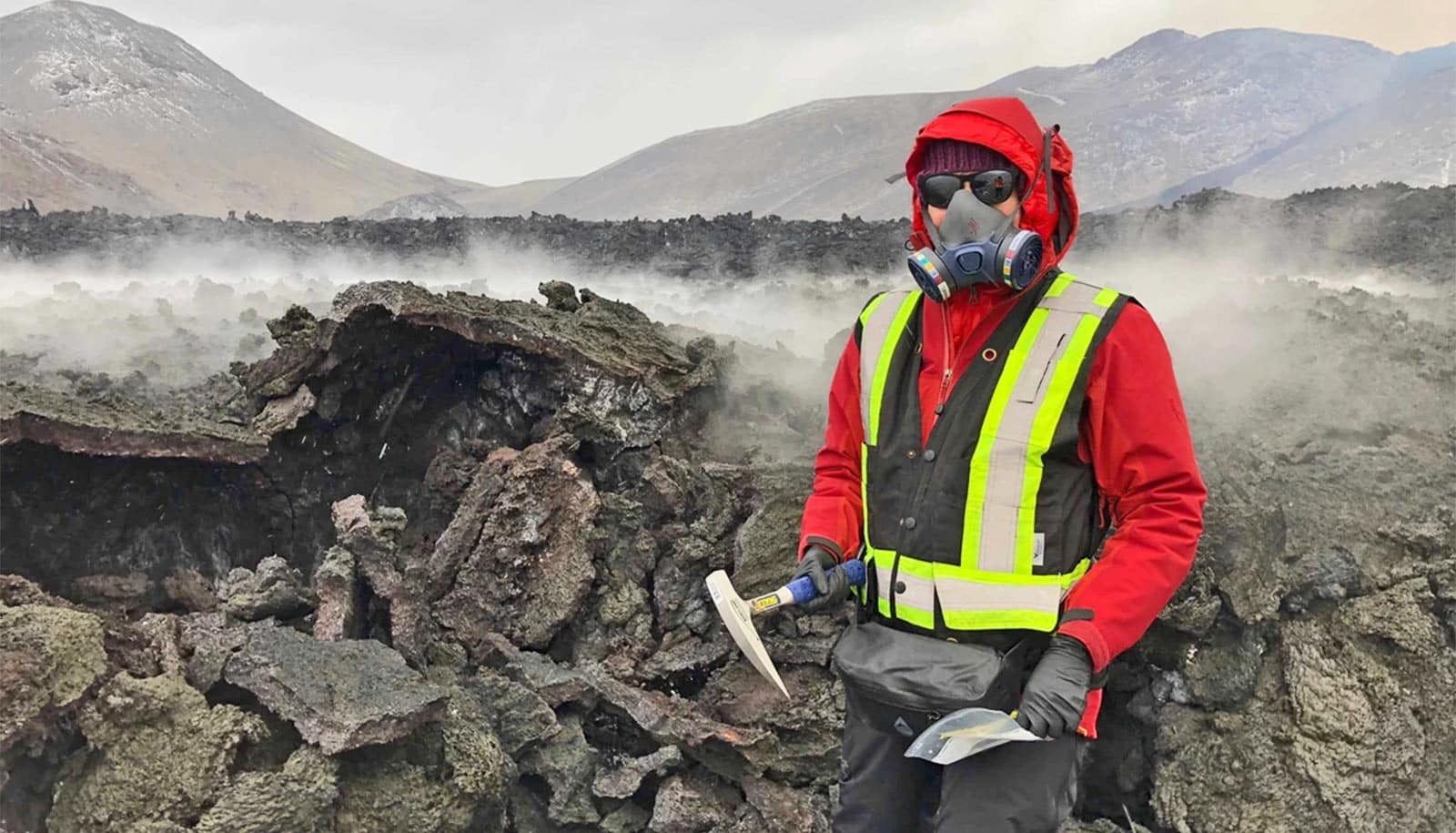
    gloves for lava experiments
    Protective gloves. (Credit: Douglas Levere/U. Buffalo)

    The work takes place at a facility 40 miles outside Buffalo, New York that gives scientists a place to conduct large-scale experiments simulating volcanic processes and other hazards. In these tests, researchers can control conditions in a way that isn’t possible at a real volcano, dictating, for example, the shape of the lava column and the speed at which water shoots into it.

    To make lava, scientists dump basaltic rock into a high-powered induction furnace. They heat it up for about 4 hours. When the mixture reaches a red-hot 2,400 degrees Fahrenheit, it’s poured into an insulated steel box and injected with two or three jets of water.

    Then, a hammer drives a plunger into the mix to help stimulate an explosion. (In some cases, if enough molten rock was present above the injection point, an intense reaction began before the hammer fell).
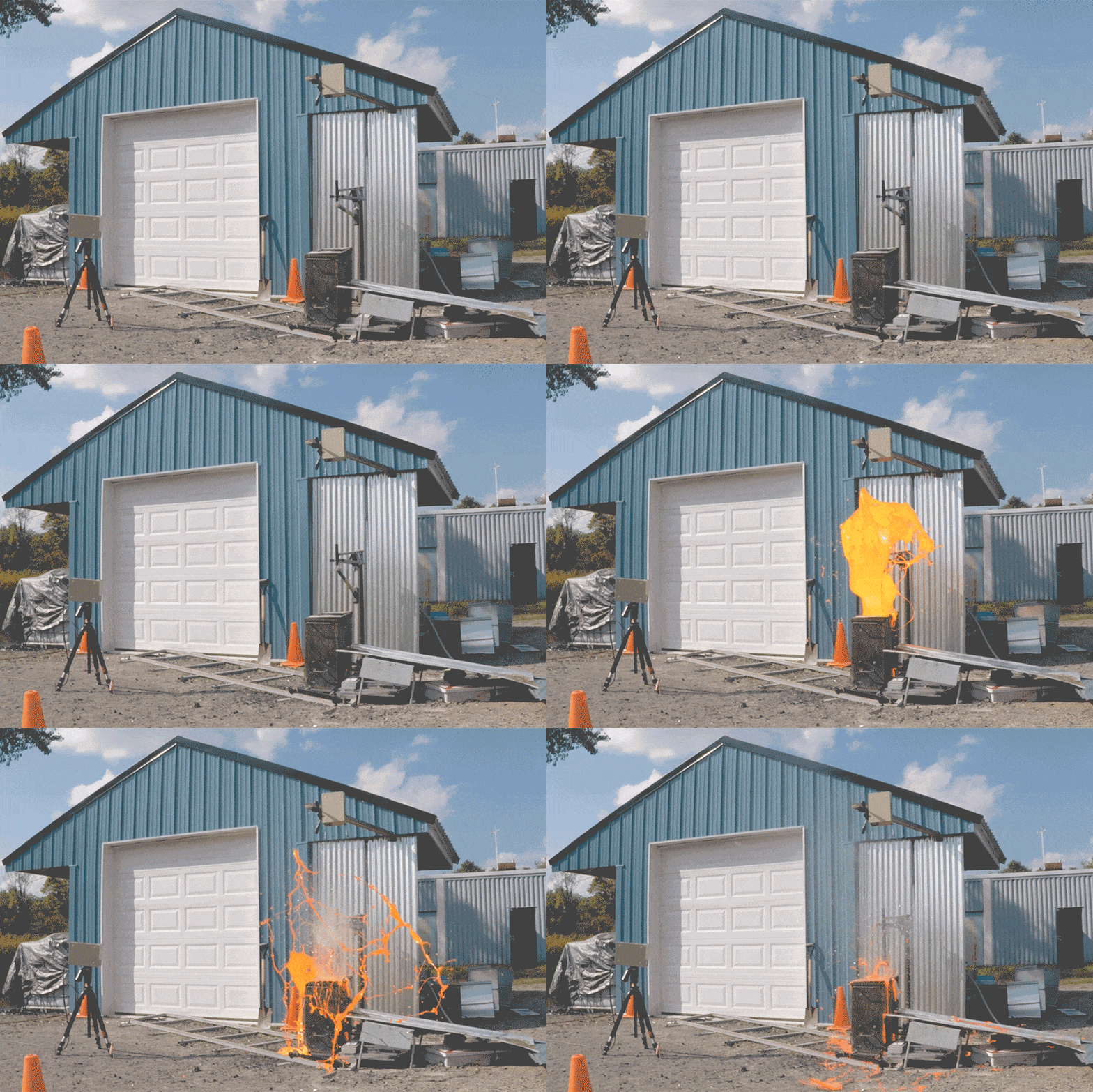
    lava + water reaction
    Another view of the explosive reaction. (Credit: Douglas Levere/U. Buffalo)

    In addition to identifying some preliminary trends, the study attests to the wide variety of physical processes that can occur when lava and water meet.

    “The system response to water injection varied from mild, evaporation-dominated processes, in which only a little melt was ejected from the container alongside some steam, to stronger reactions with visible steam jets, and with melt domains ejected to several meters height,” the scientists write.

    Explosive speed

    The study did not examine why box height and water injection speed corresponded with the biggest explosions. But Sonder, who has a background in geosciences and physics, offers some thoughts.

    He explains that when a much hotter substance traps a blob of water, the outer edges of the water vaporize, forming a protective film that envelops the rest of the water like a bubble, limiting heat transfer into the water and preventing it from boiling. This is called the Leidenfrost effect.

    But when researchers rapidly inject water into a tall column of lava, the water—which is about three times lighter than the lava—will speed upward and mix with the molten rock more quickly. This may cause the vapor film to destabilize, Sonder says. In this situation, the unprotected water would expand rapidly in volume as it heated up, imposing high stresses on the lava, he says. The result? A violent explosion.

    In contrast, when water is injected slowly into shallower pools of lava, the protective vapor film may hold, or the water may reach the lava’s surface or escape as steam before an explosion occurs, Sonder says.

    He hopes to explore these theories through future experiments: “Not a lot of work has been done in this field,” he says, “so even some of these basic processes are really not well understood.”

    The first results of the long-term, ongoing project appear in the Journal of Geophysical Research (JGR): Solid Earth.

    The National Science Foundation funded the study. Additional coauthors are from the University at Buffalo; the California State University, Chico; the University of Missouri-Kansas City; the University of Arizona; and the Universität Würzburg in Germany.

    Source: University at Buffalo
    Play Video

    Listening to volcanoes could improve eruption forecasts

    (Credit: Getty images)

    Monitoring inaudible low frequencies called infrasound that come from some active volcanoes could improve the forecasting of significant, potentially deadly eruptions, according to a new study.

    Scientists analyzed the infrasound detected by monitoring stations on the slopes of the Villarrica volcano in southern Chile, one of the most active volcanoes in the world. The distinctive sound emanates from the roiling of a lava lake inside a crater at the volcano’s peak and changes depending on the volcano’s activity.

    The study, which appears in the journal Geophysical Research Letters, demonstrates how changes in this sound signaled a sudden rise in the lake level, along with rapid up-and-down motions of the surging lake near the crater’s rim just ahead of a major eruption in 2015. Tracking infrasound in real time and integrating it with other data, such as seismic readings and gas emission, might help alert nearby residents and tourists that a volcano is about to blow its stack, the researchers say.

    Aerial view of Villarica volcano
    Aerial view of Villarica volcano. (Credit: Iain and Sarah/Creative Commons)

    “Our results point to how infrasound could aid in forecasting volcanic eruptions,” says coauthor Leighton Watson, a graduate student in the lab of Eric Dunham, an associate professor in the geophysics department of the Stanford School of Earth, Energy & Environmental Sciences. “Infrasound is potentially a key piece of information available to volcanologists to gauge the likelihood of an eruption hours or days ahead.”

    ‘Ominous serenity’

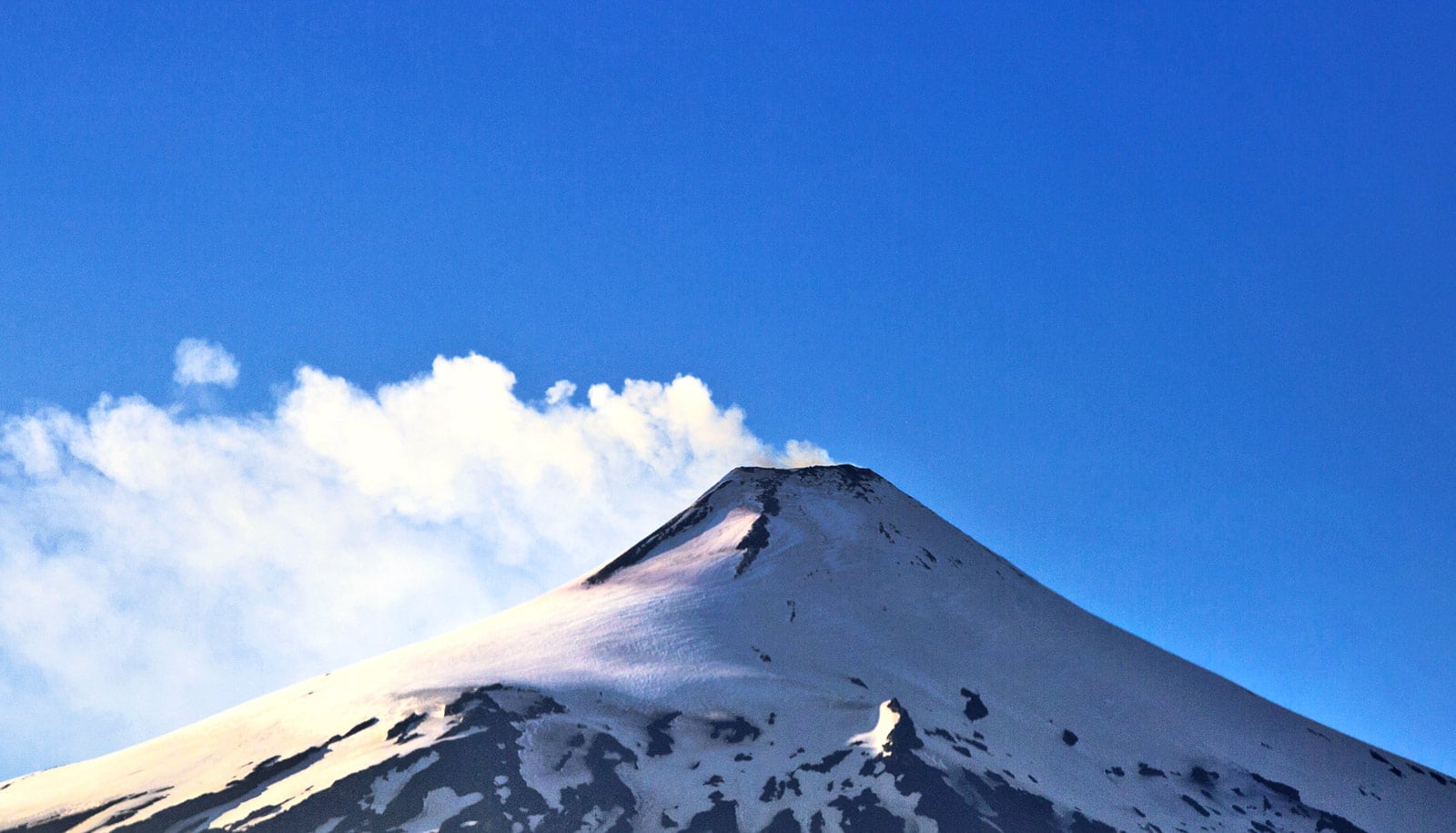
    Villarrica is a picturesque mountain with an altitude of 9,300 feet. The snowcapped volcano looms over a lake and across from the city of Pucón, which swells to a quarter million people in the summer tourist season. At night, residents of Pucón can often see a scarlet glow from Villarrica’s lava lake, normally hidden well below the volcano’s rim.

    When the lava lake rises up in the crater, potentially heralding an eruption, the pitch or frequency of the sound increases, “just like when the trombone is retracted…”

    The ominous serenity that had held at Villarrica since its last eruption in the mid-1980s ended in the early morning hours on March 3, 2015. An incandescent fountain of lava rocketed from the mountaintop nearly a mile into the sky, spewing ash and debris and triggering bolts of lightning from the thick heat-generated clouds enveloping the summit. Around 4,000 people evacuated the immediate area. The eruption proved short-lived, however, and with risks of mudslides and flooding from melted snow minimal, evacuees soon returned to their homes.

    Infrasound monitoring stations established at Villarrica just two months before the 2015 event and maintained by coauthor Jose Palma from the University of Concepción in Chile captured its before-and-after sonic activity. Studying these data, the research team saw that in the build-up to the eruption, the pitch of the infrasound increased, while the duration of the signal decreased. Flyovers in aircraft documented the changes in Villarrica’s lava lake, allowing researchers to explore connections between its height and the sound generation.

    Watson offers a music analogy to explain this relationship. Similar to a person blowing into a trombone, explosions from gas bubbles rising and then bursting at the surface of the lava lake create sound waves. Just as the shape of a trombone can change the pitch of the notes it produces, the geometry of the crater that holds the lava lake modulates its sounds.

    When the lava lake is deep down in the volcano’s crater, the sound registers at a lower pitch or frequency—”just like when a trombone is extended,” says Watson. When the lava lake rises up in the crater, potentially heralding an eruption, the pitch or frequency of the sound increases, “just like when the trombone is retracted,” says Watson.

    Sonic warning signal

    Future research will seek to tie infrasound generation to other critical variables in volcano monitoring and eruption forecasting, such as seismicity. Ahead of an eruption, seismic activity in the form of small earthquakes and tremors almost always increases. This seismicity emanates from several miles underground as magma moves through the volcano’s “plumbing system” of fractures and conduits that connect the volcano’s opening to magma chambers in our planet’s crust.

    Tidal cycles may warn us about volcanoes ready to erupt

    Volcanologists think that changes in lava lake levels—and their attendant infrasound—result from the injection of new magma through volcanic plumbing, increasing the odds of a violent outburst.

    In this way, the collection of infrasound should prove beneficial for forecasting purposes at “open vent” volcanoes like Villarrica, where an exposed lake or channels of lava connect the volcano’s innards to the atmosphere. Closed vent volcanoes, however, where the pooling magma remains trapped under rock until an explosive eruption occurs, do not generate the same kind of infrasound and thus pose additional forecasting challenges.

    Mount St. Helens in southwestern Washington state, whose eruption in 1980 remains the most lethal and destructive eruption in the history of the United States, is an example of a closed vent volcano.

    “Volcanoes are complicated and there is currently no universally applicable means of predicting eruptions. In all likelihood, there never will be,” Dunham says.

    “Instead, we can look to the many indicators of increased volcanic activity, like seismicity, gas emissions, ground deformation, and—as we further demonstrated in this study—infrasound, in order to make robust forecasts of eruptions.”

    Magma under volcanoes is like a leaky snow cone

    Other coauthors are from Boise State University. Funding camefrom the Fulbright Scholar Program, the National Science Foundation, and the Chilean volcano monitoring authorities (OVDAS/SERNAGEOMIN).

    Source: Stanford University