Archives

Play Video

Battery-free tags let you control games with your clothes

(Credit: Getty Images)

RFID-embedded clothing could control avatars in video games or tell you when you should sit up straight.

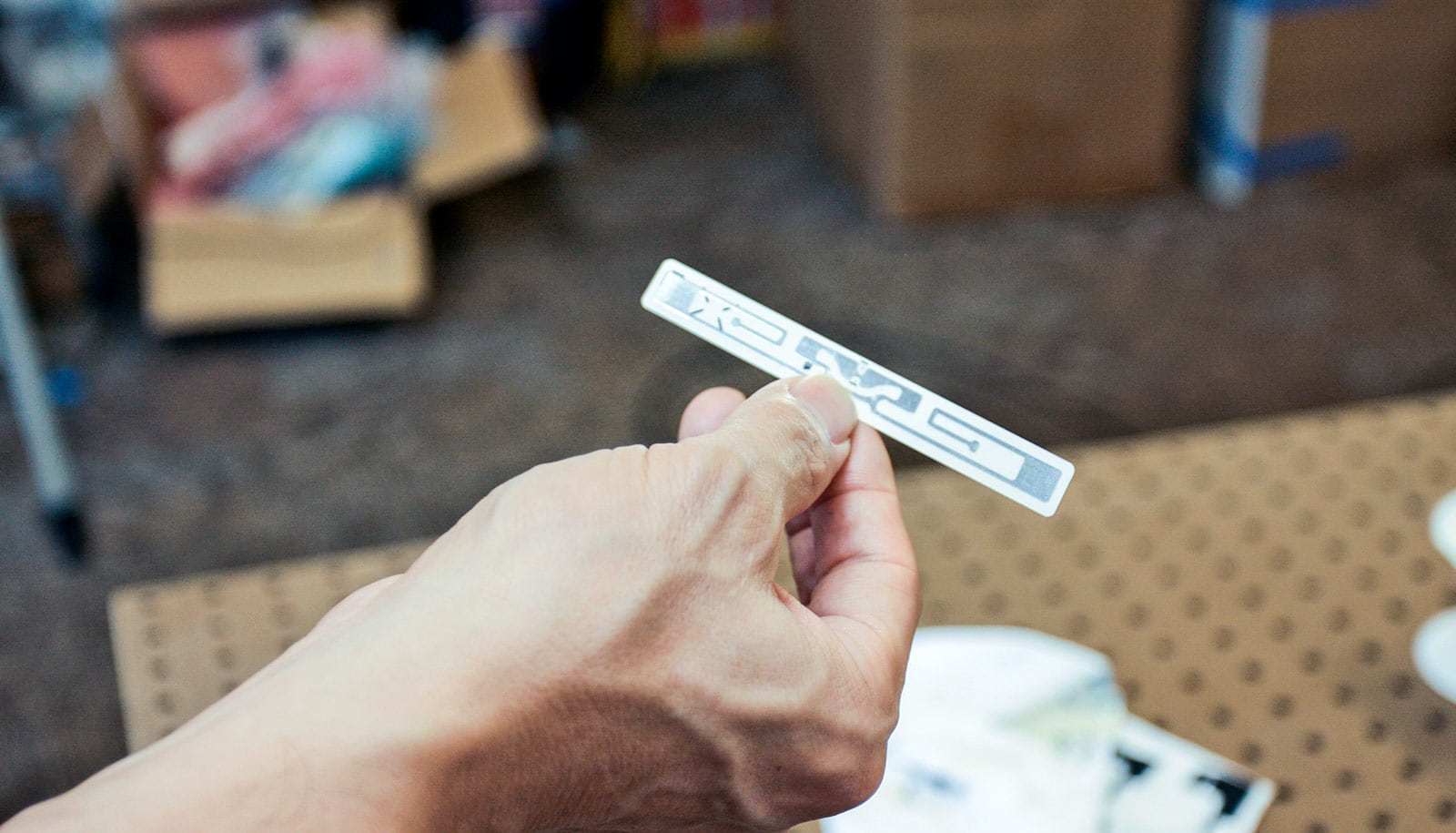
Researchers have found ways to track body movements and detect shape changes using arrays of radio-frequency identification (RFID) tags in clothing.

RFID tags are nothing new, which is part of their appeal for these applications, says Haojian Jin, a PhD student in Carnegie Mellon University’s Human-Computer Interaction Institute (HCII). They are cheap, battery-free, and washable.

RF-wear for fun and exercise

What’s new is the method that Jin and his colleagues devised for tracking the tags, and monitoring movements and shapes. RFID tags reflect certain radio frequencies. It would be possible, but not practical, to use multiple antennae to track this backscatter and triangulate the locations of the tags. Rather, the researchers showed they could use a single, mobile antenna to monitor an array of tags without any prior calibration.

Just how this works varies based on whether the tags are used to track the body’s skeletal positions or to track changes in shape. For body-movement tracking, arrays of RFID tags are positioned on either side of the knee, elbow, or other joints. By keeping track of the ever-so-slight differences in when the backscattered radio signals from each tag reach the antenna, it’s possible to calculate the angle of bend in a joint.

“By attaching these paper-like RFID tags to clothing, we were able to demonstrate millimeter accuracy in skeletal tracking,” Jin says.

The researchers call this embedded clothing, which they described earlier this year at the UbiComp 2018 conference in Singapore, RF-Wear. It could be an alternative to systems such as Kinect, which use a camera to track body movements and can only work when the person is in the camera’s line of sight. It also could be an alternative to existing wearables, which generally depend on inertial sensors that are expensive, difficult to maintain, and power hungry, Jin says.

RFID-embedded clothes might also be an alternative to wrist-worn devices, such as Fitbit, for activity tracking or sports training.

Wishing for better posture

The technology for monitoring changes in curves or shapes, called WiSh (for Wireless Shape-aware world), also uses arrays of RFIDs and a single antenna, but relies on a more sophisticated algorithm for interpreting the backscattered signals to infer the shape of a surface.

The researchers presented WiSh earlier this year at Mobisys, the International Conference on Mobile Systems, Applications, and Services, in Munich. It could be incorporated into smart fabrics and used to track a user’s posture. It could also embed in a variety of objects.

“We can turn any soft surface in the environment into a touch screen,” Wang says. Smart carpets, for instance, could detect the presence and locations of people, or control games or devices. Soft toys could respond to or otherwise register squeezes and bends. Smart pillows might help track sleep quality.

WiSh also could monitor the structural health of bridges or other infrastructure, Wang notes. The researchers measured the curvature of Pittsburgh’s 10th Street Bridge by using a robot to drag a string of 50 RFID tags along the bridge’s sidewalk.

“We’re really changing the way people are thinking about RF sensing,” Jin adds.

“Weaving these tags into clothing will only add a minimal cost, under $1,” Jin says. The most expensive part of these measurement systems is the antenna. But smartphones already use 13 MHz antennas for services such as Apple Pay. Adding a 900 MHz antenna for RFID-related applications might be feasible in future smartphones, eliminating the need for a separate device, he suggests.

Additional researchers came from Carnegie Mellon and Tsinghua University in China. The National Science Foundation and Google provided support for this research.

Source: Carnegie Mellon University

  • ‘Tags’ sewn into clothes could monitor vital signs
  • Play Video

    Watch: VR lets users control robots from miles away

    (Credit: Getty Images)

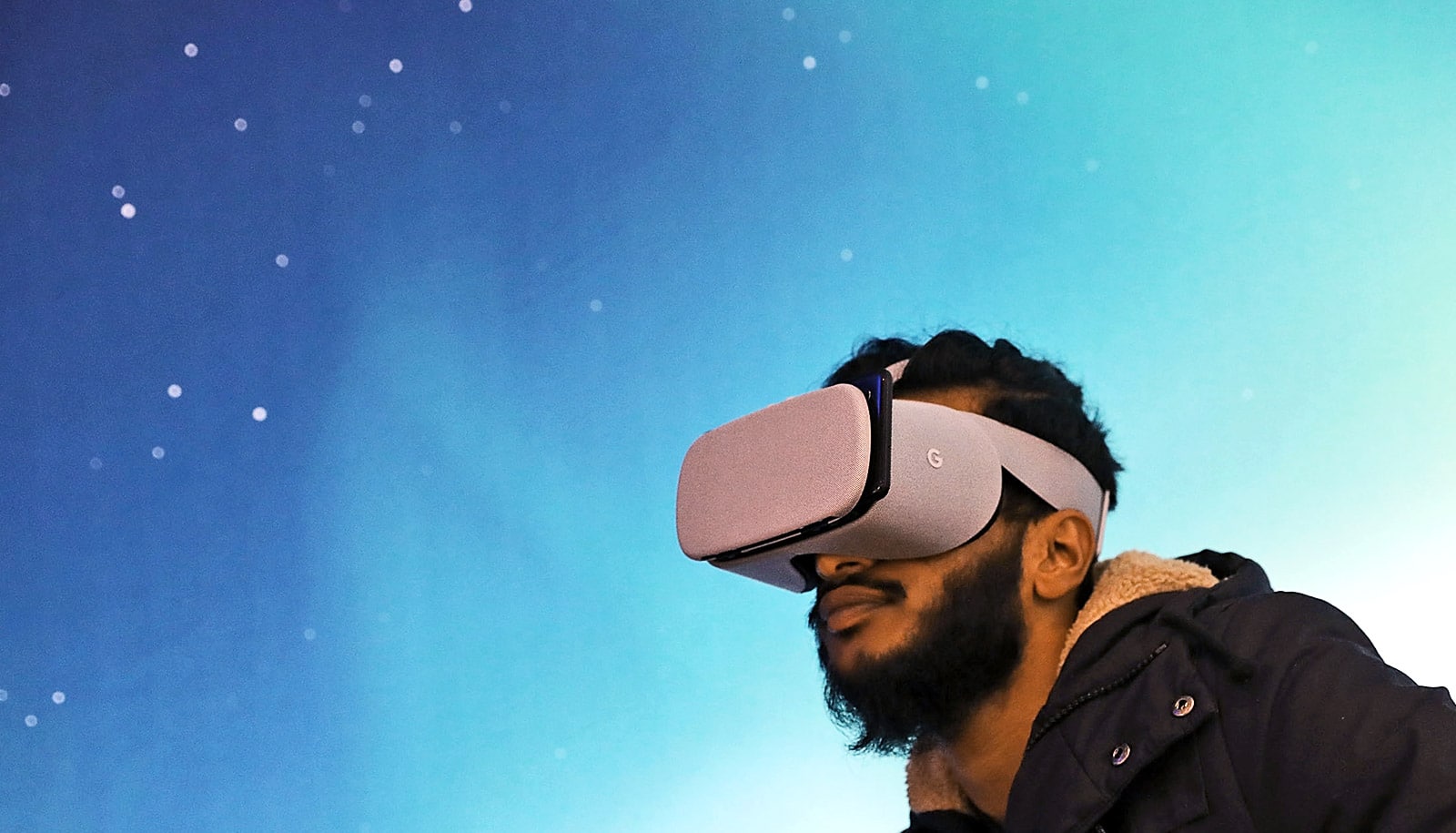
    New software allows people using virtual reality hardware to control robots over the internet.

    Even as autonomous robots get better at doing things on their own, there will still be plenty of circumstances where humans might need to step in and take control. The new software allows remote control over the robots and helps users to become immersed in a robot’s surroundings despite being miles away physically.

    The software connects a robot’s arms and grippers as well as its onboard cameras and sensors to off-the-shelf virtual reality hardware via the internet.

    Using handheld controllers, users can control the position of the robot’s arms to perform intricate manipulation tasks just by moving their own arms. Users can step into the robot’s metal skin and get a first-person view of the environment, or can walk around the robot to survey the scene in the third person—whichever is easier for accomplishing the task at hand.

    student controlling robot with VR headset
    Undergraduate Eric Rosen operates a Baxter robot using a virtual reality interface developed in the Humans to Robots lab. (Credit: Nick Dentamaro/Brown)

    The data transferred between the robot and the virtual reality unit are compact enough to be sent over the internet with minimal lag, making it possible for users to guide robots from great distances.

    “We think this could be useful in any situation where we need some deft manipulation to be done, but where people shouldn’t be,” says David Whitney, a graduate student at Brown University who co-led the development of the system.

    “Three examples we were thinking of specifically were in defusing bombs, working inside a damaged nuclear facility, or operating the robotic arm on the International Space Station.”

    “In VR, people can just move the robot like they move their bodies, and so they can do it without thinking about it…”

    Whitney co-led the work with undergraduate student Eric Rosen. Both work in the Humans to Robots lab, which Stefanie Tellex, an assistant professor of computer science, leads.

    Even highly sophisticated robots are often remotely controlled using some fairly unsophisticated means—often a keyboard or something like a video game controller and a two-dimensional monitor. That works fine, Whitney and Rosen say, for tasks like driving a wheeled robot around or flying a drone, but can be problematic for more complex tasks.

    “For things like operating a robotic arm with lots of degrees of freedom, keyboards and game controllers just aren’t very intuitive,” Whitney says. And mapping a three-dimensional environment onto a two-dimensional screen could limit one’s perception of the space the robot inhabits.

    Whitney and Rosen thought virtual reality might offer a more intuitive and immersive option. Their software links together a Baxter research robot with an HTC Vive, a virtual reality system that comes with hand controllers. The software uses the robot’s sensors to create a point-cloud model of the robot itself and its surroundings, which is transmitted to a remote computer connected to the Vive. Users can see that space in the headset and virtually walk around inside it. At the same time, users see live high-definition video from the robot’s wrist cameras for detailed views of manipulation tasks to be performed.

    Gentle nudges teach robots to better assist us

    For their study, the researchers showed that they could create an immersive experience for users while keeping the data load small enough that it could be carried over the internet without a distracting lag.

    A user in Providence, Rhode Island, for example, was able to perform a manipulation task—the stacking of plastic cups one inside the others—using a robot 41 miles away in Cambridge, Massachusetts.

    In additional studies, 18 novice users were able to complete the cup-stacking task 66 percent faster in virtual reality compared with a traditional keyboard-and-monitor interface. Users also reported enjoying the virtual interface more, and they found the manipulation tasks to be less demanding compared with keyboard and monitor.

    Rosen thinks the increased speed in performing the task was due to the intuitiveness of the virtual reality interface.

    “In VR, people can just move the robot like they move their bodies, and so they can do it without thinking about it,” Rosen says. “That lets people focus on the problem or task at hand without the increased cognitive load of trying to figure out how to move the robot.”

    The researchers plan to continue developing the system. The first iteration focused on a fairly simple manipulation task with a robot that was stationary in the environment. They’d like to try more complex tasks and later combine manipulation with navigation. They’d also like to experiment with mixed autonomy, where the robot does some tasks on its own and the user takes over for other tasks.

    There are perks to attending class as a robot

    The researchers have made the system freely available online. They hope other robotics researchers might give it a try and take it in new directions of their own.

    The researchers presented a paper describing the system and evaluating its usability at the International Symposium on Robotics Research in Chile.

    In addition to Whitney, Rosen, and Tellex, other authors on the paper were Elizabeth Phillips, a postdoctoral researcher with Brown’s Humanity Centered Robotics Initiative, and George Konidaris, as assistant professor of computer science. Grants from the Defense Advanced Research Projects Agency (DARPA) funded this work in part.

    Source: Brown University