Archives

  • Better ‘tagging’ yields detailed look at flu virus
  • Play Video

    ‘Spit test’ detects malaria before symptoms begin

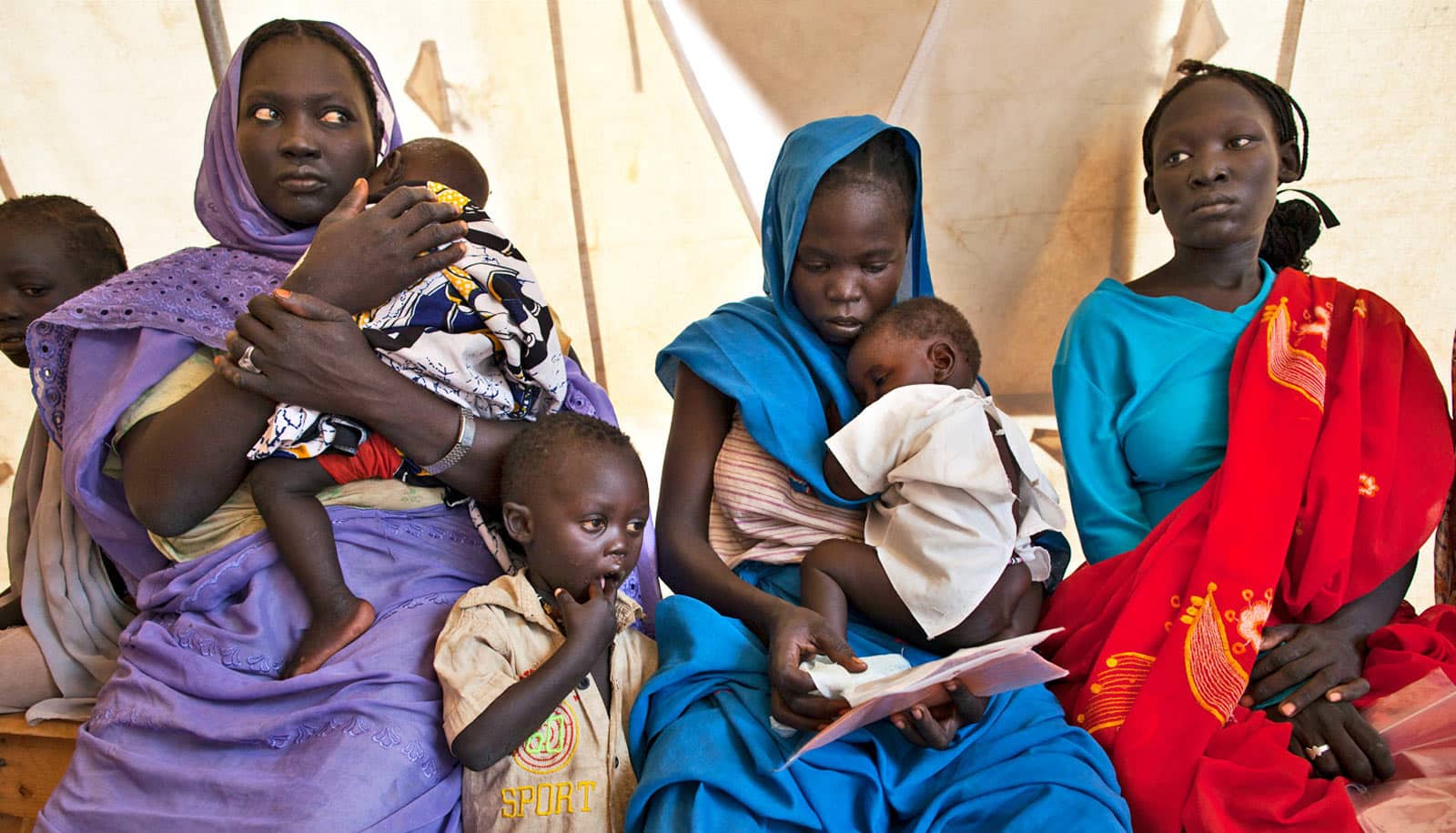
    Sudanese refugees wait in line to get a malaria test in the out patient department at the MSF ( Medecins Sans Frontieres ) field hospital July 17, 2012 in Jamam refugee camp, South Sudan. (Credit: Paula Bronstein/Getty Images)

    Researchers have developed an easy-to-use saliva test to screen for the parasite that causes malaria.

    The non-invasive “spit test” could be a key tool in efforts to eradicate malaria, which kills about 500,000 children each year, mostly under the age of 5 in sub-Saharan Africa.

    Clinicians currently test for malaria using a blood test, which requires skin pricks that often are stressful for children and their parents.

    Further, blood tests can miss subclinical infections with the parasites that cause malaria, leading some patients to come down with the disease when they thought they were free of it. Blood tests also require an infrastructure, such as mobile clinics and trained staff—and can lead to accidental exposure to both patients and clinic workers.

    By contrast, the saliva test only requires spitting into a tube, and can take place outside a clinical setting, ideally in schools or community centers, says Rhoel Dinglasan, an infectious diseases researcher at the University of Florida.

    Earlier detection

    Early detection can lead to early treatment and the prevention of disease and further transmission of malaria.

    “What if we can identify a child before they get sick because there’s something in their saliva,” Dinglasan says. “If we get to them earlier, they can be cured well before they get the disease.”

    Early, subclinical detection of malaria is crucial to malaria eradication because individuals who carry the parasite without exhibiting symptoms are the reservoir that leads to infection of mosquitoes and transmission of the disease.

    The saliva test exposes a novel biomarker for Plasmodium falciparum parasites. In some areas of the world, the parasites have acquired a mutation that blood-based tests can no longer catch, Dinglasan says.

    But the saliva test detects an essential protein the parasite needs for survival, which should avoid the problem of mutation and keep the test effective long-term.

    Sick within a week

    The diagnostic test detects female parasites circulating in an infected human who is asymptomatic but is carrying the parasite and likely to come down with malaria within a week. The advantage of detecting females over males is that there are four times as many female parasites as males in an infected human.

    “We are trying to understand malaria transmission by working with people who are not yet sick because those are the people we miss in the clinic,” Dinglasan says.

    “Malaria is like a big iceberg that we’ve always chipped away at on top, above the water line. But it’s the bottom of the iceberg, this reservoir for transmission, that we don’t understand because it’s a population that, until now, we could not see. This test takes us below that water line, so we can see how big the reservoir is.”

    Dinglasan began working on the test in 2014, while still at Johns Hopkins University, which has licensed the test. The findings appear in Science Translational Medicine.

    Source: University of Florida

    Play Video

    Cleaner air could cut infant deaths in sub-Saharan Africa

    Dar es Salaam, Tanzania. (Credit: Andrew Moore/Flickr)

    Even modest improvements in air quality could lead to substantial reductions in infant mortality in developing countries, a new study shows.

    Exposure to particulate matter in sub-Saharan Africa led to 400,000 otherwise preventable infant deaths in 2015.

    “Many wealthy countries have recently used legislation to clean up their air,” says coauthor Marshall Burke, assistant professor of earth system science in the School of Earth, Energy & Environmental Sciences at Stanford University and coauthor of the study in Nature.

    “We find that if countries in Africa could achieve reductions in particulate matter exposure similar to wealthy countries, the benefits to infant health could be larger than nearly all currently used health interventions, such as vaccinations or food and water supplements.”

    “…we don’t yet know how big a threat poor air quality is relative to other common health risks like poor nutrition and infectious disease.”

    Led by Sam Heft-Neal, a research scholar at Stanford’s Center on Food Security and the Environment, the research team combined 15 years of survey data on nearly 1 million births across sub-Saharan Africa with satellite-based measurements of particulate matter, an important contributor to poor air quality. The mixture of microscopic particles in the air can cause serious health effects when inhaled.

    “We know that breathing dirty air is bad for your health,” says Heft-Neal. “But in developing countries in particular, we don’t yet know how big a threat poor air quality is relative to other common health risks like poor nutrition and infectious disease.”

    Understanding the impact of poor air quality in developing countries has traditionally been difficult, as most do not have on-the-ground pollution monitors or vital registration data recording birth outcomes.

    To overcome these constraints, the researchers compiled data from 65 household surveys across 30 sub-Saharan African countries spanning from 2001 to 2015. Using new satellite-based measures of ambient particulate matter, they then compared the particulate matter each infant was exposed to while in utero and after birth. From this, they could relate exposure to particulate matter with health outcomes.

    “The results were sobering,” Burke says. “We find that mortality rates are substantially higher for infants exposed to higher levels of particulate matter.”

    The findings show that high particulate matter concentrations were responsible for 22 percent of infant deaths from 2001 to 2015. They also found that this number has not decreased over the past 15 years and remains unchanged even in wealthier households.

    The group’s estimate of the effect of particulate matter exposure on mortality is about three times larger than existing estimates, suggesting poor air quality is an even bigger problem than currently believed.

    The main explanation for these larger estimates, the authors say, is that exposure to particulate matter can lead to a range of negative health effects, including lower birth weight and impaired growth in the first year of life, beyond those typically considered in health analyses.

    Air pollution tied to higher risk of abnormal fetal growth

    One of the study’s most important implications is that relatively small decreases in particulate matter concentrations could result in major reductions in mortality.

    The researchers conclude that finding cost-effective ways to reduce particulate matter exposure should be a research and policy priority.

    U.S. lags behind peers in fighting child mortality

    “We now have a better sense of the immense benefits of air quality improvements for infant health,” says Heft-Neal. “Next we need to establish how these improvements can be achieved.”

    Additional coauthors are from Stanford and from the University of California, San Diego. The Stanford Environmental Venture Projects program and the National Science Foundation funded the work.

    Source: Stanford University