Archives

Play Video

Teflon stirrers can skew lab science

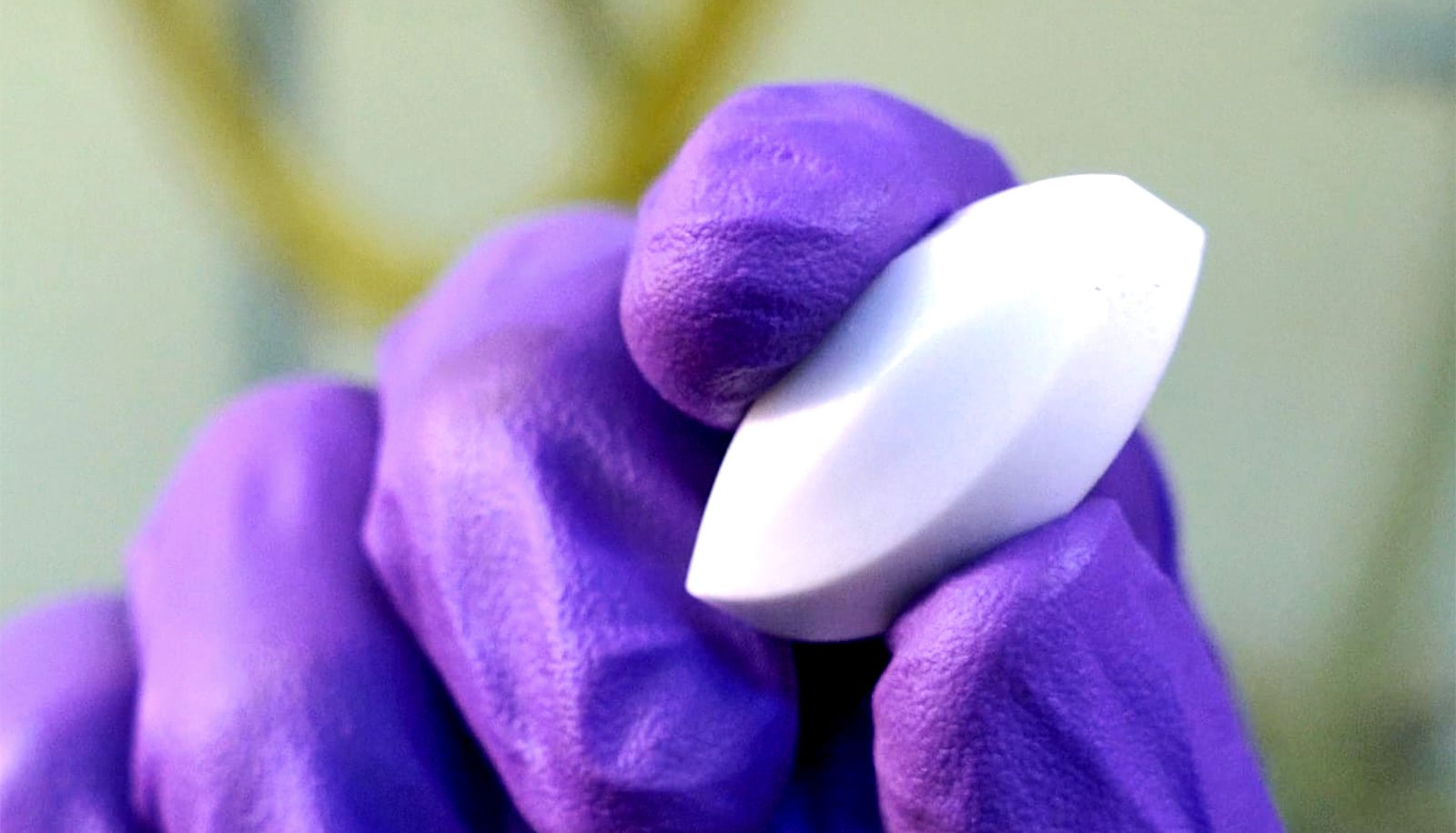
A pristine stir bar made of ferromagnetic metal with a PTFE, or Teflon, coating. chemists discovered the inert bars, which are commonly used to mix chemicals, cause unwanted results during Billups-Birch reactions with carbon and other nanotubes. (Credit: Brandon Martin)

Using the wrong stir bar in a chemistry lab can introduce errors, according to a new study.

Scientists have discovered that stir bars made of PTFE, more commonly known as Teflon, can introduce errors into a standard lab reaction used to manipulate the properties of carbon or boron-nitride nanotubes.

Stir bars are pellet-like rods of ferromagnetic metal covered in PTFE that sit in the bottom of a beaker. A rotating magnetic field turns the stir bars. They allow researchers to mix a solution in a closed flask without manual stirring.

A new paper in ACS Omega outlines what happens when scientists use PTFE stir bars to functionalize nanotubes through Billups-Birch reduction, a long-used reaction that frees electrons to bind with other atoms.

Scientists often use reduction to make nanotubes more amenable to functionalization, the process of customizing them for applications by adding molecules like proteins.

That can be as simple as dispersing nanotubes in a chemical bath laden with the molecules you want to add. Billups-Birch, a one-step process used to functionalize nanotubes with a variety of molecules, is one such method, researchers say. Edward Billups, professor emeritus of chemistry at Rice University, helped develop the method.

When they used it to modify nanotubes of boron-nitride, the researchers were surpised to see their tubes turn gray while the PTFE stir bars turned black. Standard thermogravimetric analysis, usually adequate to see evidence of functionalization, didn’t see anything wrong—but the researchers did.

“Aside from that, we couldn’t get consistent results,” says Angel Martí, an associate professor of chemistry, of bioengineering, and of materials science and nanoengineering.

“Sometimes we would get very high functionalization—or apparent functionalization—and sometimes we wouldn’t. That was really strange.”

They found the lithium in the ammonia-based solvent used in the Billups-Birch reaction was reacting with the white PTFE from the bars, turning them black.

“Because carbon nanotubes are black, it would be easy to believe that nanotubes were depositing on the bars throughout the reaction,” Martí says. “But that’s not what happens. We found that in Billups-Birch conditions, the PTFE reacts.

“Teflon doesn’t generally react with anything,” he says. “That’s why it’s used in stir bars, and in cookware. That’s why it’s also easy to overlook what we saw happening in the lab.”

A search of the literature turned up nothing about avoiding PTFE in Billups-Birch, Marti says. “That was odd, too. Maybe everybody else knows—but just in case we decided to explore the problem. That’s why we decided to write a paper.”

The researchers suspect the unexpected reaction with Teflon is creating radicals that reduce the efficiency of the reaction and that can attack the boron-nitride or carbon nanotubes. In the meantime, their quick solution to the problem is perhaps the simplest.

“Now we use glass-coated stir bars,” Martí says. “Glass is completely inert. That gives us reproducibility and good functionalization.”

The National Science Foundation, the Air Force Office of Scientific Research, and the Welch Foundation supported the research.

Source: Rice University
  • Reusable freeze-dried foam sucks up carbon dioxide
  • Play Video

    Heat turns 4D-printed materials from solid to spongy

    (Credit: Getty Images)

    Flexible, lightweight, 4D-printed materials could lead to better shock absorbers, morphing airplane or drone wings, soft robotics, and tiny implantable biomedical devices, report researchers.

    3D printing, also known as additive manufacturing, turns digital blueprints to physical objects by building them layer by layer. 4D printing is similar to this technology, but with one big difference: it uses special materials and sophisticated designs to print objects that change shape with environmental conditions such as temperature acting as a trigger, says senior author Howon Lee, an assistant professor in the mechanical and aerospace engineering department at Rutgers University. Time is the fourth dimension that allows them to morph into a new shape.

    “We believe this unprecedented interplay of materials science, mechanics, and 3D printing will create a new pathway to a wide range of exciting applications that will improve technology, health, safety, and quality of life,” Lee says.

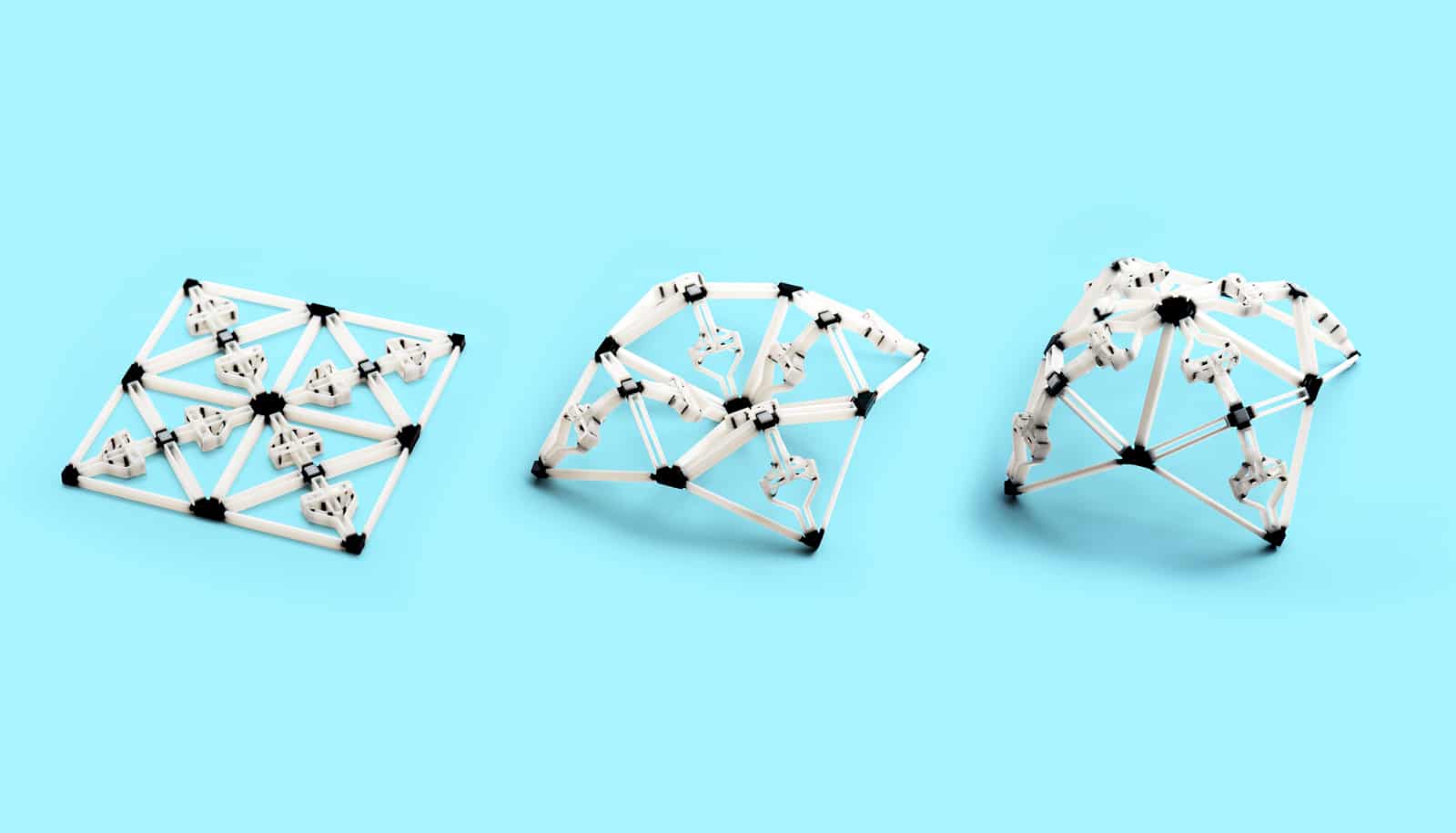
    4D-printed metamaterials can temporarily transform into any deformed shape and then return to their original shape on demand when heated. The scale bar is 2 millimeters. (Credit: Chen Yang/Rutgers)

    The engineers created a new class of “metamaterials”—materials engineered to have unusual and counterintuitive properties. The word metamaterials is derived from the Greek word “meta,” which means “higher” or “beyond.”

    Previously, it wasn’t possible to reverse the shape and properties of metamaterials after manufacturing. But the researchers can tune their plastic-like materials with heat, so they stay rigid when struck or become soft as a sponge to absorb shock.

    The researchers can adjust the stiffness more than 100-fold in temperatures between room temperature (73 degrees) and 194 degrees Fahrenheit, allowing great control of shock absorption. They can also reshape the materials for a wide variety of purposes. The materials can temporarily transform into any deformed shape and then return to their original shape on demand when researchers expose them to heat.

    The materials could be useful in airplane or drone wings that change shape to improve performance, and in lightweight structures that collapse for space launches and reform in space for a larger structure, such as a solar panel.

    Soft robots made of soft, flexible, and rubbery materials inspired by the octopus could have variable flexibility or stiffness that adapt to the environment and task at hand. Tiny medical devices doctors insert or implant in people for diagnosis or treatment could temporarily become soft and flexible for minimally invasive and less painful insertion into the body, Lee says.

    Their research appears in the journal Materials Horizons. Additional coauthors are from Rutgers and the Korea University.

    Source: Rutgers University