Archives

Play Video

190 stumbles could lead to better prosthetic legs

Looking at how people recover from tripping while walking could lead to improved prosthetic legs, say researchers.

Andrés Martínez, a PhD student from Vanderbilt University, strode briskly on the treadmill, staring straight ahead and counting backwards by seven from 898, a trick to keep his brain from anticipating the literal stumbling block heading his way: a compact 35 pounds of steel specifically designed to make him fall.

Special goggles kept him from looking down. Arrows on an eye-level screen kept him from walking off the sides. A harness attached to a ceiling beam kept him safe. Sure enough, when a computer program released the steel block, it glided onto the treadmill, and he struggled to stay on his feet.

“Not only did our treadmill device have to trip them, it had to trip them at specific points in their gait…”

That automatic stumble response, so natural for most people, is virtually impossible for those who use prosthetic legs, simply because even state-of-the-art prosthetics cannot adapt to stumbling. Patients with above-the-knee amputations are far more likely to fall than typical counterparts in their age group.

The first step researchers took in addressing that challenge in lower-body prosthetics was coming to understand the way people with two legs catch themselves, accomplished by covering test subjects with motion-capturing sensors. It also required tripping them over and over—190 times, to be exact. But because humans are so mentally geared to resist stumbling, a team of mechanical engineers first had to design the stumbling device described above.

“Not only did our treadmill device have to trip them, it had to trip them at specific points in their gait,” says Shane King, a PhD student at Vanderbilt University and lead author on the paper in the Journal of NeuroEngineering and Rehabilitation.

“People stumble differently depending on when their foot hits a barrier. The device also had to overcome their fear of falling, so they couldn’t see or feel when the block was coming.”

In addition to protecting test subjects, the harness included a scale. If a subject put 50 percent or more of their weight on it during a stumble, that counted as a fall. The team’s design for the machine and outcomes of their tests are available for other labs to use in the open-source journal.

Michael Goldfarb, professor of mechanical engineering and the principal investigator on the study, says designing the stumble device and measuring outcomes was only the first of three parts.

“So now we understand what the stumble reflex should look like,” he says. “The next phase is to take that information and program it into computer-controlled prosthetic legs. After that, we will safely stumble amputees wearing both commercially available prosthetics and the ones we’ve designed with these reflexes and learn whether ours can prevent more falls.”

The National Institutes of Health funded the work.

Source: Vanderbilt University

Play Video

Prosthetic ‘tripod foot’ offers stability on rough terrain

(Credit: Stanford)

Hiking trails and other rough terrain are especially difficult for people with prosthetic legs. Now, engineers have come up with a more stable option.

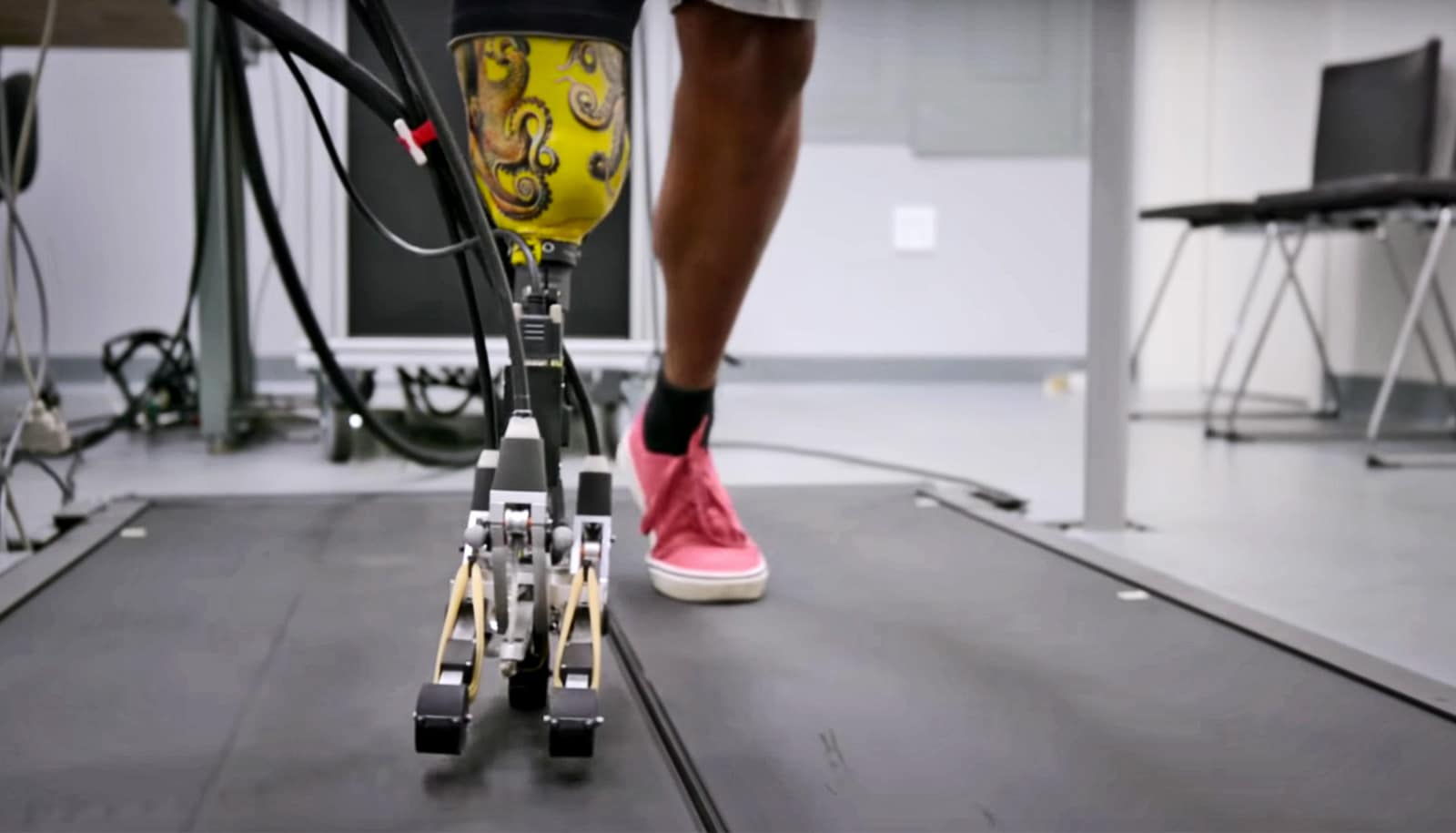
The cornerstone of the new design is a kind of tripod foot that responds to rough terrain by actively shifting pressure among three different contact points. Researchers say the tool they developed for quickly emulating and improving their prototypes is just as important as the foot.

“Prosthetic emulators allow us to try lots of different designs without the overhead of new hardware,” says Steven Collins, an associate professor of mechanical engineering at Stanford University and a member of Stanford Bio-X.

“Basically, we can try any kind of crazy design ideas we might have and see how people respond to them,” he says, without having to build each idea separately, an effort that can take months or years for each different design.

Fall risk

Around half a million people in the United States have lost a lower limb, with effects that go beyond simply making it harder to move around. People with a leg amputation are five times more likely to fall in the course of a year, which may contribute to why they tend to be less socially engaged. A better prosthetic limb could improve mobility and overall quality of life as well.

Making prosthetic limbs that can better handle rough ground particularly interested researchers. Collins, graduate student Vincent Chiu, and postdoctoral researcher Alexandra Voloshina thought a tripod with a rear-facing heel and two forward-facing toes might offer a solution.

Outfitted with position sensors and motors, the foot could adjust its orientation to respond to varying terrain, much as someone with an intact foot could move their toes and flex their ankles to compensate while walking over rough ground.

But the engineers knew that perfecting the design would be tough—even with simple designs, a conventional approach can take years or more. “First you have to come up with an idea and then you prototype it and then you make a nice machined version,” Chiu says. “It could take several years, and most of the time you find out that it doesn’t actually work.”

Heel and toe

The researchers thought they could accelerate the process if they developed an emulator, which flips the design process on its head. Rather than building a prosthetic limb someone could test in the real world, the team instead built a basic tripod foot, then hooked it up to powerful off-board motors and computer systems that control how the foot responds as a user moves over all kinds of terrain.

That approach let them put their design focus on how the prosthesis should function—how hard one toe should push off while walking, how springy the heel should be, and so forth—without having to worry about how to make the device lightweight and inexpensive at the same time.

So far the team has reported results from work with one participant, a 60-year-old man who lost his leg below the knee due to diabetes and the early results are promising—making them hopeful they can take those results and turn them into more capable prosthetics.

“One of the things we’re excited to do is translate what we find in the lab into lightweight and low power and therefore inexpensive devices that can be tested outside the lab,” Collins says. “And if that goes well, we’d like to help make this a product that people can use in everyday life.”

The National Science Foundation funded the work, which appears in IEEE Transactions on Biomedical Engineering.

Source: Stanford University