Archives

  • New tech prints flexible electronics on odd surfaces
  • Play Video

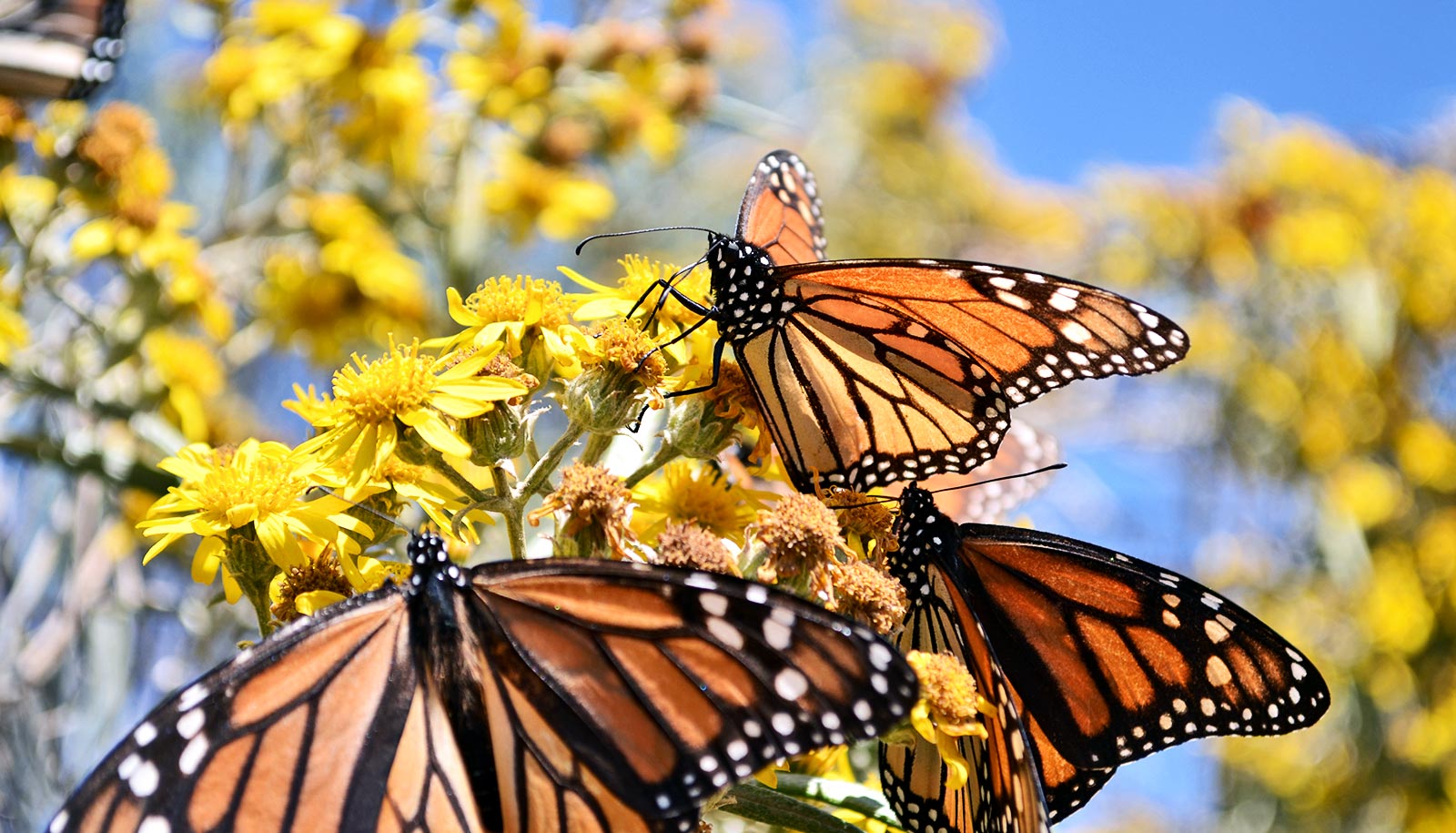
    Monarch butterflies have heat-sensitive ‘timer’ for migration

    Biologist D. André Green holds a monarch butterfly in an outdoor insectary. Green studies monarch migration and the internal timer that tells the butterflies it’s time to wake from winter dormancy and prepare for their springtime journey northward. (Credit: Daryl Marshke/U. Michigan)

    Overwintering monarch butterflies rely on a temperature-sensitive internal timer to wake them up to make the trip back north, researchers report.

    The fact that millions of North American monarch butterflies fly thousands of miles each fall and somehow manage to find the same overwintering sites in central Mexican forests and along the California coast, year after year, is pretty mind-blowing.

    Once they get there, monarchs spend several months in diapause, a hormonally controlled state of dormancy that aids winter survival. Though diapause is not as obviously impressive as the celebrated annual migrations, it holds mysteries that have perplexed scientists who study biological timing.

    D. André Green works inside an outdoor insectary (monarch butterflies concept)
    D. André Green works inside an outdoor insectary at the Matthaei Botanical Gardens in Ann Arbor. (Credit: Daryl Marshke/U. Michigan)

    Weeks before warming temperatures and longer days signal to the monarchs that it’s time to mate and begin spring’s northward migration, an internal timer goes off like an alarm clock to rouse the insects, telling them it’s time to end diapause and prepare for the critical upcoming events.

    Studies in other organisms have shown that cold temperatures can influence the diapause-termination timer, and D. André Green, a postdoctoral fellow in the ecology and evolutionary biology department at the University of Michigan who began the work while at the University of Chicago, suspected the same is true for monarchs. His study at monarch overwintering sites in central California confirmed it, and his gene expression analyses help explain how cold temperature speeds up that internal timer.

    Monarch butterflies in the winter

    “These results are particularly interesting because they address a counterintuitive result: How does cold temperature, which normally slows down an organism’s metabolism and development, speed up diapause? This work is one of the first to provide insights into this question,” says Green,

    The findings have important implications for North America’s monarchs—whose populations have declined steadily for decades at the overwintering sites—as the climate changes, Green and coauthor Marcus Kronforst of the University of Chicago write in a new study in Molecular Ecology.

    “Understanding how diapause dynamics are affected by environmental and anthropogenic factors at their overwintering sites may be critical for understanding North American monarch population decline and guiding future conservation efforts, a point highlighted by the record low number of monarchs recorded in the western North American monarch population in 2018,” Green and Kronforst write.

    The findings also suggest that monarchs will act as an important sentinel species for monitoring environmental change and disturbance at overwintering sites. If diapause ends too early, monarchs may lose some of the protective time the dormancy period provides.

    Speeding up the timer

    Green’s study involved capturing female monarch butterflies at overwintering sites in central California in November 2015, after they entered diapause. The live insects were brought back to the Chicago lab.

    In an environmental chamber there, the researchers exposed butterflies to temperatures and day lengths approximating November in central California: 10 hours of light at 63 degrees Fahrenheit, followed by 14 hours of darkness at 50 degrees.

    In December and again in January, Green’s team returned to the same overwintering sites, live-captured additional female monarchs, and shipped them to the lab. In the wild, those winter-caught butterflies also experienced short days, along with nighttime temperatures that dipped below 50 degrees.

    Green then compared the reproductive maturity of the different groups by counting the number of eggs in each female. An abundance of mature eggs is an indication that the female has terminated diapause, while a paucity of mature eggs indicates that she is still in diapause.

    “The monarchs collected from the wild in December showed increased reproductive development compared to the monarchs that had been in the laboratory since November,” Green says. “This indicated that an environmental condition in the wild—cold temperature—sped up the timer.”

    As part of the same study, Green also analyzed gene expression in the different groups of monarchs to understand how the internal timer works. Results suggest that transient markings on histones—proteins around which DNA winds and that control gene expression—may act as a timing mechanism.

    The results also show that calcium signaling in the butterfly’s head is key, potentially linking the accumulation of cryoprotectants during cold weather to the internal timer.

    The National Science Foundation, the US Fish and Wildlife Service, and National Institutes of Health supported the study. Researchers collected wild monarchs on private property near Pismo Beach, California with permission of the landowners.

    Source: University of Michigan
    Play Video

    Satellite tracking puts duck migration on the map

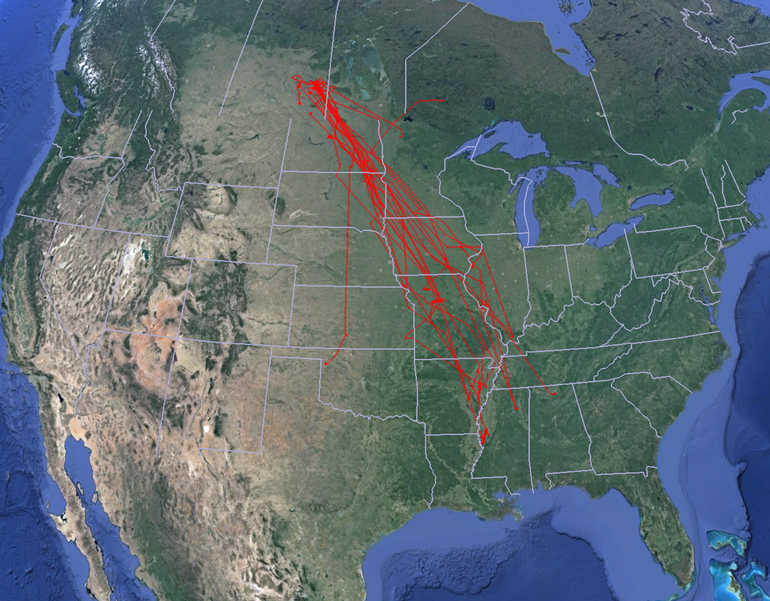
    Researchers have used satellite tracking technology to monitor Mallard duck migration from Canada to the American Midwest and back again.

    Their findings show that 2011-2012 migrations extensively used public and private wetland conservation areas.

    Scientists now have baseline information for future research into what influences the ducks’ migration flight paths, landing site selection, and foraging behavior. The data will also be useful to conservationists looking for ways to ensure healthy duck populations into the future.

    The research shows private lands enrolled in the USDA’s Wetland Reserve Program (WRP) have become a critical component of the ducks’ migrations, says Lisa Webb, cooperative assistant professor of wildlife at University of Missouri and research ecologist with the USGS Cooperative Research Unit. The WRP provides landowners with technical and financial support for restoring and maintaining wetland areas that have conservation benefits.

    Migratory ducks also use sanctuaries on public areas, such as state wildlife management areas and the National Wildlife Refuge System extensively.

    duck with tracking device on its back
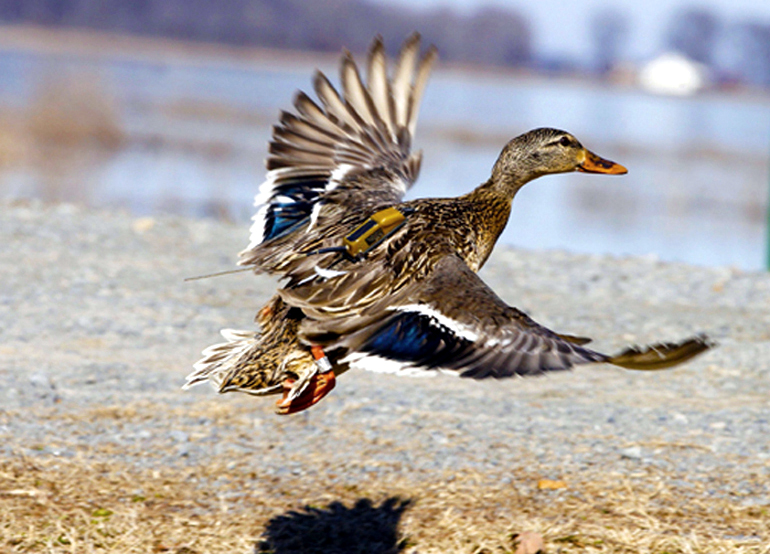
    A mallard with a tracking device on its back lands on a Missouri wetland. (Credit: Mike Wintroath/Arkansas Game and Fish Commission)

    Tracking ducks from orbit

    The project attached small solar-powered tracking devices to the ducks, which transmitted their locations every 4 hours. Data  bounced off a satellite and then went to the researchers who monitored the ducks’ progress in real time.

    [related]

    “This allowed us to evaluate their behavior and biology on an exceptionally detailed scale throughout their annual migration cycle,” says Dylan Kesler, co-investigator and assistant professor of fisheries and wildlife.

    “Previously, we only knew when the birds left and when they arrived and little else. Now, we have an extensive dataset from which to understand the role of different habitats and other factors in migratory populations. We can begin to understand migration in a way that it has never been understood before.”

    Kesler points out that scientists also now know more about the pre-migratory feeding habits of the ducks. The ducks’ ability to gain weight before their long flights is an important factor in how many will make it to their northern breeding grounds and southern wintering stations.

    Identifying ways to support duck populations is important because more than 50 percent of American wetlands have been lost since 1800, says Kesler. This loss has affected migratory bird populations and migration timing and routes, he says.

    map showing Mallard duck migration
    The satellite tracker followed the ducks from Canada to Mississippi. This is the first time that this data has been captured. (Credit: U. Missouri)

    The mallard is probably the most familiar and abundant duck in North America. The male has a green head and chestnut breast while females are mottled brown. Both sexes have a blue speculum (wing patch) bordered on both sides by white.

    The mallard nests in the spring throughout Canada and northern US, with eggs hatching in April and May. They migrate to a winter home in the Midwestern and southern US in September and October. They take off back to Canada in February and March.

    The National Wildlife Refuge System is the largest protected area network in North America specifically designated for wildlife conservation and includes more than 150 million acres stretching from Alaska to the Caribbean.

    The program is designed to maintain wetlands and other wildlife habitat in areas where surrounding lands have been converted to golf courses, cities, and agriculture.

    Better conservation areas

    The new dataset is so extensive that William Beatty, postdoctoral fellow of University of Missouri Fisheries and Wildlife Sciences, is using the information as the basis for a computer model to understand future migrations and the effect that human populations, physical obstructions, agriculture, and conservation areas may have on migratory bird populations.

    The satellite tracking data showed the researchers something not known until now—during their migrations ducks forage for food up to 20 miles away from their roosting areas. Beatty says this discovery shows how the conservation areas being used by the ducks can be improved.

    He recommends establishing multiple types of conservation areas in selected locations to promote wetland habitat diversity to give birds a variety of food choices.

    “The role of habitat conditions during the non-breeding season—fall migration, winter and spring migration—is not fully understood,” Webb says.

    “Now that scientists and conservationists better understand which habitat features are important to mallards during the non-breeding season, we can begin to consider how results may help conservation agencies as they decide where to restore new wetland habitat for waterfowl.”

    The research results appear in Biological Conservation.

    Source: University of Missouri