Archives

Play Video

Why glue isn’t proof of Neanderthal smarts

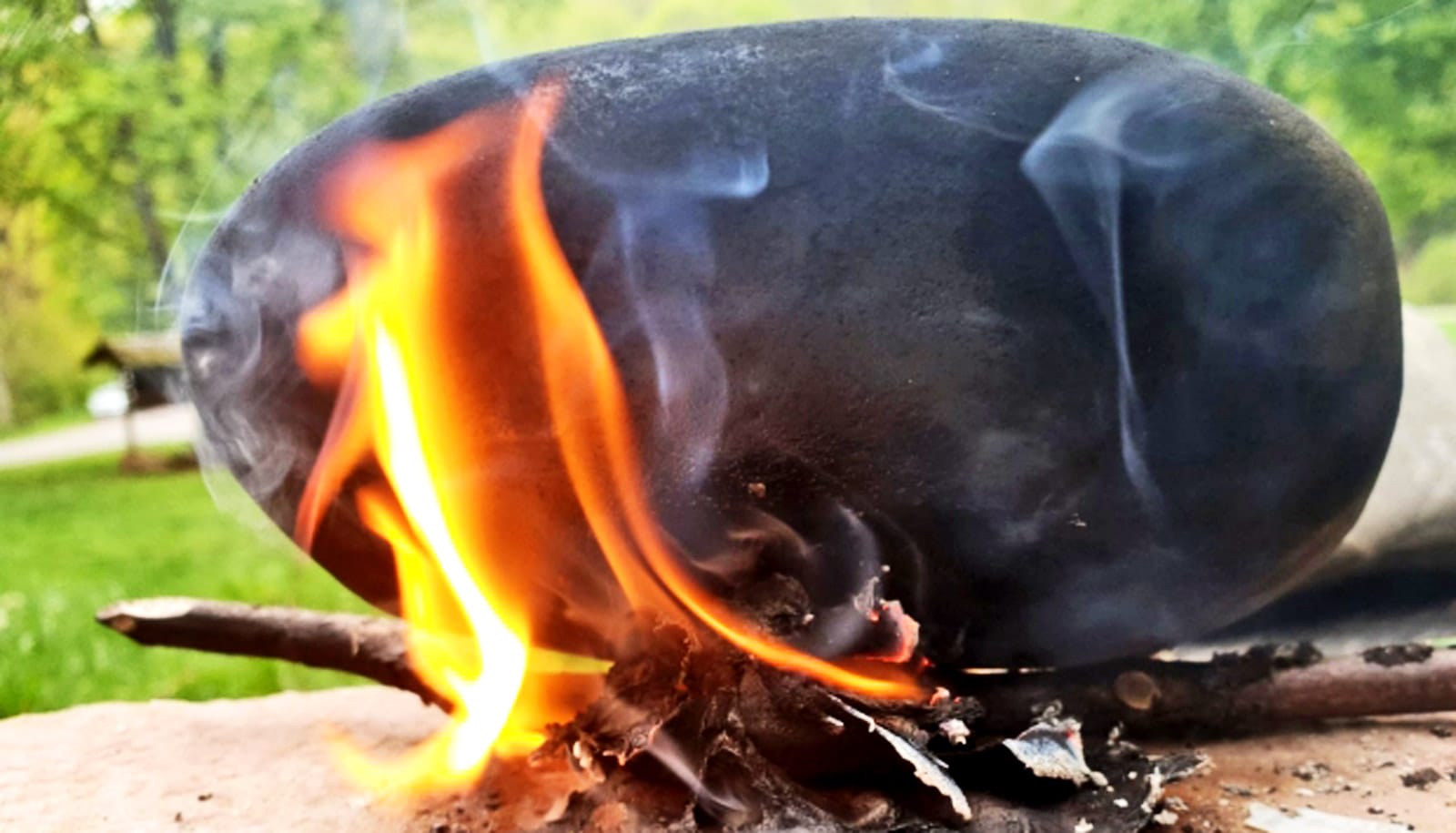
This is an experimental set-up for the production of birch tar. Researchers burned birch bark near flat surfaces that Neanderthals would have used. (Credit: Matthias Blessing/U. Tübingen)

The discovery that it’s actually quite simple to make glue from birch bark debunks a bit of evidence for the cognitive and cultural achievement of Neanderthals.

Neanderthals and other early humans produced a tarry glue from birch bark. Researchers had long believed that birch tar—which the Neanderthals used to make tools—required the complex work of heating the bark in the absence of air.

“Our paper challenges common beliefs that the presence of birch tar in Neanderthal archaeological assemblages means they had sophisticated cognitive abilities,” says coauthor Radu Iovita, a paleoanthropologist and Paleolithic archaeologist in the New York University anthropology department and a member of the faculty of the department of early prehistory and quaternary ecology at the University of Tübingen in Germany.

Prior researchers had experimented with pits, clay structures, ash mounds, and metal and ceramic vessels as means to heat the bark in the absence of oxygen.

Instead, this research team experimented with ordinary materials available in the Stone Age. They collected cut fresh birch bark or dead bark in the forest and burned it near flat river stones. After three hours, the process yielded a usable amount of a black sticky material. They could easily scrape the tar off the surface of the stones.

Its molecular characteristics were similar to archaeological samples from Neanderthal sites and, more important, it formed a stronger glue than tar produced in more complex oxygen-free processes.

The team used their adhesive to make a wood-scraping tool and turned to a robot that used force-control technology that researchers Ludovic Righetti and Johannes Pfleging developed.

tool (flat object set into piece of wood) presses against flat block of wood at an angle
A robot used force-control technology to test the adhesive by scraping a block of wood 170 times. (Credit: Johannes Pfleging/NYU Tandon)

Their robot arm dragged the tool with a precision that humans cannot emulate over 170 strokes. The approach also allowed the researchers to measure the effects with precision: The tool showed no weakening of the adhesive bond.

In another test, the researchers used the adhesive to stick a stone scraper to a wooden handle, as the Neanderthals had done. Iovita was able to scrape the tough outer membrane from the thigh bone of a calf.

The researchers say this method of making birch tar is so simple that early humans could have easily discovered it by accident in the course of their everyday activities. The production and use of birch tar can therefore no longer serve as an indicator of modern or complex behavior.

The findings appear in the Proceedings of the National Academy of Sciences. Righetti is an associate professor at NYU Tandon School of Engineering and a senior researcher at the Max-Planck Institute for Intelligent Systems in Tübingen. Pfleging is a visiting scholar of anthropology at NYU and a doctoral student in robotics at ETH Zürich in Switzerland.

Source: NYU

Play Video

Neanderthal used toothpicks for painful teeth

Researchers have found signs of dental manipulations and multiple toothpick grooves on the teeth of a 130,000-year-old Neanderthal, evidence of a kind of “prehistoric dentistry.”

“As a package, this fits together as a dental problem that the Neanderthal was having and was trying to presumably treat itself, with the toothpick grooves, the breaks, and also with the scratches on the premolar,” says David Frayer, a professor of anthropology at the University of Kansas.

“It fits into a pattern of a Neanderthal being able to modify its personal environment by using tools…”

“It was an interesting connection or collection of phenomena that fit together in a way that we would expect a modern human to do. Everybody has had dental pain, and they know what it’s like to have a problem with an impacted tooth,” he says.

The researchers analyzed four isolated but associated mandibular teeth on the left side of the Neanderthal’s mouth.

The teeth were found at Krapina site in Croatia, and Frayer and Davorka Radovčić, curator at the Croatian Natural History Museum, have made several discoveries about Neanderthal life there, including a widely recognized 2015 study about a set of eagle talons that included cut marks and were fashioned into a piece of jewelry.

The teeth and all the Krapina Neanderthal fossils were discovered more than 100 years ago from the site, which was originally excavated between 1899-1905. However, Frayer and Radovčić in recent years have re-examined many items collected from the site.

In this case, they analyzed the teeth with a light microscope to document occlusal wear, toothpick groove formation, dentin scratches, and antemortem, lingual enamel fractures.

Even though the teeth were isolated, previous researchers were able to reconstruct their order and location in the male or female Neanderthal’s mouth. Frayer says researchers have not recovered the mandible to look for evidence of periodontal disease, but the scratches and grooves on the teeth indicate they were likely causing irritation and discomfort for some time for this individual.

They found the premolar and M3 molar were pushed out of their normal positions. Associated with that, they found six toothpick grooves among those two teeth and the two molars farther behind them.

“The scratches indicate this individual was pushing something into his or her mouth to get at that twisted premolar,” Frayer says.

Teeth alter date of grassy diet for pre-humans

The features of the premolar and third molar are associated with several kinds of dental manipulations, he says. Mostly because the chips of the teeth were on the tongue side of the teeth and at different angles, the researchers ruled out that something happened to the teeth after the Neanderthal died.

Past research in the fossil record has identified toothpick grooves going back almost 2 million years, Frayer says. They did not identify what the Neanderthal would have used to produce the toothpick grooves, but it possibly could have been a bone or stem of grass.

“It’s maybe not surprising that a Neanderthal did this, but as far as I know, there’s no specimen that combines all of this together into a pattern that would indicate he or she was trying to presumably self-treat this eruption problem,” he says.

The evidence from the toothpick marks and dental manipulations is also interesting in light of the discovery of the Krapina Neanderthals’ ability to fashion eagle talons into jewelry because people often think of Neanderthals as having “subhuman” abilities.

Prehistoric teeth offer early evidence for right-handedness

“It fits into a pattern of a Neanderthal being able to modify its personal environment by using tools,” Frayer says, “because the toothpick grooves, whether they are made by bones or grass stems or who knows what, the scratches and chips in the teeth, they show us that Neanderthals were doing something inside their mouths to treat the dental irritation. Or at least this one was.”

Additional coauthors are dentist Joseph Gatti and Janet Monge of the University of Pennsylvania.

The study appears in the Bulletin of the International Association for Paleodontology.

Source: University of Kansas