Archives

  • How smallpox changed the face of public health
  • Play Video

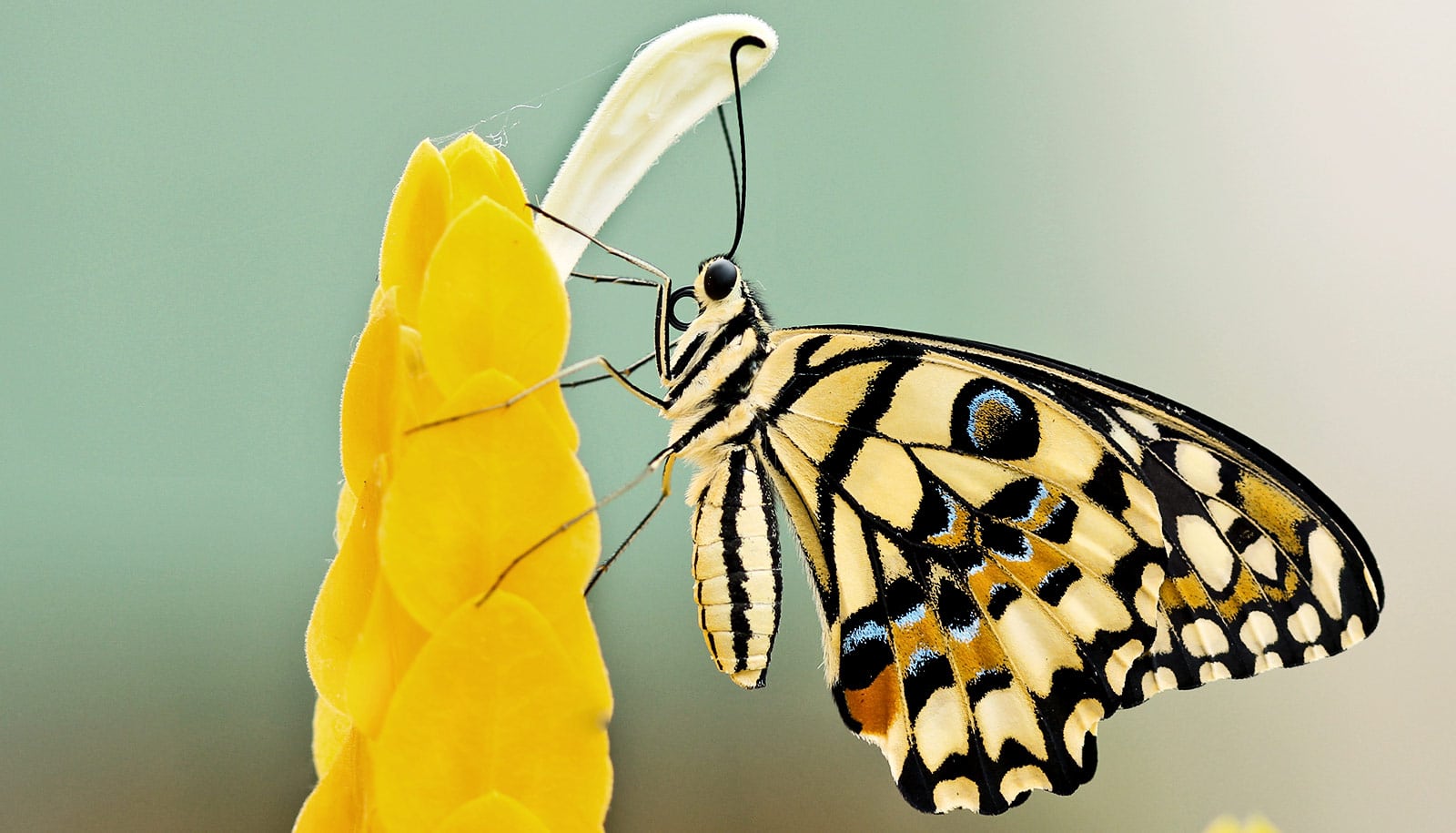
    Team cracks butterfly wing color mystery

    (Credit: pahrkm/Flickr)

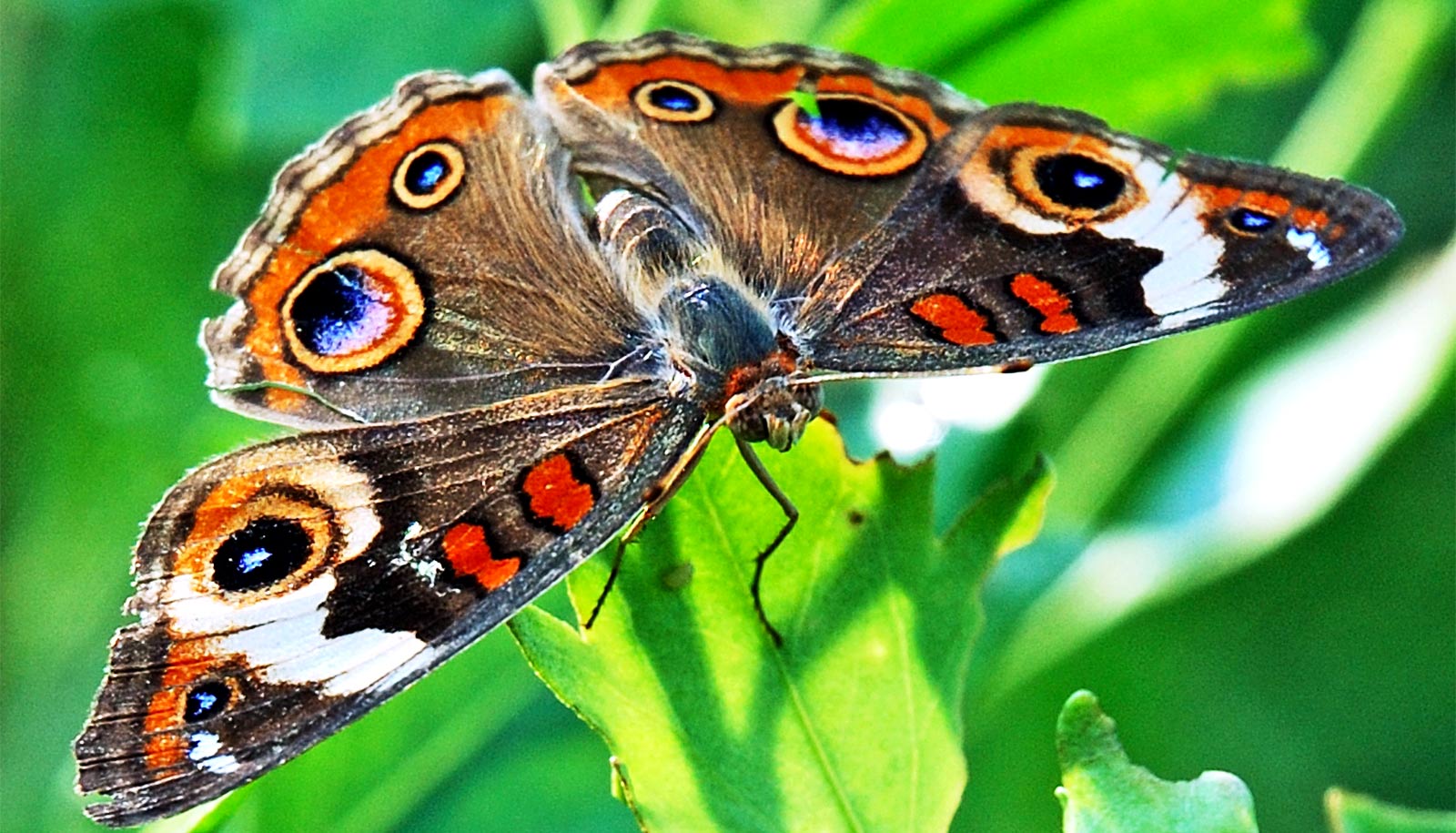
    Some butterflies can create a rainbow of structural colors by merely tuning the thickness of their wing scale’s bottom layer (the lamina), which creates iridescent colors just like soap bubbles, researchers report.

    When a team of biologists happened upon a Florida breeder’s buckeye butterflies—which are usually brown—sporting brilliant blue wings, they jumped on the chance to explore what caused the change in color.

    They compared the structural architecture of blue scales with wild-type brown scales and found that only the thickness of the lamina differed, and this pattern held across a comparative study of nine different species of Junonia.

    The team says understanding the simple change in thickness of the butterfly’s lamina is helping them recognize how butterfly wing color is created and evolves.

    Future research into how butterflies produce photonic nanostructures with optical properties could help engineers develop new ways to produce photonic nanostructures for solar panels or iridescent colors for paints, clothing, and cosmetics.

    Researchers from UC Berkeley and the Marine Biological Laboratory contributed to the work. Funding for the work came from the National Science Foundation.

    Source: National Science Foundation

    Play Video

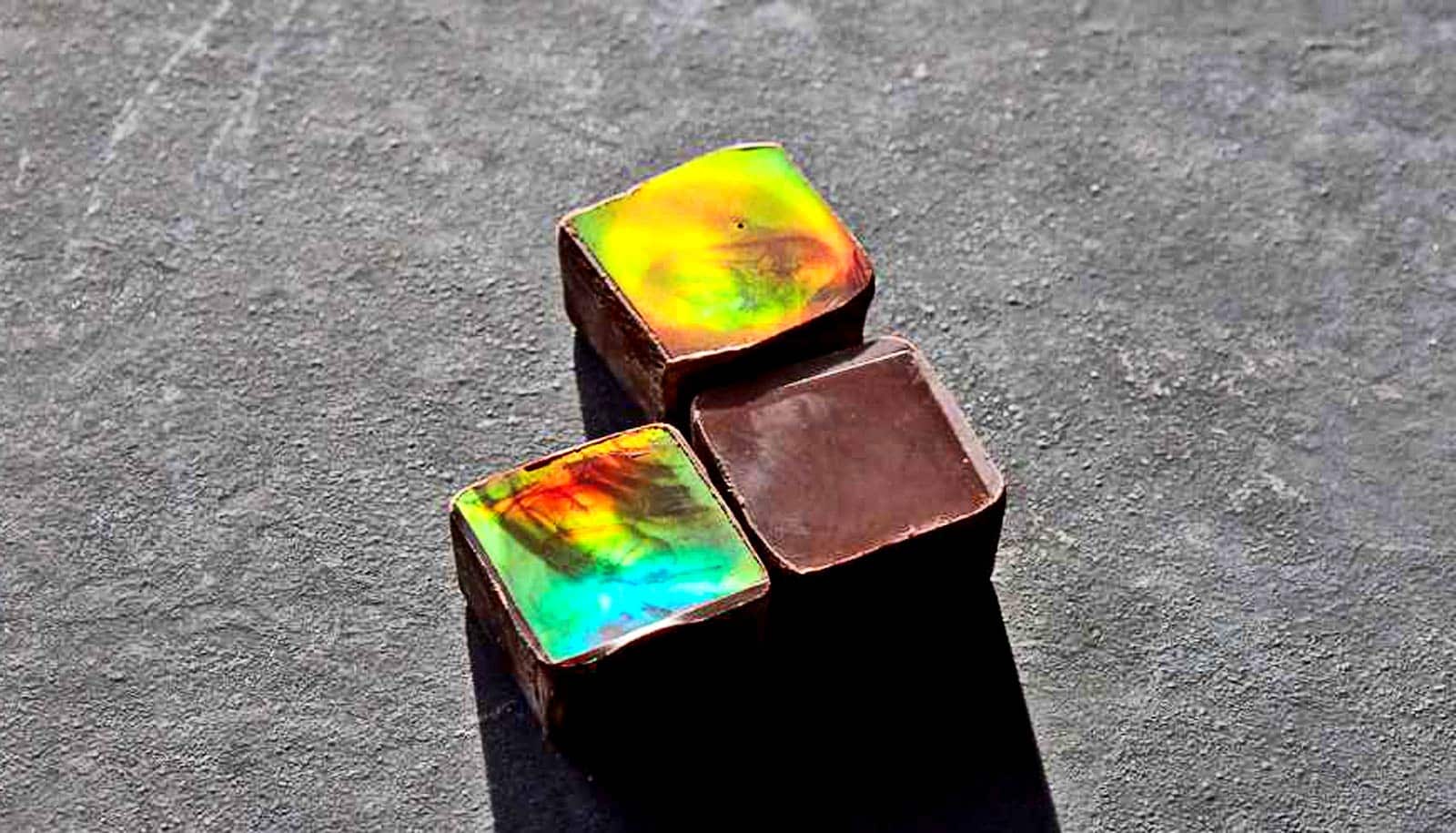
    Imprint gives chocolate a rainbow shimmer

    (Credit: Giulia Marthaler/ETH Zurich)

    Researchers have made shimmering rainbow chocolates without any colorings.

    They created a targeted color effect by imprinting a special structure on the surface of the chocolate.

    There are traditional methods for coloring chocolate, but the researchers achieved the rainbow effect with what the scientists call structural color. The process is similar to a chameleon, whose skin surface modulates and disperses light to display specific colors.

    Food scientist Patrick Rühs, materials scientist Etienne Jeoffroy, and the physicist Henning Galinski were talking about chocolate over coffee. They wondered how—and whether—it might be possible to make colored chocolate. Rühs is studying the material properties of food; Jeoffroy specializes in complex materials; and Galinski has already done in-depth research into optical materials.

    The researchers started by documenting the properties of chocolate to understand what is special about the material and why it is brown.

    First, they experimented with structural colors based on edible coatings of gold and titanium oxide. Depending on the thickness of the titanium coating, golden yellow or deep blue colors appear on the dark chocolate. Even so, the researchers rejected that method, as the production process would be too complex and coating the chocolate, whose melting point is 31°C, would be tricky and time consuming. They concluded that it must also be possible to find a solution without additives.

    The researchers decided to change course: to make an impression on the surface, rather than use a coating. The breakthrough came with the help of materials science student Anita Zingg, who was testing the new technique as part of her master’s project. After a few attempts, it works: an initial colorful shimmer appeared on the chocolate. The scientists refined the method, and the shimmer became a glow.

    Now, colleagues at FHNW University of Applied Sciences and Arts Northwestern Switzerland are developing a mold to make it possible to imprint more than one chocolate at a time with a structural color. The group has applied for a patent. The scientists are in discussions with major chocolate producers and plan to establish a spin-off company soon.

    Source: Michael Walther for ETH Zurich