Archives

Play Video

‘Invincible’ material could light up soft robots

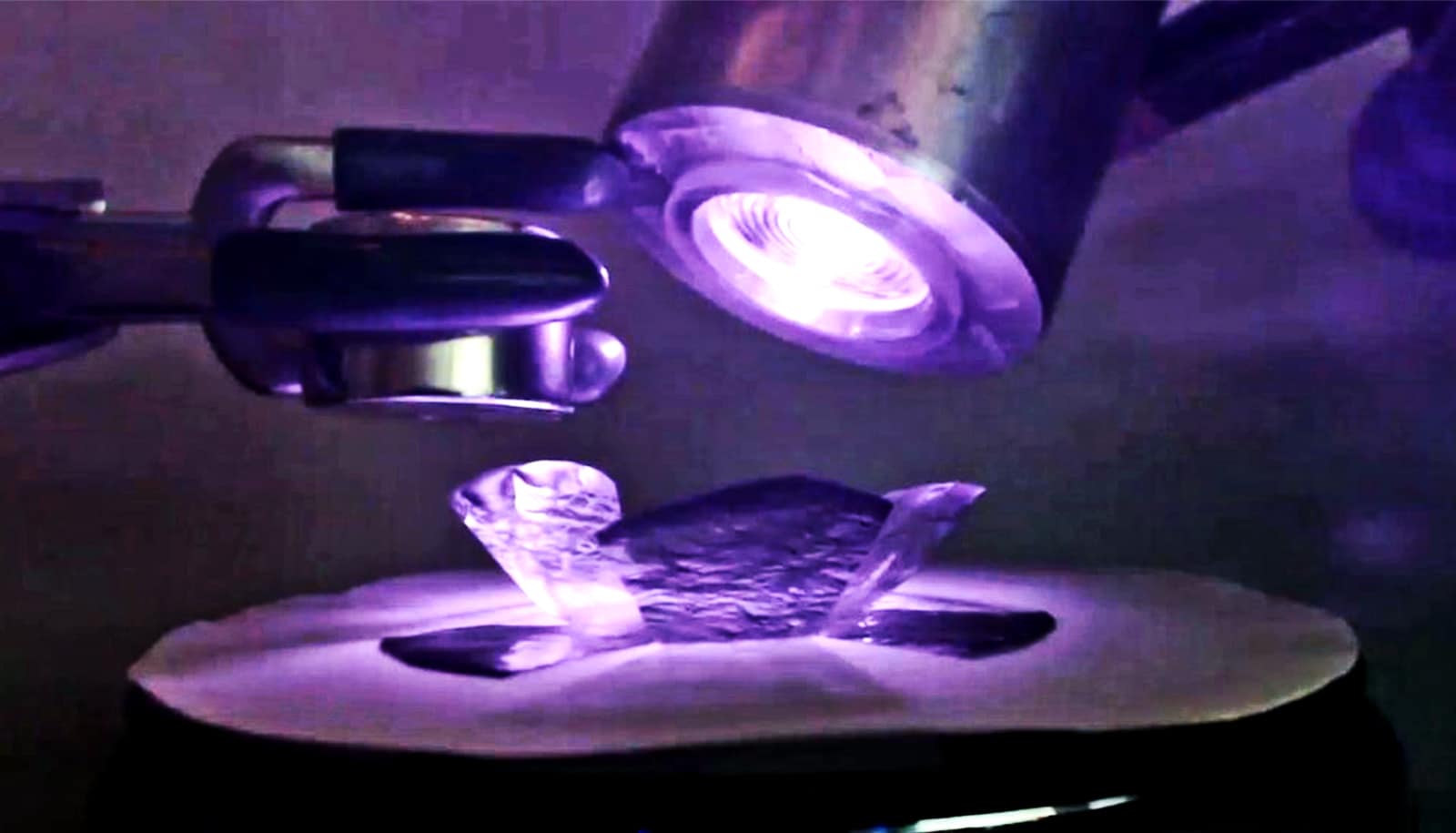
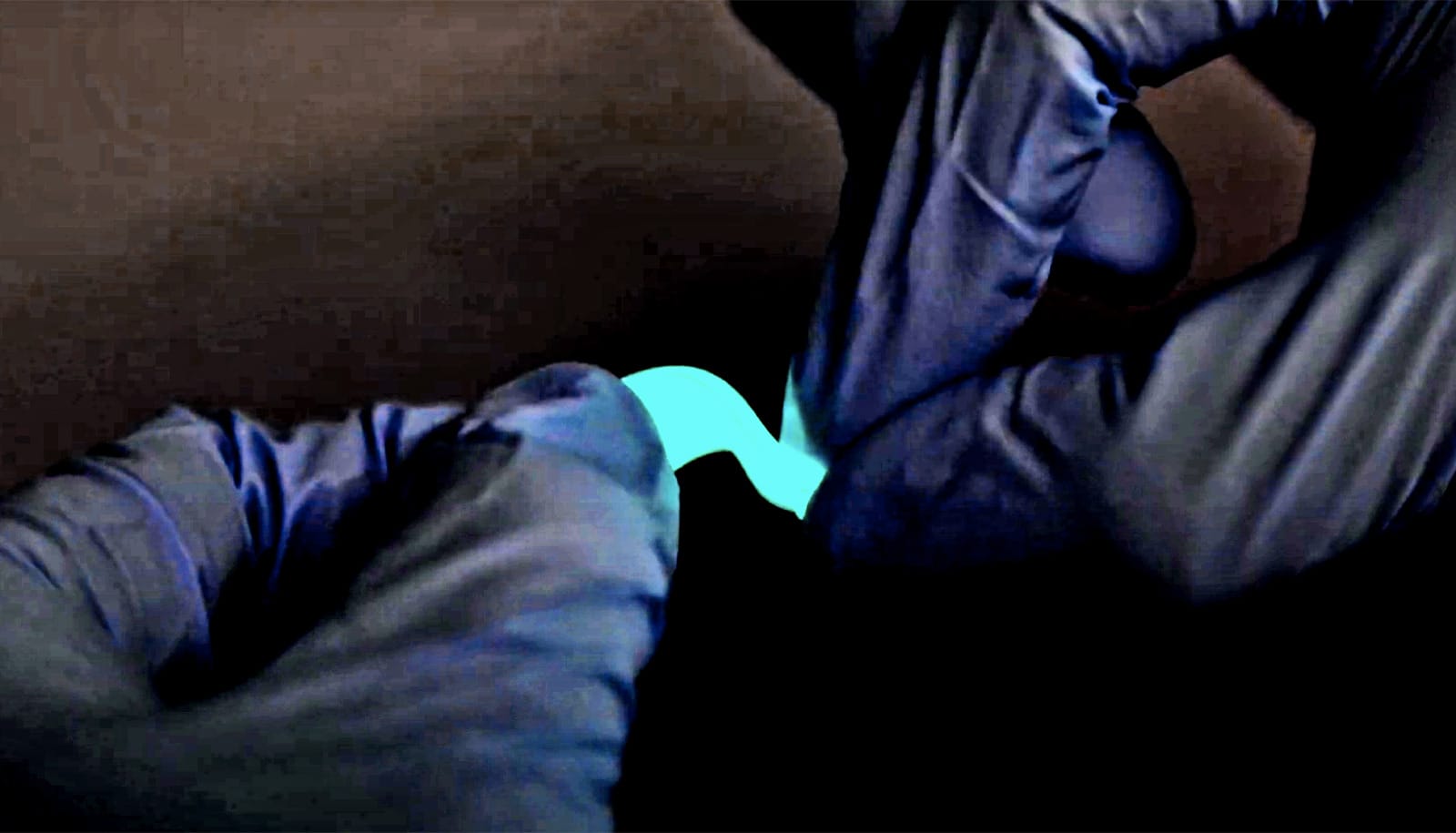
A research twists a piece of the HELIOS material that's glowing blue in the dark. (Credit: NUS)

A new stretchy material called HELIOS could pave the way for flexible digital screens that heal cracks or light-emitting robots that locate survivors in dark, dangerous environments, researchers report.

In light-emitting capacitor devices, the material enables highly visible illumination at much lower voltages than other similar materials. The HELIOS (which stands for Healable, Low-field Illuminating Optoelectronic Stretchable) material is also resilient to damage due to its self-healing properties.

“Conventional stretchable optoelectronic materials require high voltage and high frequencies to achieve visible brightness, which limits portability and operating lifetimes. Such materials are also difficult to apply safely and quietly on human-machine interfaces,” says Benjamin Tee, assistant professor in the National University of Singapore’s Institute for Health Innovation & Technology and NUS Materials Science and Engineering.

To overcome these challenges, the researchers began studying and experimenting with possible solutions in 2018, and eventually developed HELIOS after a year.

In order to lower the electronic operating conditions of stretchable optoelectronic materials, the researchers developed a material with very high dielectric permittivity and self-healing properties. The material is a transparent, elastic rubber sheet made up of a unique blend of fluoroelastomer and surfactant. The high dielectric permittivity enables it to store more electronic charges at lower voltages, enabling a higher brightness in a light-emitting capacitor device.

Unlike existing stretchable light-emitting capacitors, HELIOS-enabled devices can turn on at voltages that are four times lower, and achieve illumination that is more than 20 times brighter.

It also achieved the brightest illumination that stretchable light-emitting capacitors have attained to date and comparable to the brightness of mobile phone screens. Due to the low power consumption, HELIOS can achieve a longer operating lifetime, is safe for use in human-machine interfaces, and can get power wirelessly to improve portability.

HELIOS is also resistant to tears and punctures. The reversible bonds between the molecules of the material can be broken and reformed, thereby allowing the material to self-heal under ambient environmental conditions.

“Light is an essential mode of communication between humans and machines. As humans become increasingly dependent on machines and robots, there is huge value in using HELIOS to create ‘invincible’ light-emitting devices or displays that are not only durable but also energy-efficient,” says Tee.

“This could generate long-term cost savings for manufacturers and consumers, reduce electronic waste and energy consumption, and, in turn, enable advanced display technologies to become both wallet and environmentally friendly.”

For example, HELIOS could be used to fabricate long-lasting wireless displays that are damage-proof.

It could also function as an illuminating electronic skin for autonomous soft robots to be deployed for smart indoor farming, space missions, or disaster zones. Having a low-power, self-repairing illuminating skin will provide safety lighting for the robot to maneuver in the dark while remaining operational for prolonged periods.

The researchers have filed for a patent for the new material. They’re looking to scale up the technology for specialty packaging, safety lights, wearable devices, and automotive and robotics applications.

The research appears in Nature Materials.

Source: National University of Singapore

Play Video

‘Balloon art’ soft robot doesn’t need to plug in

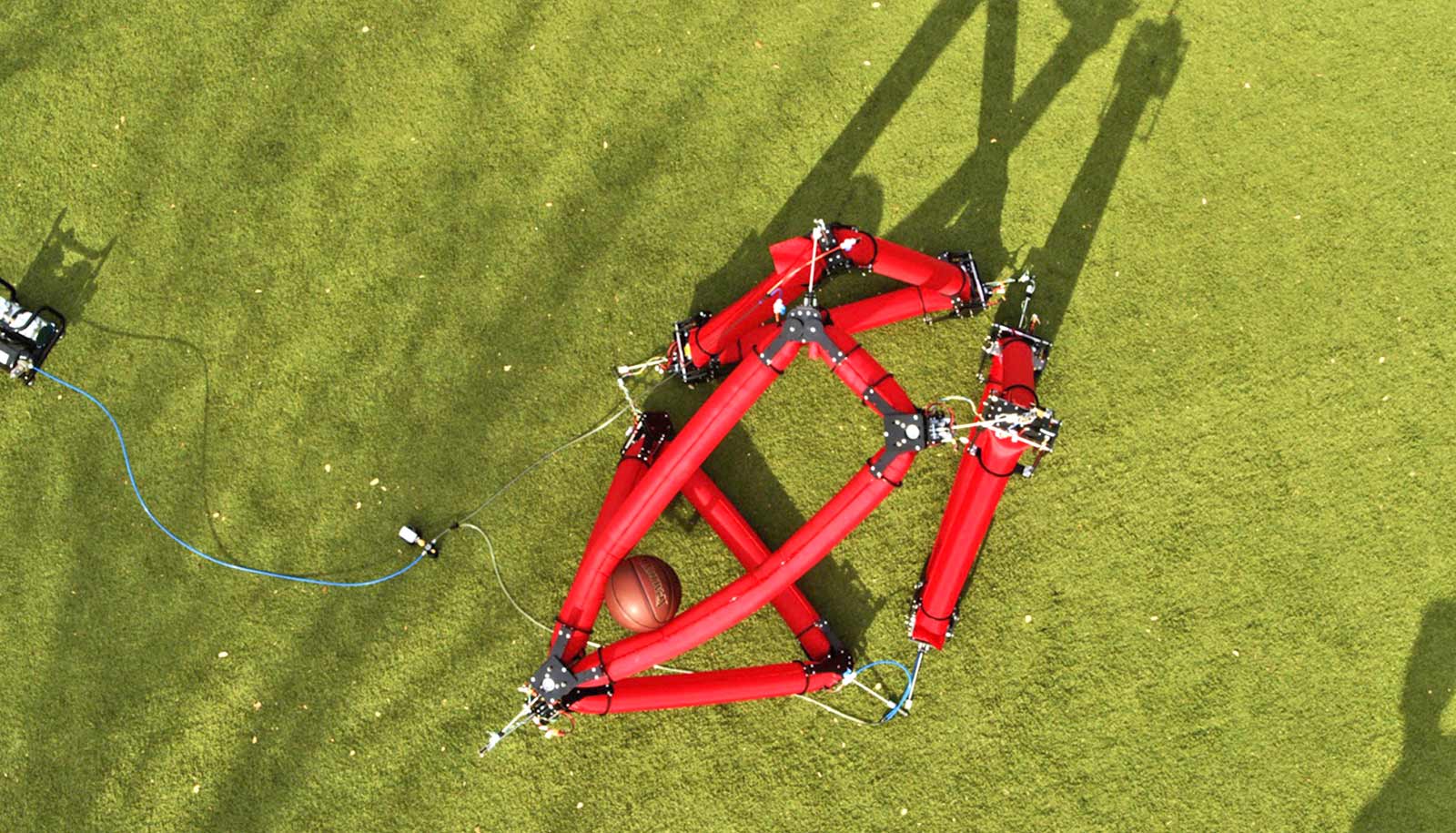
Overhead view of the isoperimetric robot grasping and handling a basketball. (Credit: Farrin Abbott/Stanford)

A pneumatic, shape-changing soft robot can navigate its environment without requiring a tether to a stationary power source, report researchers.

It’s like balloon art on steroids.

It’s also a major step in the effort to bring soft robots to human environments, where their characteristics are uniquely suited for interaction with and around people.

“…the robot is actually a collective of individual robotic rollers, which work together to move the robot and change its shape.”

“The main challenge that we’re trying to address is to make a human-scale soft robot,” says mechanical engineering professor Elliot Hawkes of the University of California, Santa Barbara. The work appears in the journal Science Robotics.

Most soft robots to date tend to be small, and often tether to the wall for power or compressed air, he explains. But what if they could create a soft robot large enough and strong enough to perform human-scale interactions and independent enough to navigate diverse, unstructured environments, such as disaster zones?

Enter the isoperimetric soft robot, a roughly four-foot-tall pneumatic robot that can move by deforming its soft, air-filled fabric tubes—while keeping its perimeter constant.

“The idea is that you can change the shape of the soft robot by using simple motors that drive along the tubes, instead of using the slow, inefficient pumps that are normally used,” says Hawkes, who conducted research for this paper while at Stanford University.

“The casual description of this robot that I give to people is Baymax from the movie Big Hero 6 mixed with Transformers. In other words, a soft, human-safe robot mixed with robots that can dramatically change their shape,” says Nathan Usevitch, a graduate student in mechanical engineering at Stanford.

Three kinds of robotics in one

The isoperimetric robot is actually a combination of concepts from three distinct robotic areas—soft robotics, truss robots, and collective robots—that together create new capabilities. The soft fabric tubes allow the robot to traverse irregular surfaces and deform as needed, and are light while being strong. The motors also can connect to each other via three-degree-of-freedom universal joints to create truss-like structures that can support weight and allow locomotion in three dimensions. And the motor “nodes” that allow the tubes to bend are themselves small, simple collective robots that together roll along the fabric tube and pinch to form joints of varying angles.

Perhaps the most notable thing about the robot is that it doesn’t require inflation and deflation to move, doing away with the need for a connection to an external, stationary source of air or an unwieldy, bulky onboard pump. The motors are powered by small batteries.

“We were looking at ways to make it untethered, and we realized that we didn’t need to pump air in and out; what we really needed to do was to move the air around,” Hawkes says. This was, in fact, one of the group’s major design challenges.

“It turns out that when you have air, even at relatively low pressure, there are huge forces that it applies,” he says, so much of the engineering actually went into creating the nodes that roll along the tube and pinch to create joints. The advantage here, Hawkes adds, is that the robot’s operation is quicker and more seamless than it would be if it had to inflate and deflate in the process.

“What’s exciting to me is that the robot is actually a collective of individual robotic rollers, which work together to move the robot and change its shape,” says Mac Schwager, assistant professor of aeronautics and astronautics and Stanford and coauthor of the paper. “This helps make it an adaptable and robust system.”

What could this sort of soft robot do?

The researchers envision many uses for this type of robot. In a collapsed building scenario, for instance, it could crawl flat into tight spaces and reconfigure into a three-dimensional truss to create space and support weight. For planetary exploration, it packs light and can navigate uncertain terrain. It can pick up and even manipulate loads, and its soft nature allows it to work alongside humans. Its simple, modular construction allows students and other robot-builders to create a variety of their own robots in different shapes for diverse purposes.

Taken together, the robot’s size, freedom of movement, strength, and utility in real-world scenarios represent the type of focus that Hawkes and his group think will be beneficial. Soft robot research is new and exciting, Hawkes says, and it’s taking off.

“But as a field, we need to think critically about what contributions each research project offers, what problems it solves, or how it advances the field,” he says, “as opposed to just making another cool gizmo.”

Other contributors to the work are from Stanford.

Source: UC Santa Barbara, Stanford

Play Video

New material offers lots of perks to soft robots

A new process called "graphene oxide-enabled templating synthesis" creates the new material for use in soft robots. (Credit: NUS)

Researchers have created a new metal-based material for use in soft robots.

“Origami robots” are state-of-the-art soft, flexible robots that could find use in drug delivery in human bodies, search and rescue missions in disaster environments, and humanoid robotic arms.

Because these robots need to be flexible, they are often made from soft materials such as paper, plastic, and rubber. To be functional, sensors and electrical components are often added on top, but these add bulk to the devices.

Combining metals such as platinum with burned paper (ash), the new material has enhanced capabilities while maintaining the foldability and lightweight features of traditional paper and plastic. In fact, the new material is half as light as paper, which also makes it more power efficient.

Prosthetics and soft robots

These characteristics make the new material a strong candidate for making flexible and light prosthetic limbs which can be as much as 60% lighter than their conventional counterparts. Such prosthetics can provide real-time strain sensing to give feedback on how much they are flexing, giving users finer control and immediate information—all without the need for external sensors which would otherwise add unwanted weight to the prosthetic.

This lightweight metallic backbone is at least three times lighter than conventional materials used in the fabrication of origami robots. It is also more power-efficient, enabling origami robots to work faster using 30% less energy. The new material is also fire-resistant, making it suitable for use in robots that work in harsh environments. The new material can withstand burning at about 800 C (1,472 F) for up to 5 minutes.

In addition, the conductive material has geothermal heating capabilities on-demand—sending a voltage through the material causes it to heat up, which helps to prevent icing damage when a robot works in a cold environment. These properties could help create light, flexible search-and-rescue robots that can enter hazardous areas while providing real-time feedback and communication.

How they made the new material

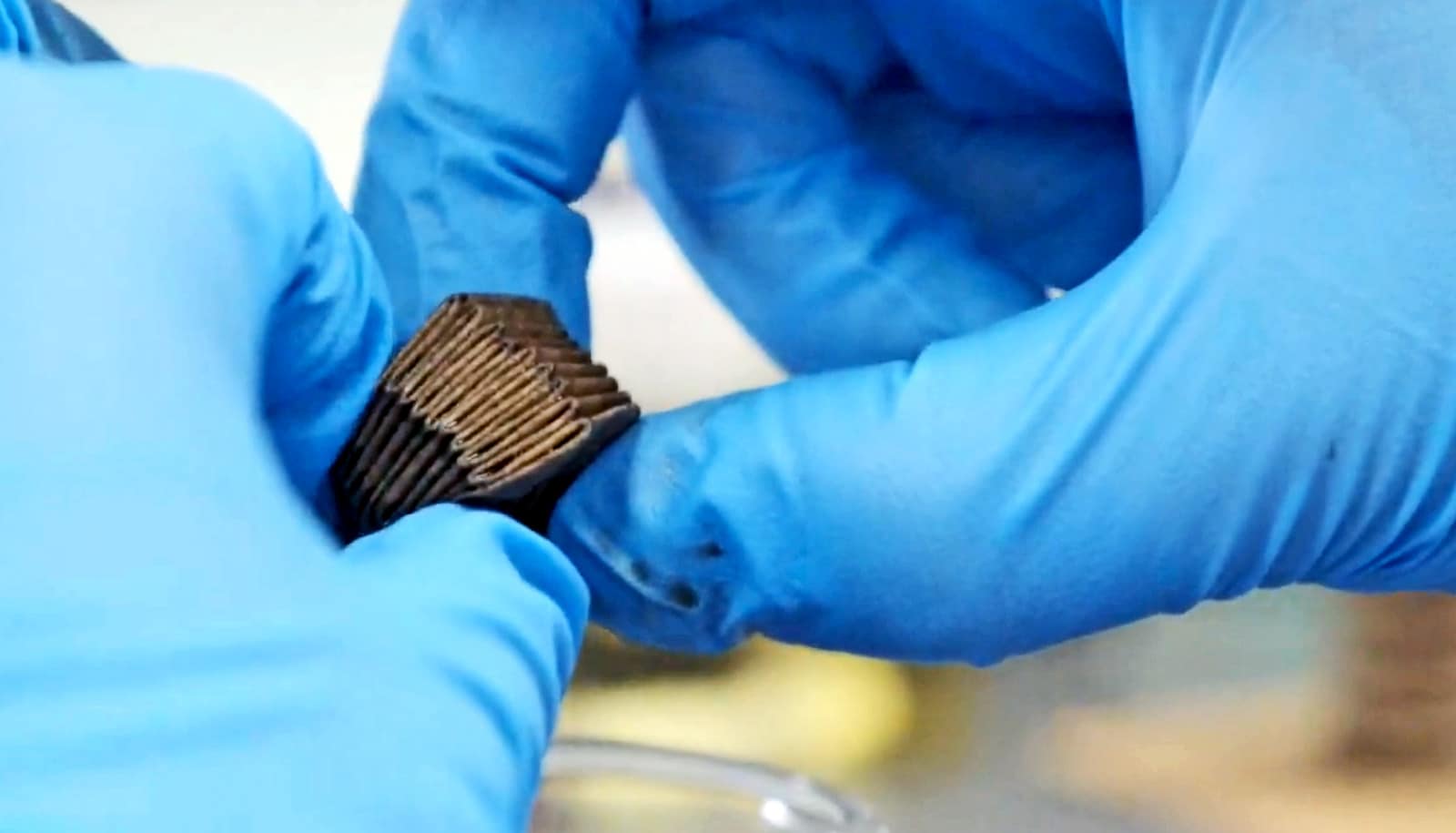
Researchers create the metal-based material through a new process called “graphene oxide-enabled templating synthesis.” They first soak cellulose paper in a graphene oxide solution, before dipping it into a solution made of metallic ions such as platinum. The material then burns in an inert gas, argon, at 800 C (1,472 F) and then at 500 C (932 F) in air.

The final product is a thin layer of metal—90 micrometers (μm), or 0.09mm—made up of 70% platinum and 30% amorphous carbon (ash) that is flexible enough to bend, fold, and stretch. Other metals such as gold and silver can also be used.

The work appears in the journal Science Robotics.

Team leader Chen Po-Yen used a cellulose template cut out in the shape of a phoenix for his research. “We are inspired by the mythical creature. Just like the phoenix, it can be burnt to ash and reborn to become more powerful than before,” says Chen, assistant professor at NUS Chemical and Biomolecular Engineering.

Conductive backbones

The team’s material can function as mechanically stable, soft, and conductive backbones that equip robots with strain sensing and communication capabilities without the need for external electronics.

Being conductive means the material acts as its own wireless antenna, allowing it to communicate with a remote operator or other robots without the need for external communication modules. This expands the scope of origami robots, such as working in high-risk environments (e.g. chemical spills and fire disaster) as remote-control untethered robots, or functioning as artificial muscles or humanoid robotic arms.

“We experimented with different electrically conductive materials to finally derive a unique combination that achieves optimal strain sensing and wireless communication capabilities,” says Yang Haitao, doctoral student at NUS Chemical and Biomolecular Engineering and the first author of the study. “Our invention therefore expands the library of unconventional materials for the fabrication of advanced robots.”

Chen and his team are now looking to add more functions to the metallic backbone. One promising direction is to incorporate electrochemically active materials to fabricate energy storage devices such that the material itself is its own battery, allowing for the creation of self-powered robots. The team is also experimenting with other metals such as copper, which will lower the cost of the material’s production.

Source: National University of Singapore