Archives

Play Video

Better robot batteries get inspiration from body fat

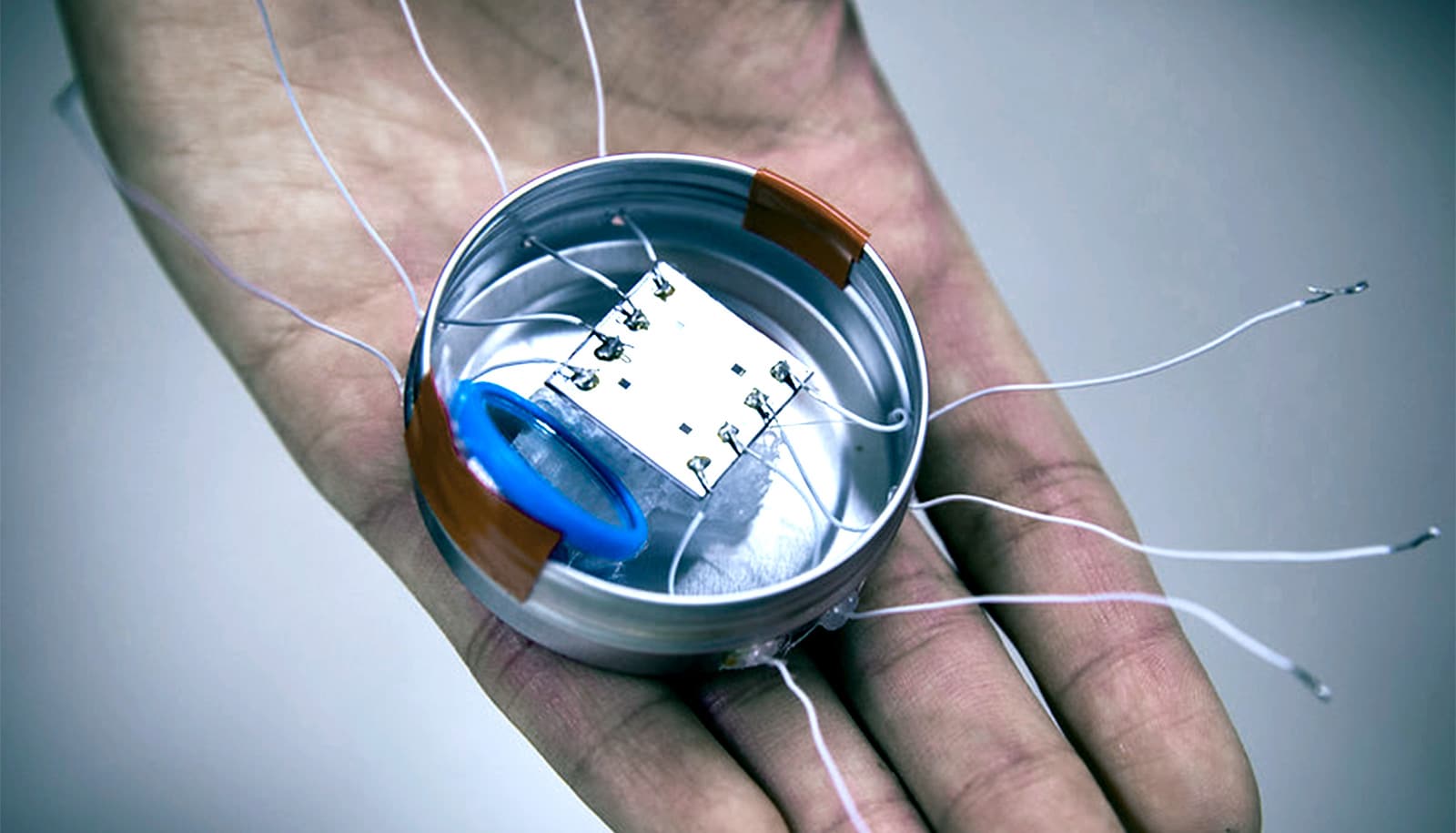
The team replaced a toy robot’s battery with their new biomorphic zinc-air batteries, applied as patches over the robot’s knees, shoulders, elbows, and head. This bio-inspired approach to energy storage, akin to fat reserves in animals, including humans, could free up both space and weight inside robots while simultaneously increasing the energy capacity. (Credit: Mingqiang Wang/Kotov Lab/U. Michigan)

Like biological fat reserves store energy in animals, a new rechargeable zinc battery integrates into the structure of a robot to provide much more energy, researchers report.

“Batteries that can do double duty—to store charge and protect the robot’s ‘organs’—replicate the multifunctionality of fat tissues serving to store energy in living creatures.”

This approach to increasing capacity will be particularly important as robots shrink to the microscale and below—scales at which current stand-alone batteries are too big and inefficient.

“Robot designs are restricted by the need for batteries that often occupy 20% or more of the available space inside a robot, or account for a similar proportion of the robot’s weight,” says Nicholas Kotov, a professor of engineering at the University of Michigan who led the research.

Better batteries for robots

Applications for mobile robots are exploding, from delivery drones and bike-lane take-out bots to robotic nurses and warehouse robots. On the micro side, researchers are exploring swarm robots that can self-assemble into larger devices.

Multifunctional structural batteries can potentially free up space and reduce weight, but until now they could only supplement the main battery.

“Distributed energy storage, which is the biological way, is the way to go for highly efficient biomorphic devices.”

“No other structural battery reported is comparable, in terms of energy density, to today’s state-of-the-art advanced lithium batteries. We improved our prior version of structural zinc batteries on 10 different measures, some of which are 100 times better, to make it happen,” Kotov says.

The combination of energy density and inexpensive materials means that the battery may already double the range of delivery robots, he says.

“This is not the limit, however. We estimate that robots could have 72 times more power capacity if their exteriors were replaced with zinc batteries, compared to having a single lithium ion battery,” says Mingqiang Wang, a recent visiting researcher in Kotov’s lab who is now a postdoctoral researcher at Harbin Institute of Technology in China, and first author of the study in Science Robotics.

How it works

The new battery works by passing hydroxide ions between a zinc electrode and the air side through an electrolyte membrane. That membrane is partly a network of aramid nanofibers—the carbon-based fibers found in Kevlar vests—and a new water-based polymer gel. The gel helps shuttle the hydroxide ions between the electrodes.

Made with cheap, abundant and largely nontoxic materials, the battery is more environmentally friendly than those currently in use. The gel and aramid nanofibers will not catch fire if the battery is damaged, unlike the flammable electrolyte in lithium ion batteries. The aramid nanofibers could be upcycled from retired body armor.

To demonstrate their batteries, the researchers experimented with regular-sized and miniaturized toy robots in the shape of a worm and a scorpion. The team replaced their original batteries with zinc-air cells. They wired the cells into the motors and wrapped them around the outsides of the creepy crawlers.

“Batteries that can do double duty—to store charge and protect the robot’s ‘organs’—replicate the multifunctionality of fat tissues serving to store energy in living creatures,” says Ahmet Emre, a doctoral student in biomedical engineering in Kotov’s lab.

The downside of zinc batteries is that they maintain high capacity for about 100 cycles, rather than the 500 or more that we expect from the lithium ion batteries in our smartphones. This is because the zinc metal forms spikes that eventually pierce the membrane between the electrodes.

The strong aramid nanofiber network between the electrodes is the key to the relatively long cycle life for a zinc battery. And the inexpensive and recyclable materials make the batteries easy to replace.

Beyond the advantages of the battery’s chemistry, Kotov says that the design could enable a shift from a single battery to distributed energy storage, using graph theory approach.

“We don’t have a single sac of fat, which would be bulky and require a lot of costly energy transfer,” Kotov says. “Distributed energy storage, which is the biological way, is the way to go for highly efficient biomorphic devices.”

Funding for the research came from the Department of Defense, the National Science Foundation, and the Air Force Office of Scientific Research. The University of Michigan has applied for patent protection and is seeking commercial partners to bring the technology to market.

Source: University of Michigan

Play Video

Teeny robots get a speed boost from origami

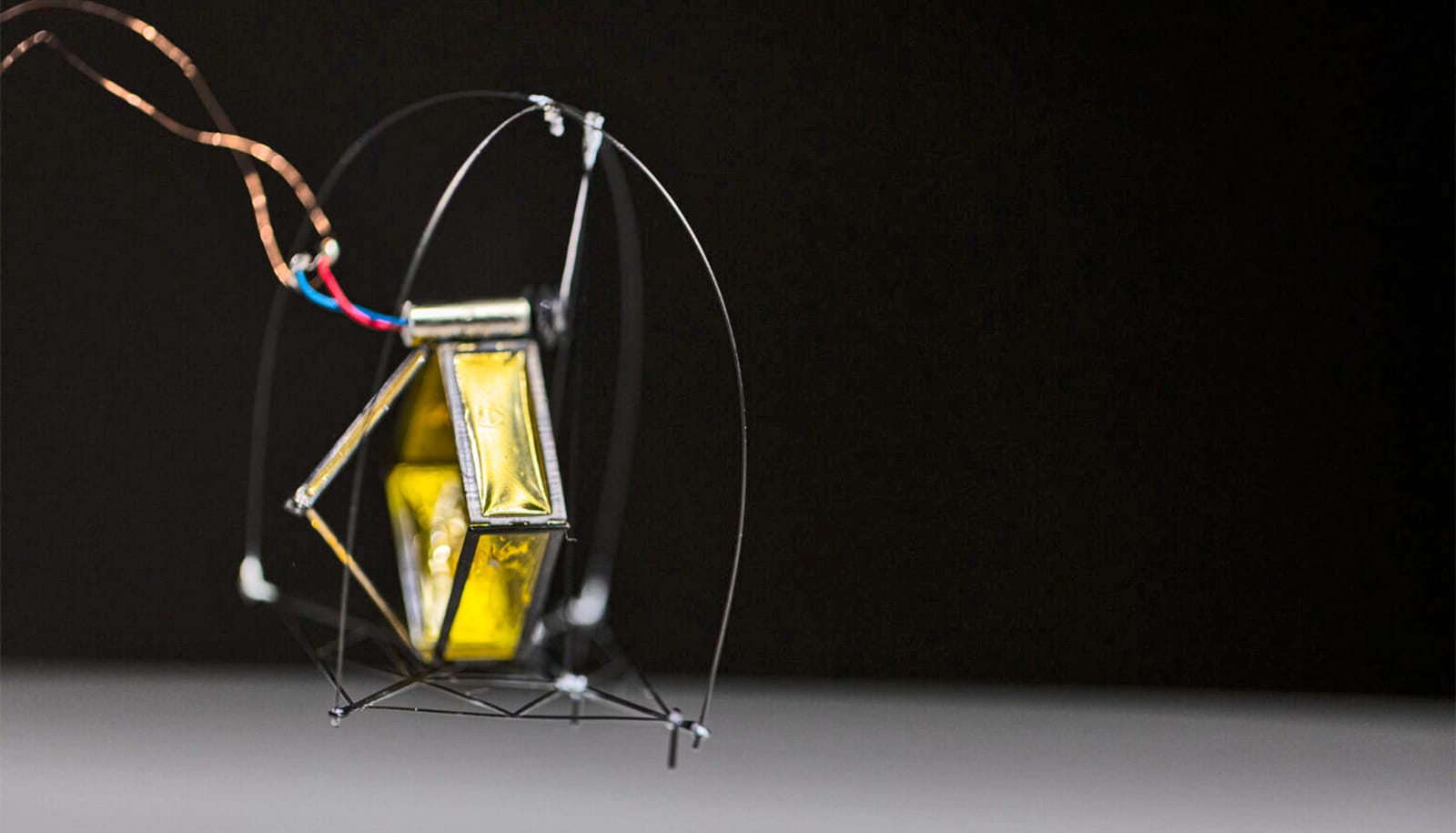
Researchers have created a new generation of micro-robotics. (Credit: Robert Coelius/U. Michigan)

Origami principles can unlock the potential of the smallest robots, enhancing speed, agility, and control in machines no more than a centimeter in size, researchers report.

The researchers have demonstrated that behavioral rules underpinning the Japanese art of folding can expand the capabilities of these machines. That could create potential for greater use in fields as diverse as medical equipment and infrastructure sensing.

The microbots can fold as far as 90 degrees and more. Larger folds allow microbots to form more complex shapes.

“We’ve come up with a new way to design, fabricate, and actuate microbots,” says Evgueni Filipov, an assistant professor of civil and environmental engineering at the University of Michigan.

“We’ve been the first to bring advanced origami folding capabilities into one integrated microbot system.”

Their bots can form one shape, complete a task, then reconfigure into a second shape for an additional task, and so on.

To date, most microbots have limited movements, which hampers their ability to perform useful tasks. To increase their range of motion, the robots need to be able to fold at large angles. The researchers’ new microbots can fold as far as 90 degrees and more. Larger folds allow microbots to form more complex shapes.

The approach enables microbots to complete their range of motion up to 80 times per second, a faster pace than most can operate.

Microbots using origami principles often require an outside stimulus to activate, such as heat inside a body or a magnetic field applied to the microbot. The new robots utilize a layer of gold and a layer of polymer that act as an onboard actuator—meaning no outside stimulus is needed.

While the microbots are currently controlled by a tether, eventually, an onboard battery and a microcontroller will apply an electric current in the systems.

“When current passes through the gold layer, it creates heat, and we use heat to control the motions of the microbot,” Filipov says. “We drive the initial fold by heating the system, then we unfold by letting it cool down.

“To get something to fold and stay folded, we overheat the system. When we overheat, we can program the fold—change where it comes to rest.”

These capabilities allow microbots to function elastically and plastically—giving them the ability to recover their original shape.

The research appears in Advanced Functional Materials. The Defense Advanced Research Projects Agency and the UM College of Engineering Dean’s Fellowship funded the study.

Source: University of Michigan

Play Video

Microbots could deliver drugs by flip-flopping through your body

(Credit: prolost/Flickr)

A new type of all-terrain microbot that moves by tumbling could help usher in tiny machines for various applications, including super-focused drug delivery, researchers report.

The “microscale magnetic tumbling robot,” or μTUM (microTUM), is about 400 by 800 microns, or millionths of a meter, smaller than the head of a pin. A continuously rotating magnetic field propels the microbot in an end-over-end or sideways tumbling motion, which helps it travel over uneven surfaces such as bumps and trenches—a difficult feat for other forms of motion.

“The μTUM is capable of traversing complex terrains in both dry and wet environments,” says David Cappelleri, an associate professor in Purdue University’s School of Mechanical Engineering and director of the Multi-Scale Robotics and Automation Lab.

microbot on a penny
The microbot can be seen just to the right of the “U” in United States on this US penny. (Credit: Purdue U./Georges Adam)

The flat, roughly dumbbell-shaped microbot is made of a polymer and has two magnetic ends. A non-magnetic midsection might be used to carry cargo such as medications. Because the bot functions well in wet environments, it has potential biomedical applications.

Tackling tricky terrain

“Robotics at the micro- and nano-scale represent one of the new frontiers in intelligent automation systems,” Cappelleri says. “In particular, mobile microrobots have recently emerged as viable candidates for biomedical applications, taking advantage of their small size, manipulation, and autonomous motion capabilities. Targeted drug delivery is one of the key applications of these nano- and microrobots.”

“The ability to climb is important because surfaces in the human body are complex. It’s bumpy, it’s sticky.”

Drug-delivery microbots might be used in conjunction with ultrasound to guide them to their destination in the body.

The machine demonstrated an impressive climbing capability in both wet and dry environments, traversing inclines as steep as 60 degrees, researchers report in the journal Micromachines.

“The ability to climb is important because surfaces in the human body are complex,” says postdoctoral research associate Maria Guix. “It’s bumpy, it’s sticky.”

The ideal technology for many applications would be an untethered microrobot that is adaptable to various environments and is simple to operate. Microbots animated through magnetic fields have shown promise, Cappelleri says.

Wet and dry conditions

While concepts explored thus far have required complex designs and microfabrication methods, the μTUM is produced with standard photolithography techniques used in the semiconductor industry. The new paper focuses on the microrobot design, fabrication, and use of rotating magnetic fields to operate them in a strategy to negotiate complex terrains.

One critical factor in the development of such microbots is the effect of electrostatic and van der Waals forces between molecules that are prevalent on the scale of microns but not on the macroscale of everyday life. The forces cause “stiction” between tiny components that affect their operation. The researchers modeled the effects of such forces.

tumbling microbot figure
At left is a schematic of the new microTUM robot. The tiny robot tumbles in two modes, as shown at right. At bottom, a still photo of the microbot’s motion is captured from a video. (Credit: Purdue U./Chenghao Bi/Maria Guix)

“Under dry conditions, these forces make it very challenging to move a microbot to its intended location in the body,” Guix says. “They perform much better in fluid media.”

Because the tiny bots contain such a small quantity and surface area of magnetic material, it takes a relatively strong magnetic field to move them. At the same time, biological fluids or surfaces resist motion.

“This is problematic because for microscale robots to operate successfully in real working environments, mobility is critical,” Cappelleri says.

One way to overcome the problem is with a tumbling locomotion, which requires a lower magnetic-field strength than otherwise needed. Another key to the bot’s performance is the continuously rotating magnetic field.

“Unlike the microTUM, other microscale robots use a rocking motion under an alternating magnetic field, where contact between the robot and the surface is continually lost and regained,” says coauthor Chenghao Bi, a graduate student at Purdue says.

“Though the continuously rotating field used for the μTUM is harder to implement than an alternating field, the trade-off is that the tumbling robot always has a point in contact with the ground, provided that there are no sharp drop-offs or cliffs in its path. This sustained contact means that the μTUM design can take advantage of the constant adhesion and frictional forces between itself and the surface below it to climb steep inclined terrains.”

Watch robots avoid crashes—but not too carefully

The microbot was tested on a dry paper surface, and in both water and silicone oil to gauge and characterize its capabilities in fluid environments of varying viscosity. Findings showed highly viscous fluids such as silicone oil limit the robot’s maximum speed, while low-density media such as air limit how steep they can climb.

The microTUM might be upgraded with “advanced adhesion” capabilities to perform drug-delivery for biomedical applications.

Making a better microbot

Future work will focus on dynamic modeling of the μTUM to predict its motion trajectories over complex terrains, as well as addressing the unique challenges present at the interface of distinct environments.

Additional goals include developing a “vision-based” control system that uses cameras or sensors for precise navigation and for using such bots to finely manipulate objects for potential industrial applications. Alternate designs for the mid-section of the robot will be explored as well.

“For all the design configurations considered, the midsection of the robot was kept non-magnetized in order to explore the future possibility of embedding a payload in this area of the robot,” Cappelleri says.

Hydrogels for future drug delivery use Boolean logic

“Replacing this area with a compliant material or a dissolvable payload could lead to improved dynamic behavior, and in-vivo drug delivery, respectively, with far-reaching potential in micro-object manipulation and biomedical applications.”

Some of the research was performed in the Birck Nanotechnology Center in Purdue’s Discovery Park. The National Science Foundation funded the work.

Source: Purdue University