Archives

Play Video

Brands can goose their own reps by praising rivals

"This isn't something brands need to do all the time, but it's something they shouldn't be afraid to do occasionally to help boost perceptions of their warmth and trustworthiness," says Keisha Cutright. (Credit: Getty Images)

New research shows the benefits of brands praising their rivals.

Whether they’re beefing on billboards or sparring on social media, big brands are known for taking jabs at their competitors (see the famous “Get a Mac” ads or “the chicken sandwich wars”).

What consumer brands typically do not do is compliment those rivals—they wouldn’t want to grant an adversary free publicity, says Keisha Cutright, a marketing professor at Duke University’s Fuqua School of Business.

But new research from Cutright in the Journal of Marketing suggests a little goodwill can pay off.

Nearly a dozen experiments with almost 4,000 people show that a brand that compliments a competitor ends up boosting its own reputation and sales.

“You don’t want to spend your media dollars talking about the competition, but there are times when it makes sense to say something nice, and at the same time, signal who you are as a brand,” Cutright says.

“That message is that they’re a warm, caring brand that you can trust, which implies they’re also going to be considerate and warm to their customers.”

To researchers’ surprise, this tactic appears most effective on the most skeptical consumers, they note in the study. Cutright cowrote the paper with Lingrui Zhou and Katherine Du, both of whom worked on the research while earning Fuqua doctorate degrees.

In one experiment, the researchers showed a group of consumers a fictitious Tweet from Kit Kat praising Twix: “Competitor or not, congrats on your 54 years in business! Even we can admit—Twix are delicious.”

After 11 days, the researchers asked the consumers who saw the fake Tweet to report any candy purchases. People who saw the public message from Kit Kat praising Twix were 34% more likely to buy a Kit Kat compared to a control group that saw a Tweet from Kit Kat about its own product. Importantly, the authors note, Twix sales didn’t increase, even after Kit Kat praised the candy as delectable.

The positive effects on reputation and sales were more significant for organizations that are not traditionally seen as “warm and fuzzy,” such as for-profit companies, compared to companies that seem intrinsically caring, such as non-profits.

In a surprising turn, the most skeptical consumers in the experiments were likely to have the biggest positive response to brands that tipped their hats to a competitor, the researchers found.

“Seeing a brand take a risk like this seems to break the ice with consumers who are least trusting of companies’ intentions,” Cutright says.

But praising a competitor will be most effective when done strategically and at the right moment—authenticity is key, she says.

“If you are constantly talking about the competition, people may not see it as sincere,” Cutright says. “This isn’t something brands need to do all the time, but it’s something they shouldn’t be afraid to do occasionally to help boost perceptions of their warmth and trustworthiness.”

Source: Duke University

  • Fake news is no match for big brands
  • Play Video

    Brands can get political, say more marketing leaders

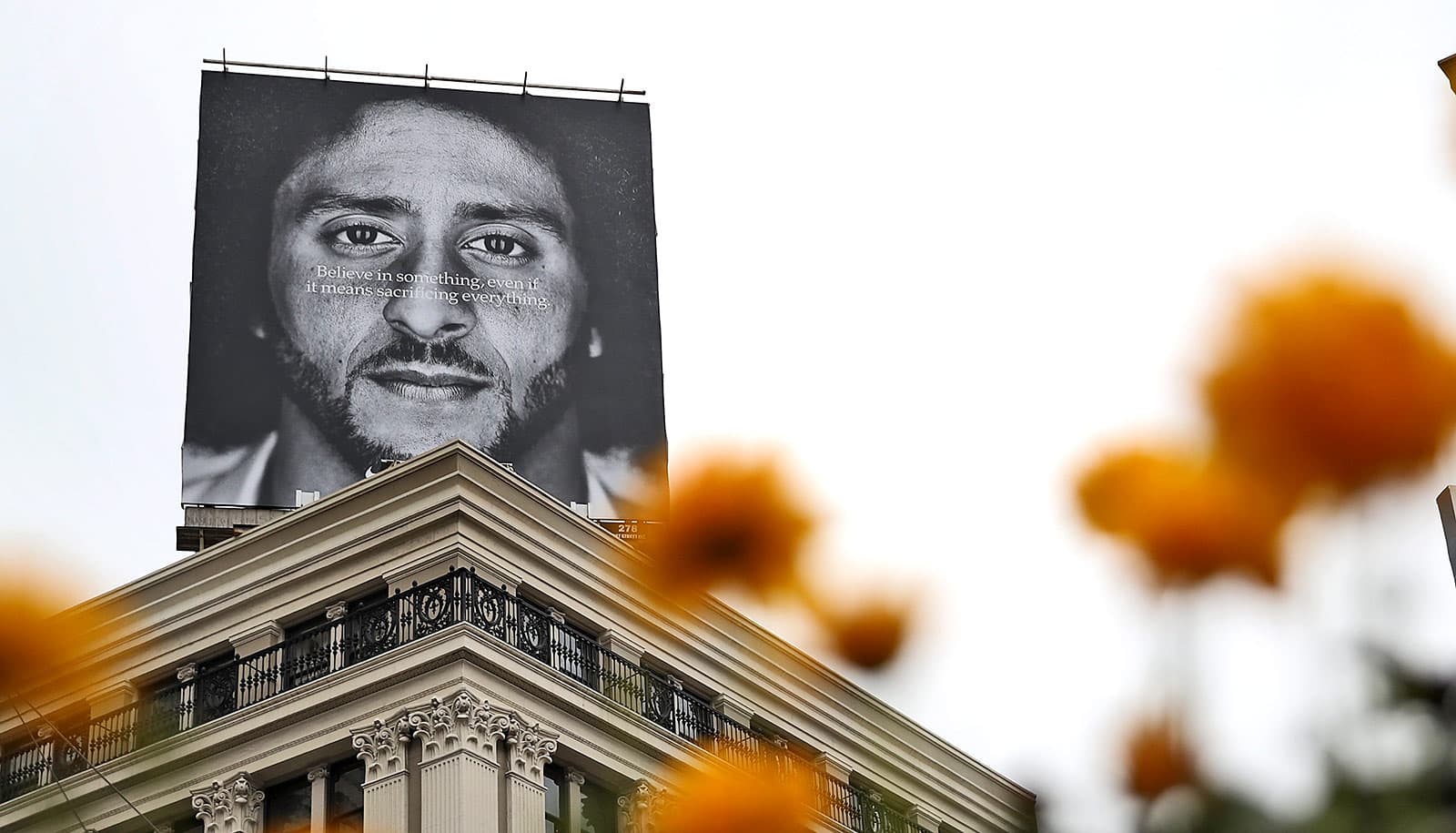
    A billboard featuring former San Francisco 49ers quarterback Colin Kaepernick appears on the roof of the Nike Store on September 5, 2018 in San Francisco. (Credit: Justin Sullivan/Getty Images)

    More marketing leaders are starting to support their brands taking a political stance, survey results show.

    The twice-yearly CMO Survey gathers insights from marketing executives at US for-profit companies. Eighteen months ago, 17.4% of survey participants said it would be appropriate for their brand to take a political stance. According to new data from 341 marketers surveyed in July and August, support has grown to 26.5%. Most supporters represented business-to-consumer companies, the data show.

    “This openness likely reflects the fact that marketers realize their customers want the companies they support to be good citizens of the world—making profits is just part of that,” says Christine Moorman, professor at the Duke University Fuqua School of Business and director of The CMO Survey.

    “Although recent examples with Nike and Colin Kaepernick point to some backlash, overall, getting involved in social debates—if done authentically and if connected to the business that the company is in—appears to be well-received in the marketplace.”

    Focus on the present or the future

    For the first time in the 11-year history of survey, chief marketers shared how they balance their time between managing the present and preparing for the future.

    Respondents said they spend most of their time (68.5%) focused on the present, which leaves just 31.5% for planning. Industries focused most on the present were education, professional services, retail and wholesale, and manufacturing.

    “When marketers spend more time putting out fires in the present, this likely means they are spending too little time on the types of strategic thinking important to creating value for customers over the long-run and to developing new growth opportunities for their companies,” Moorman says.

    “Maximizing returns on digital marketing and marketing technology investments is not a short-term game. Marketing leaders need to think about developing capabilities in these areas—a process that requires long-term pooling and orchestrating of company resources.”

    Time to replace the marketing team?

    Respondents reported a 27% increase in their use of artificial intelligence (AI) and machine learning from 2018, with the majority using AI for content personalization, predictive insights on customers, and targeting decisions.

    Marketing leaders expected these technologies to be implemented to an even greater extent during the next three years, the data showed, with the greatest use in business-to-consumer products and services.

    Although the use of blockchain is growing in many industries, marketers’ adoption has been slower, with no real growth over 2018 figures.

    More than half (57.6%) of respondents said they aren’t replacing any of their marketing employees with new technologies. However, that number is expected to drop to just over one-third (37.5%) over the next three years.

    The survey’s other findings include:

    • In the coming year, marketers expect consumers to demand excellent service (a 28% increase) and superior quality (a 12% increase) rather than low prices, for which consumer pressure has dropped 17% since the last survey.
    • Many firms continue to look to external vendors to add new marketing capabilities. A year ago, 59.8% of companies said they built new skills by training existing employees or hiring new talent. That number has decreased to 53.8% of firms as they shift to outside agencies and consultants.
    • Marketers continue an uphill climb managing customer experience, identifying the biggest opportunities for improvement as their capacity to design, deliver, and monitor the customer experience and integrate touchpoints across the customer journey to deliver this experience.

    For more in-depth analysis of the results, including how trends break down across business-to-business and business-to-consumer firms, visit cmosurvey.org.

    The American Marketing Association, Deloitte, and Duke University’s Fuqua School of Business support the survey.

    Source: Duke University