An expert has answers for you about the physics behind soccer’s greatest plays.
As the FIFA World Cup continues, fans will marvel at powerful shots, bending corner kicks, and spectacular saves.
“…the beautiful game is also a remarkable demonstration of science in motion.”
But behind every goal is a lesson in physics.
Michigan State University physicist Stuart Tessmer explains how forces, momentum, and even air pressure shape the world’s most popular sport.
How much physics is involved in soccer?
Physics is everywhere in soccer. Every pass, shot, sprint, and save relies on fundamental principles that govern motion.
Players may not be thinking about physics during a match, but they are constantly applying it. Running, changing direction, striking the ball, and controlling it all depend on forces acting between the player, the ball, and the friction with the playing surface—and frictional forces play a huge role!
Why is friction so important?
Without friction, it would be hard for soccer players to do anything at all!
When a player pushes their cleats backward against the turf, the turf pushes forward against the player, propelling the player as they wind up and then strike the ball. This is an example of Newton’s third law of motion: For every action, there is an equal and opposite reaction. Without friction between a player’s cleats and the field, players couldn’t run, accelerate, or generate powerful shots. They would simply slip.
Imagine the turfgrass was replaced by super slippery ice. As a player tried to run forward, instead their feet would slip backward with each step. There would be no way to accelerate and generate an effective shot or pass. Controlling friction is one of the keys to soccer.
What gives a soccer ball its speed?
The answer is momentum.
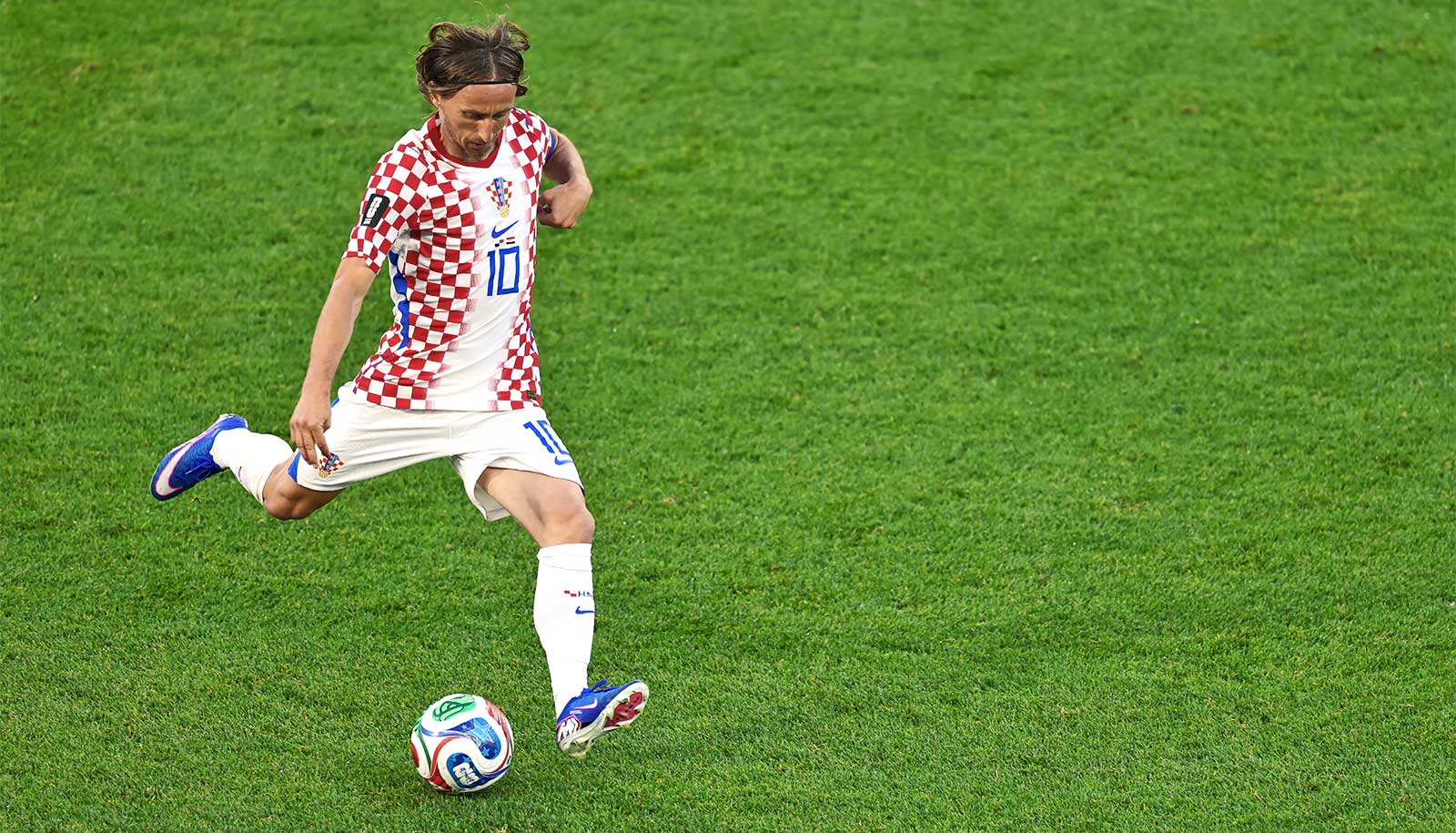
Momentum describes how much motion an object has and depends on two factors: its mass and its speed. When a player strikes a soccer ball, momentum is transferred from the player’s moving leg to the ball.
The harder and faster the kick, the more momentum is transferred, causing the ball to travel faster and farther.
Even when a ball comes to a stop, momentum hasn’t disappeared. Instead, it has been transferred to other objects, such as the net, the ground, or the surrounding air.
How do players make the ball curve?
The famous “Bend It Like Beckham” shot is actually a demonstration of friction in physics.
When a player strikes the ball off-center, the ball will spin as it moves through the air. That spin changes how air flows around the ball—slowing it down on one side and speeding it up on the other.
Air moves faster on one side of the spinning ball and slower on the other, creating a pressure difference. The result is a sideways force that causes the ball to curve during flight.
This phenomenon, often explained through the Bernoulli principle and related aerodynamic effects, allows players to bend free kicks around defenders and curl corner kicks toward the goal.
Does the design of the soccer ball matter?
Absolutely. Professional players notice the differences between soccer ball designs, including how the ball feels coming off their foot and how it behaves in the air.
The surface texture, seams, and grooves on a soccer ball affect how it interacts with the air. Small design changes can alter a ball’s aerodynamics and influence how much it curves and how predictable it is for players.
Why does the playing surface matter so much?
The field affects nearly every aspect of gameplay.
Players need enough grip to accelerate, stop, and change direction quickly. But too much grip can increase injury risk because a player’s foot may become stuck in the ground during collisions or sudden movements.
The surface also influences how players experience impacts when they fall.
You want a surface that has good grip but you don’t want it to be too sticky. A well-designed field balances traction, stability, and cushioning to help maximize performance while reducing injury risk.
Why is FIFA requiring natural grass at World Cup venues?
Natural grass is generally preferred by players because it provides a more familiar playing experience and often offers a balance of traction and cushioning.
For the 2026 FIFA World Cup, stadiums that normally use artificial turf are installing natural grass surfaces that meet FIFA standards. Researchers and turfgrass experts, including those at Michigan State University, have helped develop systems that allow natural grass to be grown, transported, and installed while maintaining healthy roots and playing quality.
Those efforts help ensure that players experience consistent field conditions regardless of where matches are played.
What’s the biggest takeaway?
The next time you watch a curling free kick or a powerful shot into the top corner, remember that physics is helping make it happen.
From the friction between a cleat and the turf to the aerodynamics of a spinning ball, the beautiful game is also a remarkable demonstration of science in motion.
Source: Michigan State University