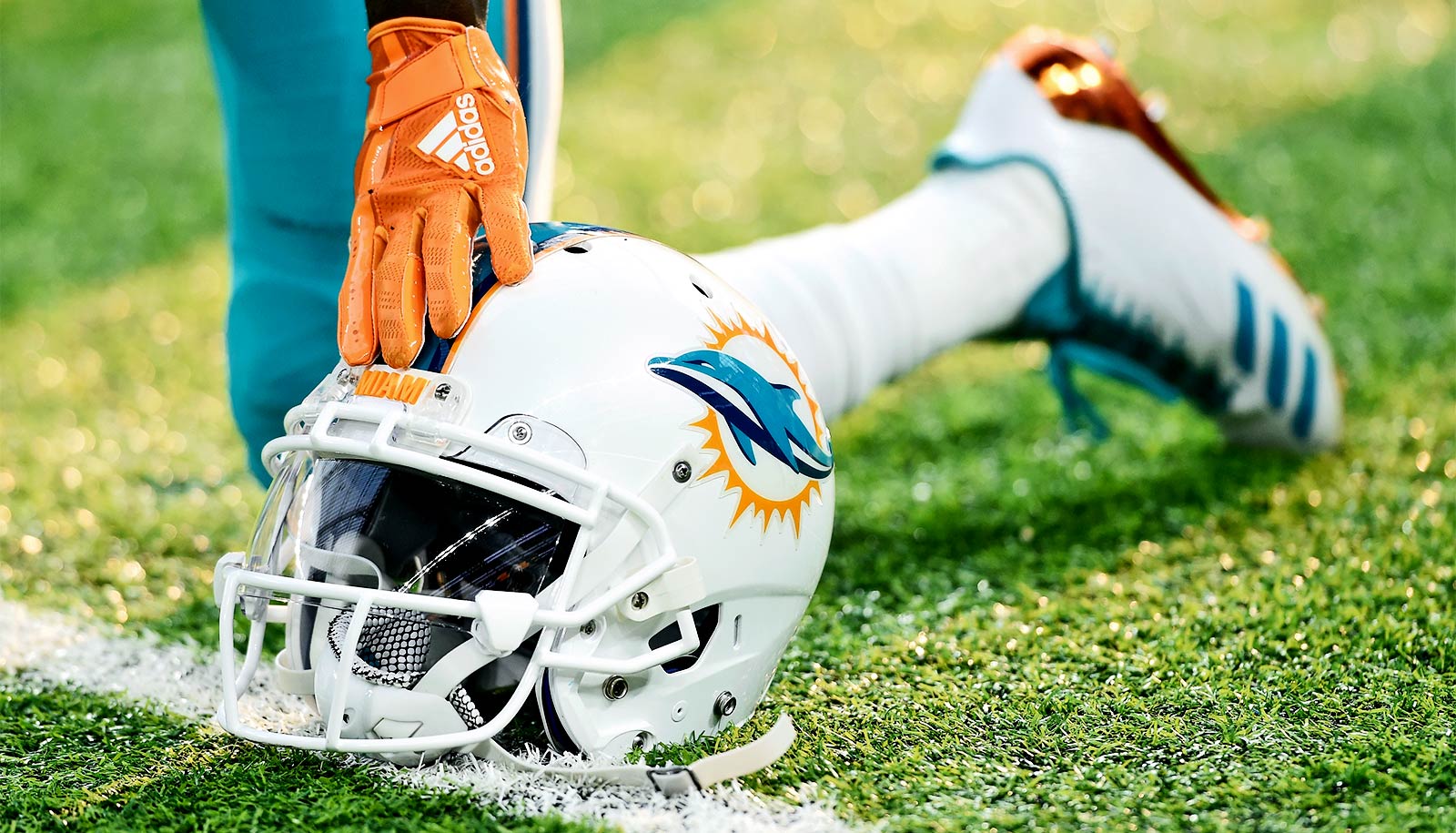
A study of nearly 20,000 National Football League players has found they are four times more likely than the general population to die of neurodegenerative diseases, including ALS, dementia, and Parkinson’s disease.
The study, led by researchers at Boston University, Mass General Brigham, and the Concussion & CTE Foundation, is the largest of its kind to date of mortality in pro football players.
Although National Football League (NFL) players had lower chances of death from cancer and cardiovascular disease, which was attributed in part to their physical fitness, the researchers say this only highlights the athletes’ heightened risk of neurodegenerative disease.
Given their physical health, NFL players could be expected to also have better protection against diseases like dementia—but it appears that’s not the case.
Previous BU research has shown a high rate of chronic traumatic encephalopathy (CTE)—a neurodegenerative disease caused by repeated hits to the head that’s been tied to a range of symptoms—among deceased former NFL players whose brains were donated for research. The BU CTE Center is the world’s leading hub for research into the disease and home to the UNITE Brain Bank, the largest repository of brain tissue of its kind.
“A fourfold increase in dementia rates from a presumed environmental cause is immense—and brain bank studies indicate that CTE is the primary explanation,” says Jesse Mez, a senior coauthor on the latest study and BU CTE Center codirector of clinical research.
The researchers found NFL players’ mortality rates for dementia were 3.8 times higher and 3.88 times higher for Parkinson’s.
“To put that in perspective, heavy lead exposure, which was banned from paint and gasoline in the US due to its neurological and cardiovascular consequences, leads to a two-to-three times greater rate of dementia.”
The study included all current and former NFL players—19,824 athletes—who played at least one professional game and made their debut between 1960 and 2019. The researchers examined data about each players’ career, from appearance totals to position played; they also analyzed National Death Index records to assess causes of death among the 1,994 deceased players. Information from the National Institute for Occupational Safety and Health was used to compare NFL players’ mortality rates to those of the general population.
The results appear in eClinicalMedicine, an open access journal from The Lancet.
Among the deceased NFL players, 178 had died of neurodegenerative disease, 106 of dementia, 39 from Parkinson’s disease, and 33 of amyotrophic lateral sclerosis (ALS). The researchers found those who died of neurodegenerative disease were older and had longer careers, starting and playing in more games. Players who stayed in the NFL for more than five years had double the risk of dying of neurodegenerative disease than those who bounced out after just one to four seasons.
What the researchers called non-speed players—offensive and defensive linemen—had lower neurodegenerative and dementia mortality rates than those who took to the field in all other, or speed, positions.
“NFL players in speed positions had twice the dementia rate of non-speed players,” they write in sharing their findings, “potentially related to greater cumulative g-force exposure, which [has] been associated with higher [neurodegenerative disease] risk.”
“While this study is about this unique cohort of elite athletes, it drives home themes that our work across different settings has shown consistently—that there is a dose-response relationship between the amount of football play and risk for neurodegenerative disease,” says Mez, a BU Chobanian & Avedisian School of Medicine associate professor of neurology and BU Alzheimer’s Disease Research Center associate director.
“Players, their families, and their doctors need to understand this relationship when making decisions about football play.”
Despite the grim rates of neurodegenerative disease death, the researchers did discover that NFL players had noticeably lower overall mortality than the general population. Former and current pro players were less likely to die of cancer, cardiovascular disease, and a range of other causes. The researchers attributed this to what they called the NFL’s “selection bias for physically fit individuals,” as well as the benefits of regular exercise and access to medical care. They called this phenomenon the selection through athletic resilience survivor (STARS) effect.
But they also concluded that this resilience made the high levels of neurodegenerative disease death even more stark.
“Compared to the general population, former NFL players have better physical fitness and cardiovascular health, leading to lower risk of all cause-mortality,” says Mez.
“In the general population, better physical fitness and cardiovascular health are also protective factors for neurodegenerative mortality. Nonetheless, former NFL players have a fourfold increased rate of neurodegenerative mortality, presumably related to their repetitive head impacts from playing football, despite their better physical fitness and cardiovascular health.”
This research received funding support from the National Institute of Neurological Disorders and Stroke, the National Institute on Aging, and the Maloney/Carpenter Trauma-Related Neurodegenerative Disease Research Fund.
Source: Boston University