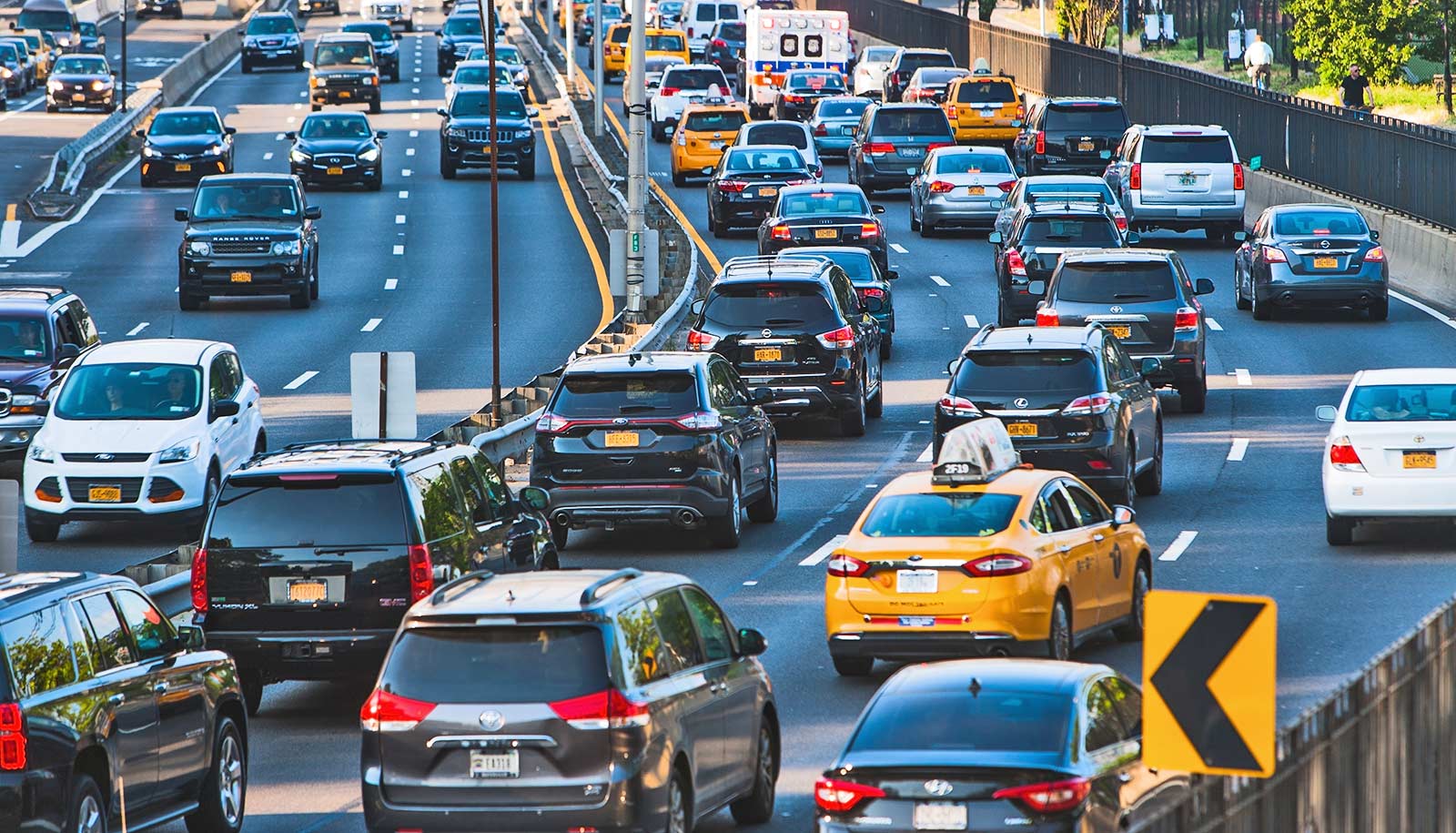
Researchers have found that urban communities isolated by roadways and traffic patterns are associated with more schizophrenia-related hospital visits.
While research has shown a link between traffic-related exposures such as air pollution and noise and adverse mental health outcomes, few studies have looked at the role of road infrastructure itself in isolating communities and breaking down their social fabric, and how that might affect the mental health of people who live there.
The new study focused on New York City. The finding about schizophrenia-related hospital visits was independent from traffic-caused air pollution.
“Imagine an environment where cars are present, but do not dominate, and that also has robust pedestrian traffic and walkable routes to neighbors’ homes, and where you can see kids playing outside and neighbors congregating to talk,” says study author Jaime Benavides, an investigator in epidemiology in the Brown University School of Public Health.
“We wanted to home in on the road infrastructure that prevents people from interacting and learn how that influences their mental health.”
In the study in Environmental Epidemiology, the research team conducted ZIP code-level analyses to investigate the association between mental health hospital visits and community isolation in New York, using annual New York State Department of Health counts of hospital visits related to mood, anxiety, adjustment, and schizophrenia disorders.
They quantified community isolation using a custom metric they’d developed while at Columbia Mailman School of Public Health. Called the Community Severance Index, it takes into account the role of roads, traffic and lack of pedestrian infrastructure (like sidewalks and crosswalks) in the physical and social disconnection of communities. The development of the index was led by Marianthi-Anna Kioumourtzoglou, now a professor of epidemiology and environment and society affiliated with Brown’s Center for Climate, Environment and Health, who also co-led this study.
“We have increasing evidence that air pollution impacts mental health,” Kioumourtzoglou says. “One of the solutions proposed is to move towards an electrified vehicle fleet. While this will result in reduced emissions, which is absolutely fantastic, what our study shows is that might not be enough. We need to move away from car dependence and towards building healthier places and communities that bring people together instead of isolating them.”
Urban living, in general, has been linked to increased risk of anxiety, mood, and schizophrenia disorders. In this study, the strongest association had to do with schizophrenia: higher levels of community isolation were associated with increased schizophrenia-related hospital visits. The effect was similar across age groups.
“While scientists are still researching the causes, prevention and treatment of mental illness and mood disorders, urban environmental exposures—specifically, traffic patterns and road infrastructure—are things that can be addressed from an urban planning perspective,” says Benavides, who has previously studied the role of environmental exposures such as pollution on mental health.
“Reducing vehicular traffic, creating more easily accessible parks, and limiting highways and roads that cut through the middle of communities can improve collective mental wellbeing.”
While the study didn’t explore the reasons behind this effect, a community cut off from others by traffic and road infrastructure has limited access to goods, services, and social connections. The researchers note that mental health may be affected through different means, including discouraging walking and physical activity, increasing psychological stress due to road safety concerns, and limiting social contacts among community residents.
“These findings draw attention to an overlooked urban exposure and highlight the need for further research on how features of city design may influence mental health,” Benavides says.
The researchers plan to build upon their findings in two different ways: they’re developing a measurement for community isolation that would be generalizable to other large US cities, and they’re also working with researchers at Brown’s Center on Heat, Health, and Aging Innovation and Research Solutions for Communities on a study that looks at the effect of the combined environmental factors of extreme heat, air pollution and community isolation on the mental health of elderly people.
This work was supported by the National Institute of Environmental Health Sciences and by the National Institute on Aging.
Source: Brown University