For the first time, researchers have described a previously unknown species of extinct dwarf sperm whale.
The whale, which lived around six million years ago, possessed a strongly asymmetrical skull and a downward-curved head. This adapted it to its habitat at that time.
Most vertebrates have a largely symmetrical skull: the left and right halves are similarly structured. Toothed whales are different. Their skulls are asymmetrical because, over the course of evolution, they have developed special organs for generating and transmitting sound. These enable them to orient themselves using echolocation and to locate prey.
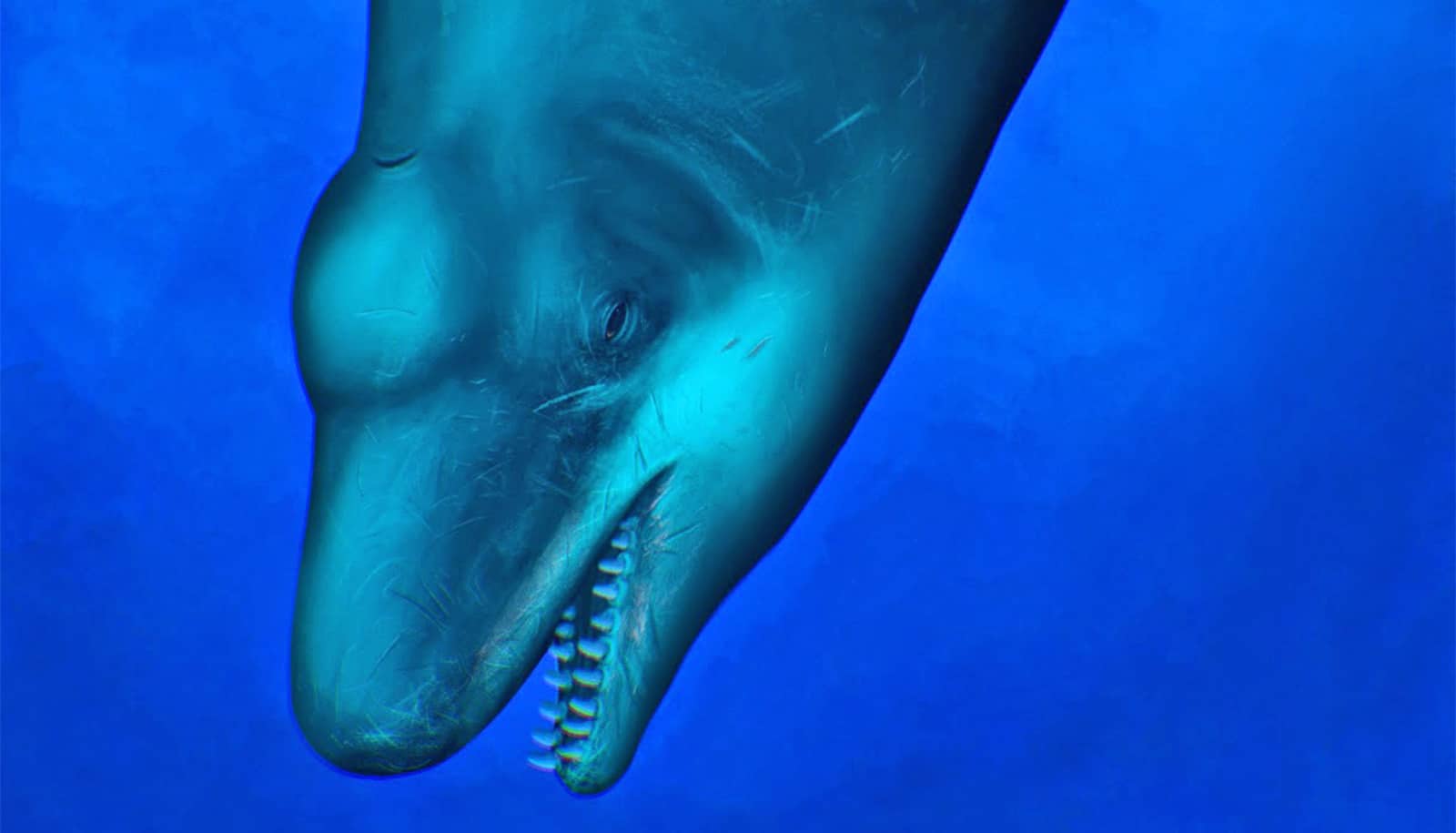
An international research team, including researchers from the University of Zurich, has described an extinct dwarf sperm whale in which this asymmetry reached a previously unknown degree. The new species, scientifically named Scaphokogia huachafo, lived off the coast of present-day Peru between 6.3 and 5.6 million years ago and grew to about 2.7 meters in length. Its skull is the most asymmetrical of any mammal known to date.
In modern toothed whales, the asymmetry is primarily concentrated in the area of the nostrils and the forehead. In contrast, in this species, which lived around six million years ago, the facial bones, the eye region, and the connection between the skull and cervical spine were also severely deformed. Both bony nostrils were located entirely on the left side of the skull. In addition, it had an oversized, downward-curving snout.
“The skull looks completely crooked, which is also what gave the new whale species its name: ‘Huachafo’ means something extravagant, exaggerated, or tasteless in Peruvian Spanish,” says lead author Aldo Benites-Palomino. He examined the fossil, which was discovered in the mid-1990s in the so-called Pisco Formation in southern Peru, during his doctoral studies at the Paleontological Institute of the University of Zurich.
For a long time, it was unclear how the extreme skull shape could be explained. Benites-Palomino, now an assistant professor at the Friedrich-Alexander University of Erlangen-Nuremberg, was able to demonstrate that the unusual shape was due neither to disease nor to deformation during fossilization. The skull of the adult animal showed no fractures or pathological changes in the bones and exhibited the asymmetry typical of toothed whales. The extreme skull shape was therefore a natural anatomical peculiarity of the species.
The investigations also provided clues about how the unusual whale lived. Unlike modern sperm whales, which primarily hunt squid in the open ocean, Scaphokogia huachafo likely foraged for food on the seabed in shallow coastal waters. Therefore, its snout was curved downwards at a 31-degree angle and made of particularly dense, heavy bone, which tilted the head’s center of gravity forwards and downwards. Furthermore, reconstructions of the neck joint revealed that the whale could tilt its head downwards by up to 55 degrees.
“The entire structure of the skull and neck was designed to point the snout directly towards the seabed,” explains Gabriel Aguirre-Fernández, coauthor of the study and researcher at the University of Zurich.
Since the whale lacked both the typical tactile hairs of other bottom-feeding marine mammals and corresponding specialized sensory structures, researchers suspect it used echolocation to find food. This could have allowed it to locate prey hidden in the soft sediment on the seabed. Scaphokogia huachafo, adapted to this highly specialized foraging strategy, may have disappeared with the changes in marine conditions at the end of the Miocene, around five million years ago.
The research appears in Communications Biology.
Source: University of Zurich