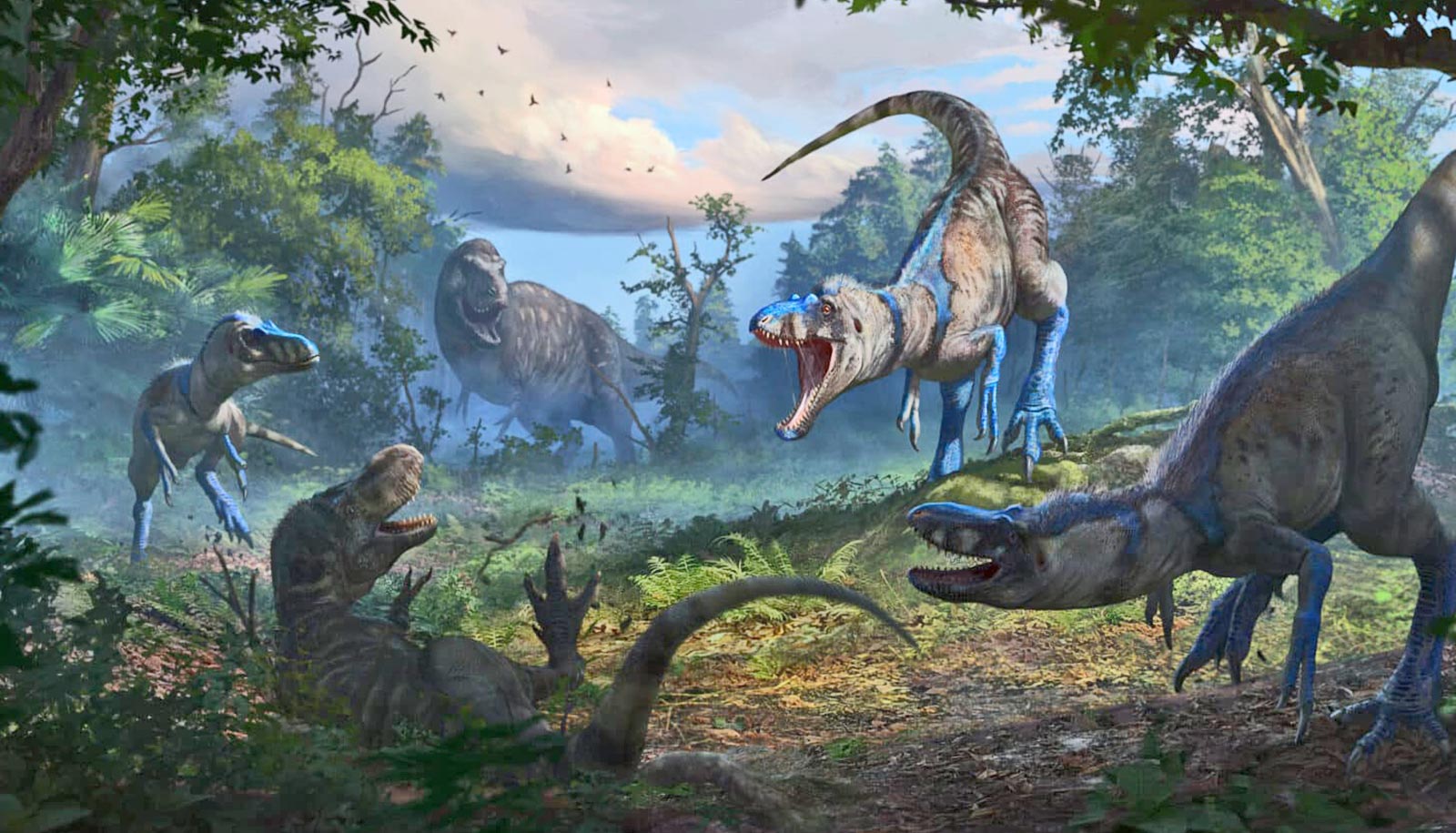
Dinosaurs might have been beachcombers that dined on washed-up seafood, researchers report.
Researchers looked at carbon isotope traces in fossilized teeth and bones from coastal-dwelling dinosaurs and found a signature that could be linked to the consumption of seafood. The work highlights the connections terrestrial and marine ecosystems have had for millions of years.
Storms wash marine matter ashore, which can serve as food sources for land-dwelling animals. This is known as marine subsidization and is particularly common today in coastal ecosystems—especially when land ecosystems yield less food than usual (during droughts, for example).
“As it turns out, what happens in the sea doesn’t stay in the sea,” says Lindsay Zanno, associate research professor at North Carolina State University, head of paleontology at the North Carolina Museum of Natural Sciences and coauthor of the study.
“We show that coastal terrestrial organisms in the greenhouse climates of the Cretaceous relied on marine resources to supplement their diets in a similar way that modern organisms do,” says first author Clayton Forster, a geologist at the University of Arkansas.
“We can identify that marine resources are passed along the food chain and incorporated in the minerals of bones and teeth of dinosaurs, crocodiles, turtles, and fish.”
Plants contain “light” (C-12) and “heavy” (C-13) carbon isotopes. The ratio of these isotopes, expressed as δ13C, is a chemical “fingerprint” that gets passed from food into the body of the consumer. When an animal eats, the δ13C value is incorporated into its tooth enamel with an upward shift in the δ13C value to a value higher than that of its food. This difference is between 11 and 13 parts per thousand in the tooth enamel of living animals.
In dino teeth, however, this difference has been found to be consistently higher, creating a mystery around carbon signatures of dino teeth. Their δ13C values were also higher than expected for animals that solely eat land-growing plants, which have lower δ13C values than most marine plants. If dinos or their prey snacked on marine matter, however, it could explain this discrepancy.
Using powder from fossils found in both previously coastal and landlocked sites, the researchers showed that the δ13C value in fossils from coastal sites was not only higher than from the land-locked fossils, but also was consistent between coastal sites, regardless of latitude or age.
Since the different carbon value was seen in both herbivores and carnivores, the researchers determined that the source of seafood would have to be low on the food chain—and was most likely seaweed.
“Our research clearly demonstrates that climate-driven extinctions in Mesozoic oceans would have had trickle up effects in the terrestrial realm,” says Zanno.
“The study is also an important step in understanding the interconnectedness between ancient animals inhabiting land and sea, which is key to identifying drivers of biodiversity loss during times of past climate change.”
The study appears in Frontiers in Ecology and Evolution.
Source: North Carolina State University