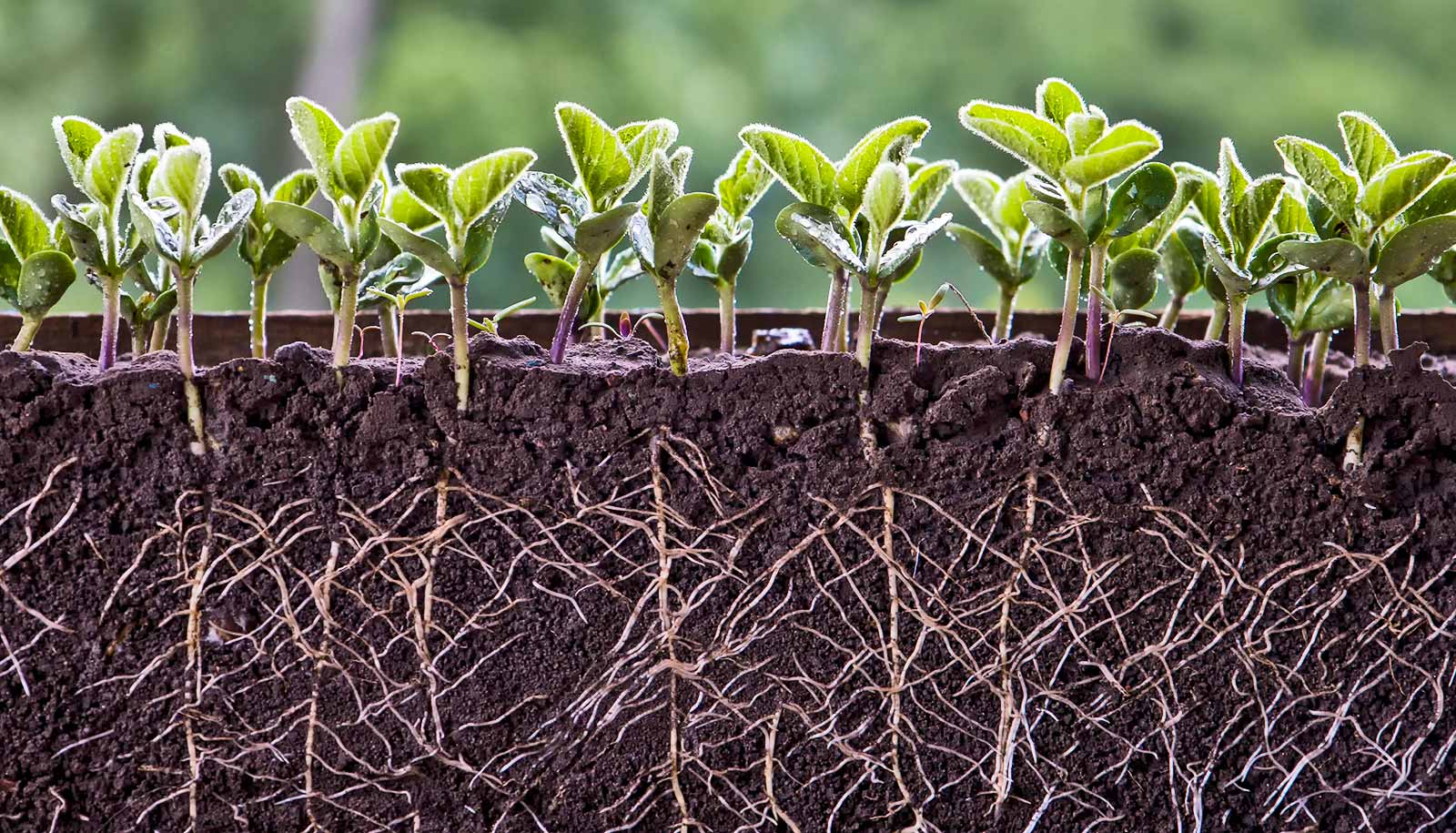
Researchers have discovered how plant roots penetrate compacted soil by deploying a well-known engineering principle.
The finding could have major implications for future crop development at a time when pressure on agricultural land is increasing.
Across the globe, soil compaction is becoming an ever more serious challenge. Heavy vehicles and machinery in modern agriculture compress the soil to such an extent that crops struggle to grow. In many regions, the problem is aggravated by drought linked to climate change.
But plants may in fact be able to solve part of the problem themselves—with a little help from us. It is already known that when soil becomes dense and difficult to penetrate, plants can respond by thickening their roots.
Until now, however, it has remained unclear how they manage this, beyond the fact that the plant hormone ethylene plays a key role.
Researchers have now pieced together the mechanism. Their results appear in the journal Nature.
“Because we now understand how plants ‘tune’ their roots when they encounter compacted soil, we may prime them to do it more effectively,” says Staffan Persson, professor at the University of Copenhagen and senior author of the study.
“In other words, the root changes its structure in line with a basic engineering principle: the larger a pipe’s diameter and the stronger its outer wall, the better it can resist buckling when pushed into a compact material,” explains Bipin Pandey, senior author and associate professor at the University of Nottingham.
The combination of root swelling and a reinforced outer layer allows the root to act as a kind of biological wedge, easing its way down through the soil.
“It’s fascinating to see how plants draw on mechanical concepts familiar from construction and design to solve biological challenges,” says Persson.
The study also reveals how this mechanism can be amplified:
“Our results show that by increasing the levels of a specific protein—a transcription factor—the root becomes better able to penetrate compact soil. With this new knowledge, we can begin redesigning root architecture to cope more effectively with compacted soils. This opens new avenues in crop breeding,” says first author Jiao Zhang, postdoc at Shanghai Jiao Tong University.
Although the experiments were conducted in rice, the researchers believe the mechanism applies broadly across plant species. Parts of the same mechanism have also been identified in Arabidopsis, which is evolutionarily distant from rice.
“Our results could help develop crops that are better equipped to grow in soils compacted by agricultural machinery or climate-related drought. This will be crucial for future sustainable agriculture,” says professor and senior author Wanqi Liang from Shanghai Jiao Tong University.
The work also opens new opportunities in plant breeding more generally. The team has identified many additional transcription factors that appear to be key regulators of cellulose production—with far-reaching implications for plant form and structure. For example, it may become possible to design plants with different shapes, which could benefit certain crops.
“The transcription factors we’ve discovered are a goldmine for cell-wall biology. There’s more than enough here to keep me busy until retirement,” concludes Persson.
Contributing institutions include Shanghai Jiao Tong University; the University of Nottingham; Universidad Argentina de la Empresa; the National Institute of Advanced Industrial Science and Technology; Zhejiang University; Duke University; Ludwig Maximilian University; and the University of Copenhagen.
Source: University of Copenhagen