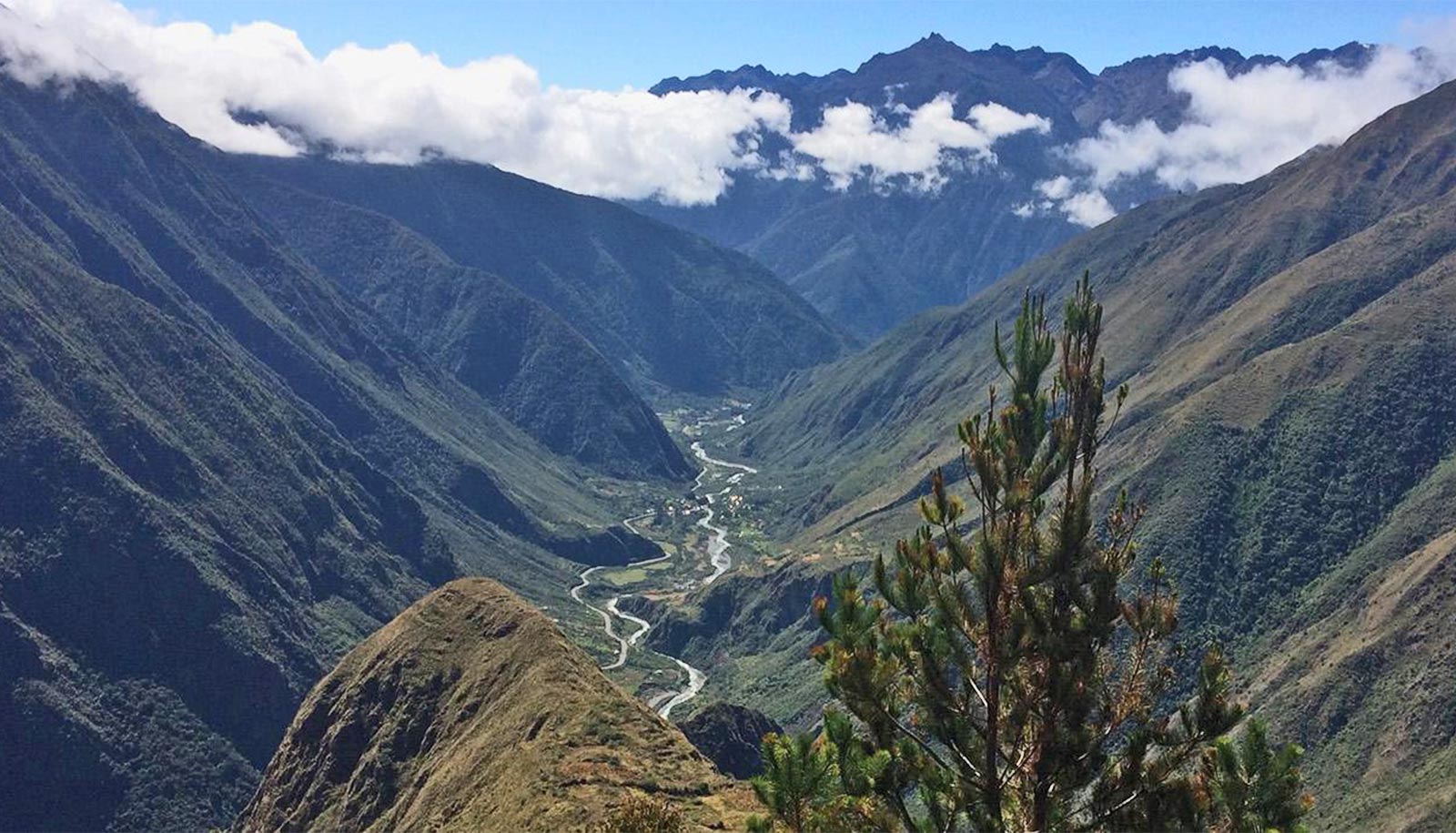
New research explains how massive canyons formed in Peru.
Imagining the creation of large geographical structures like mountains and canyons might evoke visions of cataclysmic events over short periods of time, geologically speaking—glaciers plowing through land, tectonic plates abruptly shifting, or even meteorite impacts.
New collaborative research from the lab of Nadine McQuarrie, professor and chair of the geology and environmental sciences department at the University of Pittsburgh, and researchers at the University of Glasgow has shown that it wasn’t violent collisions or sudden changes that led to the formation of immense canyons in the Andean Plateau.
Instead, they were formed by river capture, a phenomenon that made its biggest impact once the rate of tectonically driven mountain formation slowed down.
Their work appears in the journal Science Advances.
The canyons carved into the 3.7-kilometer Andean Plateau are 2-3 kilometers deep. For comparison, even at its deepest, the Grand Canyon spans less than 2 km from top to bottom. The structures are so vast, McQuarrie says, that she couldn’t capture its scope on camera. “We were there, I know it’s there, but the pictures don’t convey the scale of the full canyon.”
There have been two predominant theories for the processes that led to the formation of the canyons: Either they were the result of an abrupt event, such as the rapid rise of earth caused by an earthquake, or they were the result of a period of heavy rainfall, increasing the amount of water carving its way through the plateau. The researchers wanted to determine which of the two explanations was likely to be correct.
It turned out, there might be a third explanation.
The research team, which included first author Jennie Plasterr, a graduate student working in McQuarrie’s lab, tested both scenarios using computer modeling. They ran models incorporating current knowledge about historical tectonic activity in the region and recent estimates about climate and precipitation.
“What we found is that neither of the two prior explanations were likely the primary driver of the canyon incision,” McQuarrie says. “They were both important contributors, but the main thing that allowed for the incision of this deep canyon was the ability of a river to capture another river.”
River capture occurs when the erosional power of a river carves the surrounding land until it ultimately breaches the ridgeline that separates it from another river. The water from the second river is diverted to the first, increasing its erosional power and its ability to dramatically reshape the landscape.
In the Andean Plateau, although it was not the primary factor, tectonic activity was one of the mechanisms that allowed river capture to take place, but not by lifting the ground up. “Counter to what most people think, the uplift needs to slow down,” McQuarrie explains.
As the ground was rising in response to tectonic activity—a process known as uplifting—and the plateau was forming, rivers didn’t have enough power to erode through the rising ridgeline. However, once that tectonic uplift slowed, the erosional power of the river could carve through the ridgeline, ultimately breaching it and capturing a nearby river.
In fact, according to the research team’s models, tectonic uplift had to slow down by almost an order of magnitude before river capture could occur and reshape the area. “When growth slows from 4 mm per year to 0.4 mm per year, that’s when capture can occur, and you start getting a landscape that looks like the modern landscape.”
In a way, tectonic uplift and river incision were both drivers of the canyons’ creation, McQuarrie says, “But the effect of tectonics wasn’t the mountains going up and the rivers incising into them. It’s that the mountains were up and then everything slowed down.” Then rivers, strengthened by river capture, were able to carve the landscape that exists today.
This research was supported by the National Science Foundation and the German Research Foundation.
Source: University of Pittsburgh