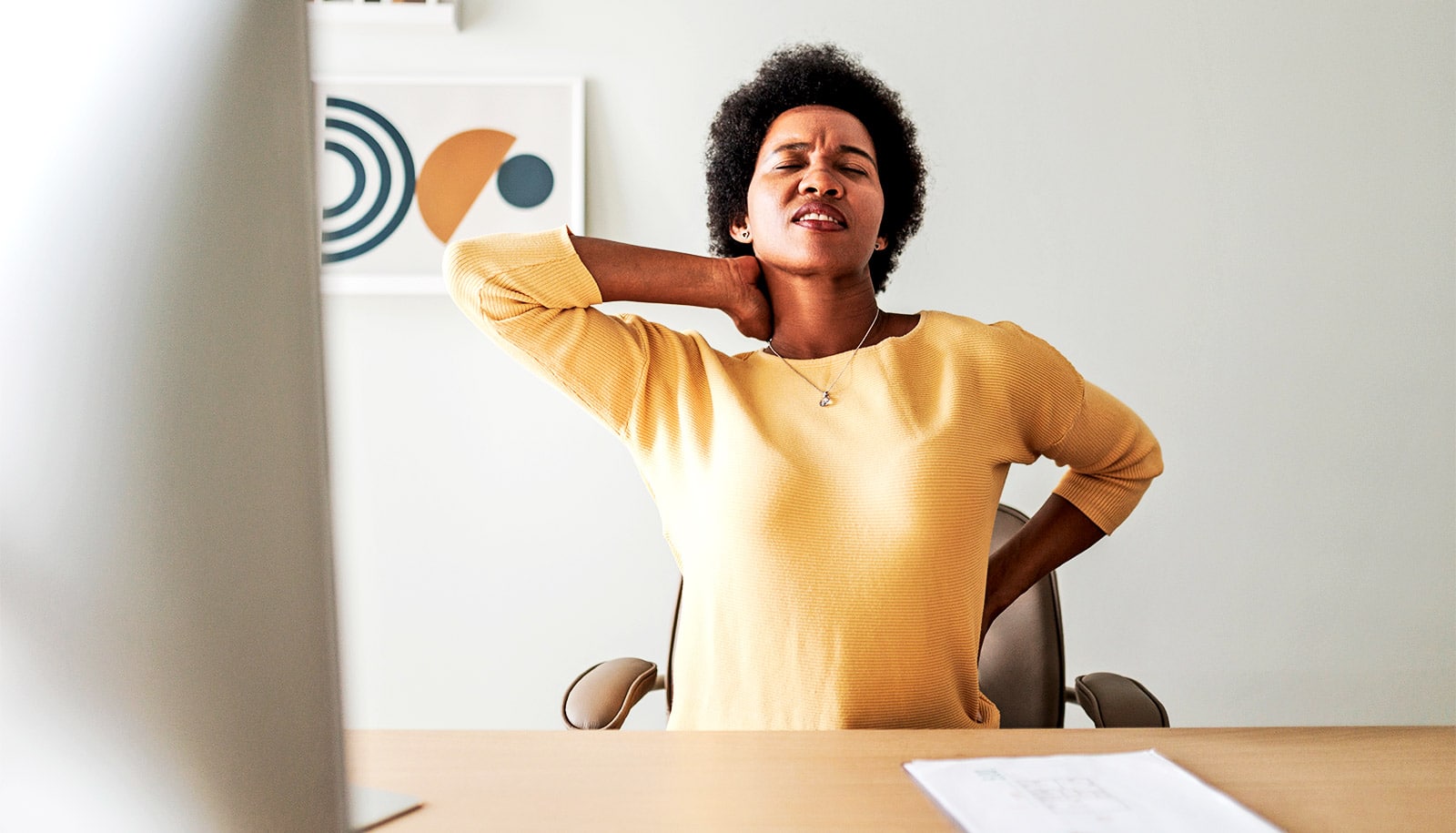
Experts have tips to help you avoid “tech neck.”
You’re doing it right now: slouching your neck forward and looking at your screen. And you aren’t the only one.
On average, American adults spend five to six hours every day on their phones. That is a staggering amount of time in poor posture.
Add in the hours we spend sitting and staring at our computers at our jobs, we brew the perfect storm for “tech neck.”
Tech neck is a mild to moderate discomfort in the neck resulting from using our phones or computer screens incessantly. When we lean forward, we force our neck and shoulder muscles (upper trapezius muscles) to be active, otherwise our head would just drop forward. Tech neck arises when we maintain that position for an extended period.
“Tech neck is not an official diagnosis, but we are definitely seeing it in the clinic. I call it neck tightness or postural concerns,” says Cassidy Foley Davelaar, a sports medicine physician at Emory University. “I haven’t quite diagnosed it as tech neck yet, but it is probably coming.”
Severe forms of neck pain arise due to trauma from car accidents or falls but tech neck can be disabling in the long term. It can begin as people having difficulty concentrating, experiencing headaches and losing time from work. Over time, the pressure of hunching forward can get to the spine and the nerve cells nestled in our neck and back.
“The further your head comes forward, the more the muscles of the neck contract to keep the head from dropping off the body. Basically, that’s why we get fatigue,” says Peter Sprague, an orthopaedic clinical specialist and assistant professor of rehabilitation medicine at Emory.
Our head, on average, weighs about 12 pounds at rest. If we bring our head forward, the posture alongside the effect of gravity increases our head’s weight by three-fold. People with a tendency to go into these positions may experience numbness in the upper body. In severe cases, problems with balance and muscle activity can arise throughout the body.
“Stop what’s causing it in the first place by having better posture,” says Davelaar. “Sit 90 degrees at your ankle, knees, hips, and elbows and prop your phone up or put your laptop on a couple of books and use a remote keyboard.”
Muscles are attached to the back and front of the cervical spine. Hunching our head forward works the back muscles. The front muscles, called the intrinsic or deep flexor muscles, stay relaxed. Research shows that cervical pain is associated with a lack of muscle activity from those muscles.
“The deep flexor muscles hold and control one vertebra together on top of the other and act as seatbelts,” says Sprague. “If they are weaker, one has a higher risk of developing cervical spine pain. If someone has this type of pain already, improving the strength of these muscles will likely resolve the pain.”
Reducing phone use is an excellent solution to tech neck but Sprague says that we can still use our phones—if we keep changing our positions every 20 minutes.
“Switching positions frequently is most helpful in reducing strain from sitting because you are no longer staying static,” says Sprague. “Squat, kneel, or lie down on your side or stomach to promote neuromusculoskeletal health while using your phone.”
Helpful exercises
Chin tuck: A staple for anyone who wants to engage the deep flexor muscles in the cervical spine.
This is a simple exercise you can do anywhere and anytime. Bring your chin slightly down toward your chest, making a double chin. You should feel a little tightness in the front part of your neck. Think of a string coming up from the top of your neck. Elongate that and then hold that posture for 2-3 seconds and release. Remember not to pop your head forward.
Open book exercise: A way to improve mobility in the upper back, where we get stiff while hunching forward, and to stretch your thoracic spine and pectoral muscles.
Lie down on your side with your knees bent at a 90-degree angle. Put both arms out in front of you with your palms together. Move your arm up and hold before switching sides. Keep the legs in the same position throughout the exercise. Sweeping the arm up and down allows the opportunity to identify where it’s tight and to make sure to stretch that area.
W rows: A way to promote a good upright posture and work your paraspinal muscles, middle and lower trapezius muscles and rotator cuffs.
Hold a piece of resistance band with both hands and bring your hands apart and shoulder blades together. Pull the band to form a “W” shape with your arms and squeeze your shoulders together at the back of the movement. Slowly come back to the extended position and don’t hunch your shoulders forward.
Doorway stretch: Put your arms down on either side of the doorway and lean forward so that you’re stretching out the front of the neck and out of the shoulder.
“Our bodies are engineered to move, and we don’t,” Sprague says. “My best advice—even better than the exercises—would be to change and alter your positions.”
Source: Emory University