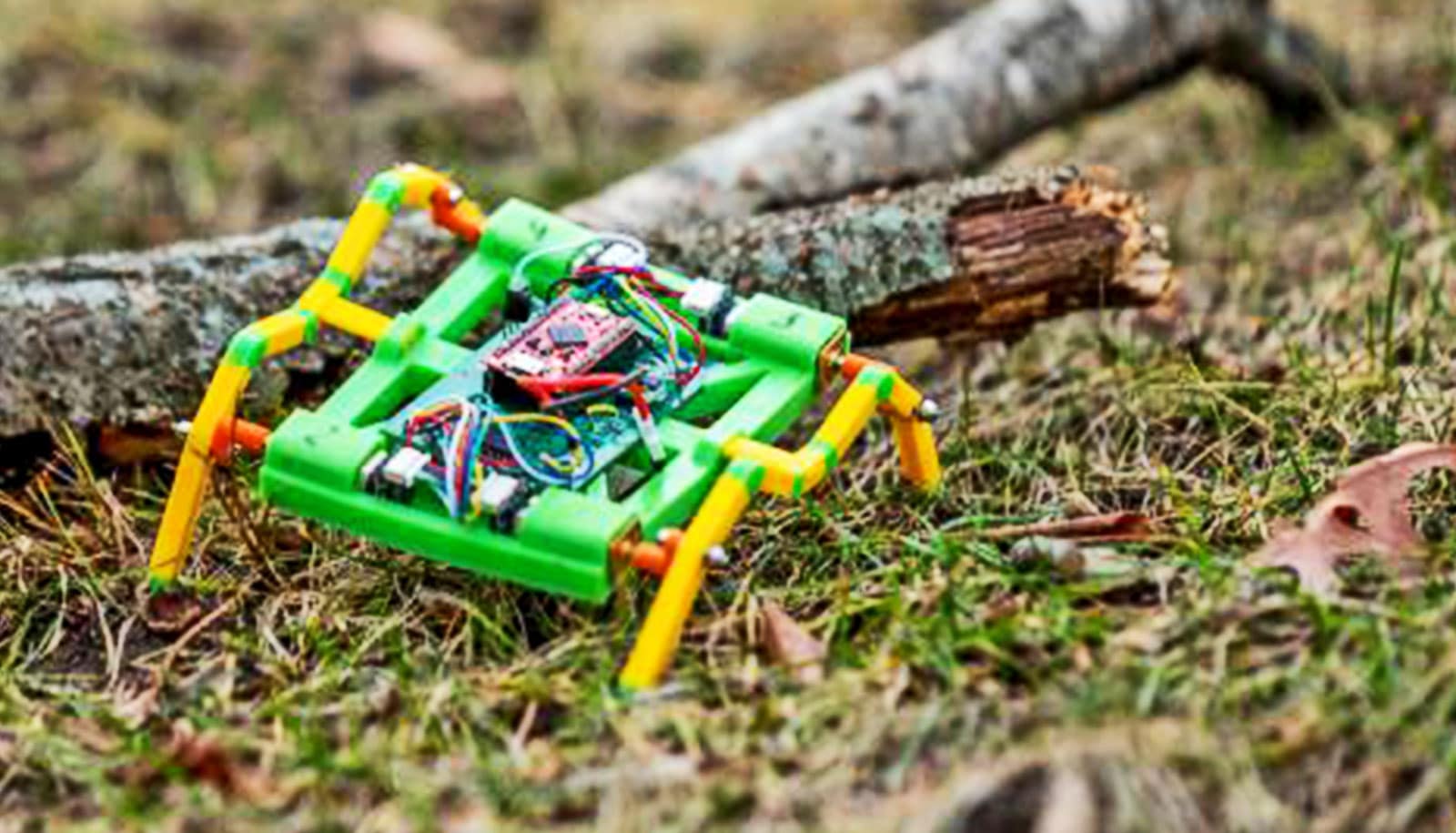
A researcher has built a robotic swarm with no electronics, no batteries, and no brains.
A LEGO brick is not smart. It doesn’t compute. It doesn’t plug in. It just fits.
A team of Georgia Tech researchers has applied that logic to robotics.
Bolei Deng, an assistant professor in Georgia Tech’s Daniel Guggenheim School of Aerospace Engineering, and Xinyi Yang, an aerospace engineering PhD student, build swarms of tiny robotic particles that latch, release, and reorganize without a single electronic component. No sensors, no processors, and no code.
The research recently appeared on the cover of Advanced Intelligent Systems.
Deng didn’t invent the idea. Novelist Kurt Vonnegut imagined self-organizing machines more than 60 years ago.
Deng’s goal was to turn that science fiction into fact.
“Instead of using a central controller, our particles’ behavior is governed by their mechanical design and how they interact with one another,” Deng says.
Traditionally, building smarter robots means adding complexity: more hardware, more processors, more code. Deng and Yang stripped all of that away.
What remains is mechanics.
Yang calls it “mechanical intelligence.” Instead of using sensors or a central brain, each particle is designed to let its shape do the “thinking.”
“The intelligence isn’t programmed in—it’s built in,” Yang explains. “Change the geometry, and you change what the swarm does.”
When the particles feel vibration, they respond automatically. Mix different shapes together, and the group starts to move like a flock of birds or a colony of ants.
In three dimensions, the same rule holds: shape controls behavior. Each particle’s geometry determines how it pushes, locks, or releases its neighbors. The result is coordinated movement without signals or code—interaction written directly into form.
Each particle in the swarm is identical—and completely useless on its own.
“Each unit can be very dumb and follow simple rules,” Deng says. “But when you combine enough of them, a sort of intelligence begins to emerge.”
Each particle has flexible arms spaced evenly around its body. When two particles meet, the arms bend and latch, storing tension like a compressed spring. An external vibration releases that stored tension. The arms snap open, the particles push apart, and the swarm spreads.
How far they spread, and how quickly, depends on how the arms are built. Change the curvature, and they hold on longer. Make them stiffer, and they release faster. Each particle follows the same simple mechanical rules: bend, latch, release.
A single vibration sets the system in motion. Particles break apart in a defined sequence, each interaction triggering the next. No central control. The order of disassembly is pre-programmed in how the particles physically connect. .
The particles can be built at dramatically different scales—from the width of a human hair all the way up to 1.5 inches in size.
At their smallest, particles can enter the bloodstream. Doctors could place a compact swarm inside the vascular system and activate it with ultrasound. The vibration releases the stored tension in the arms. The particles spread outward and enter vessels a single robot cannot reach.
Deng envisions swarms delivering cancer drugs directly to hard-to-reach tumors while sparing healthy tissue. The approach targets diseased cells without compromising the rest of the body.
The swarm may also be able to map blood vessels, extending beyond the reach of today’s medical imaging tools.
“These particles could explore vessels no camera or catheter can reach,” Yang says. “You send the vibration, and they spread into parts of the body we can’t otherwise see.”
The same approach could work beyond the body. In space, even small fixes require astronauts to suit up for risky spacewalks, and radiation degrades electronics.
The particles could be launched as a compact cluster, land on a surface, and then be released with vibration. They spread out, move around obstacles, and reconfigure without sending anyone outside.
Because their behavior is built into their structure—and not electronics—the swarm could operate in radiation and temperature extremes that disable conventional robots.
“In space, once you build something, you need an astronaut or a robot to change it,” Deng says. “In our system, you just send the vibration.”
Deng and Yang have shown that mechanics alone can move a swarm. Now they are pushing this idea further.
They are building structures whose joints respond to different vibrations. One pulse unlocks one joint. Another pulse releases a different section. The structure doesn’t just move—it rearranges itself. No processor chooses what shifts. The design does.
“We’re still just scratching the surface of what’s possible when you let the design do the work,” Yang says.
It’s the same LEGO logic the research team started with. No electricity required.
Source: Georgia Tech