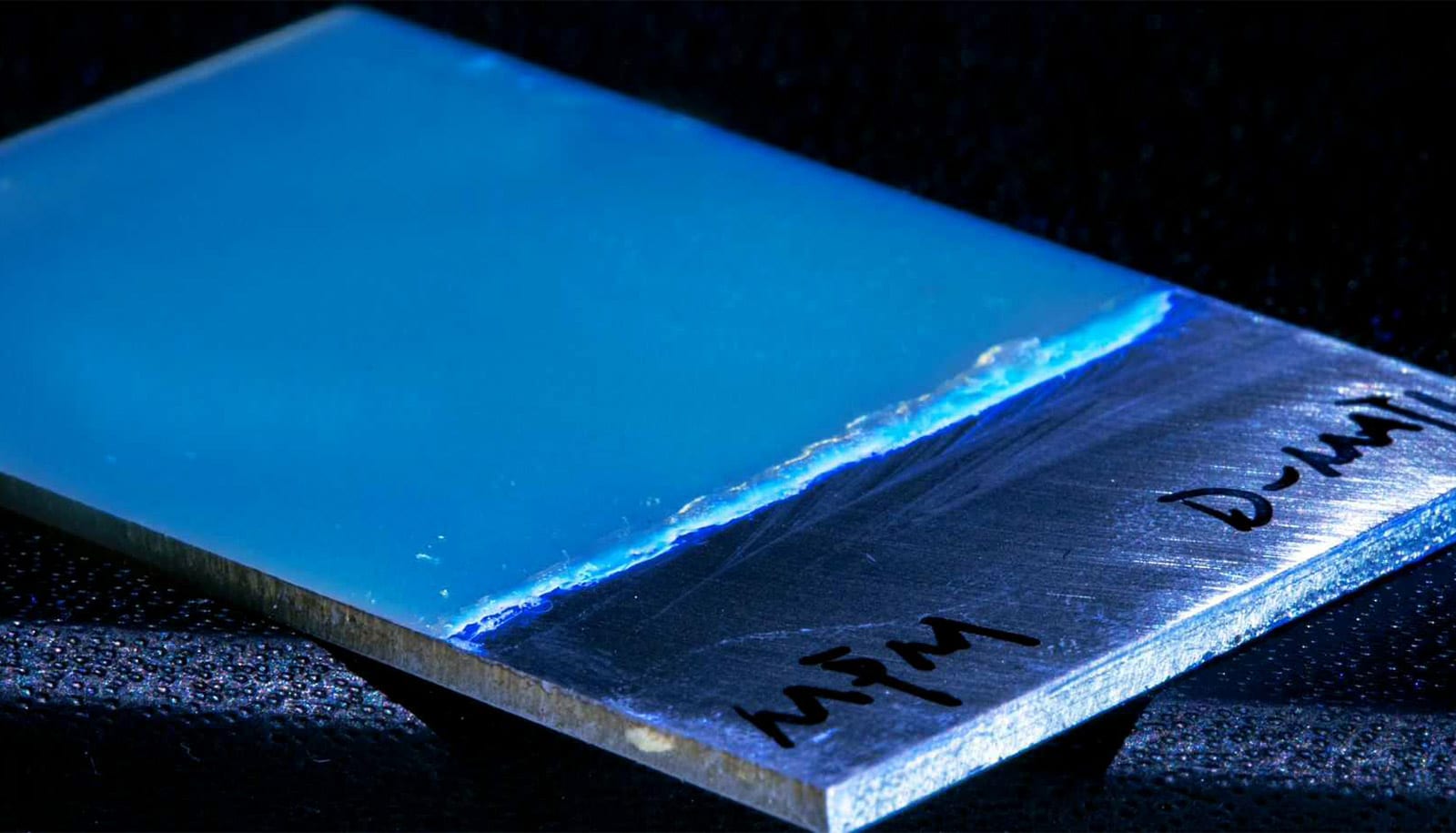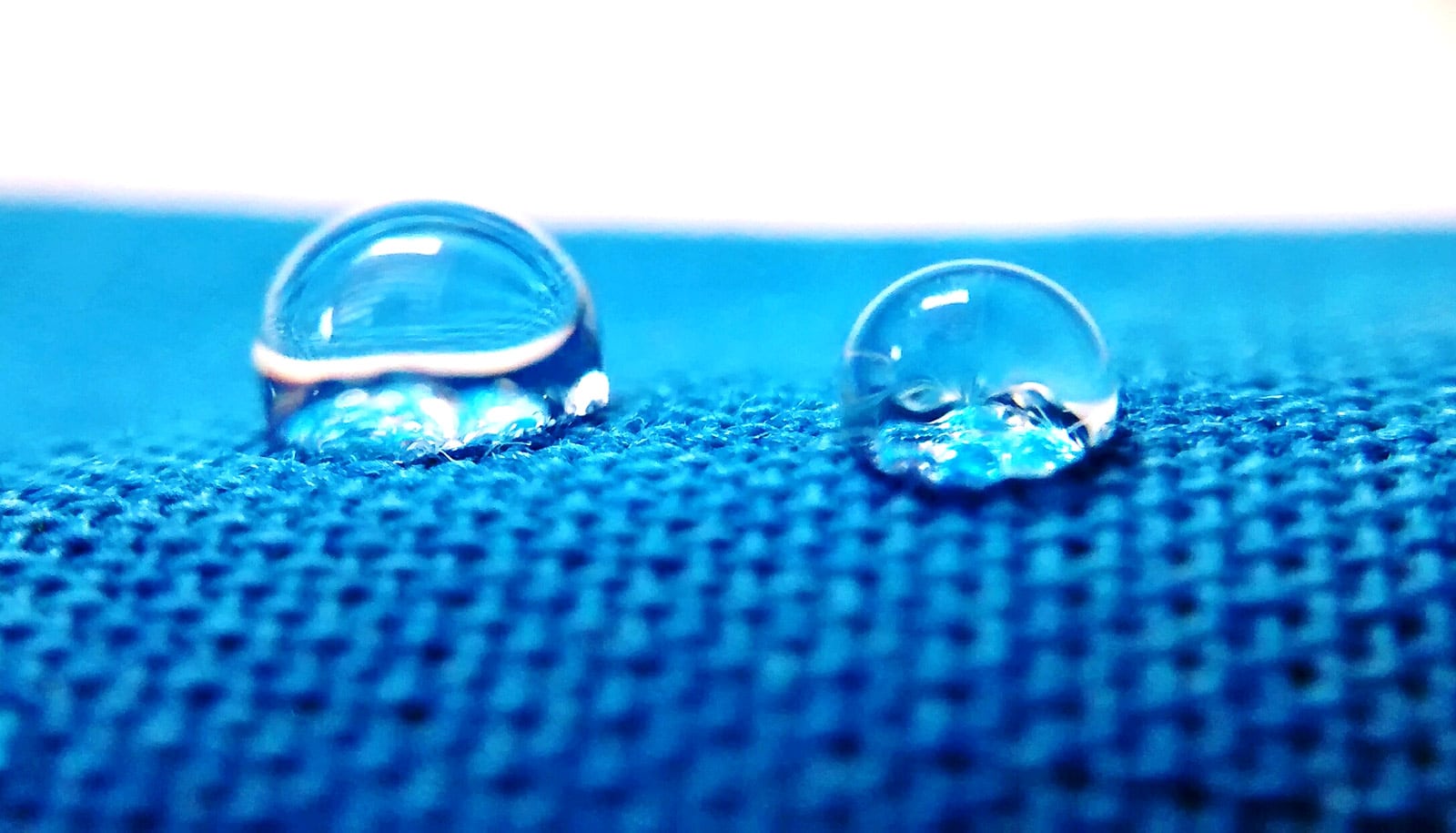
Imagine a paint that changes color depending on how hard its surface is hit.
It could be used on football helmets to monitor concussion-level impacts, to record the handling history of shipped packages, or placed on insoles to analyze an orthopedic patient’s gait.
The paint is the latest innovation coming from the Tufts University Silklab, led by Fiorenzo Omenetto, a professor of engineering. Omenetto and research assistant professors Marco Lo Presti and Giulia Guidetti developed the paint to quantitatively measure the site and force of an impact without using any electronic circuitry or sensors.
The innovative substance is made with a color‑changing polymer surrounded by a silk protein polymer shell, and can be painted on surfaces of almost any size, texture, or contour.
The potential applications cover a wide range of measurements, from the subtle changes in pressure when analyzing the surface aerodynamics of cars and planes to the powerful impacts that could occur from military or industrial blast exposure.
The researchers even collaborated with Grammy Award-winning drummer Terri Lyne Carrington to demonstrate how the paint can reveal patterns of impact on a drum skin surface.
The research appears in the journal Advanced Science.
How does it work?
The tiny spherical particles in the coating—each about the size of a human blood cell—contain a core of color‑changing polymer called polydiacetylene, surrounded by a harder polymer shell made of silk fibroin proteins derived from the common silk moth.
The core polymer undergoes a blue-to-red transition when under mechanical stress, such as being squeezed, twisted, or stretched. At the microscopic level, the mechanical stress twists the chemical backbone of the inner polymer, affecting how electrons move along its length.
That in turn affects how the electrons absorb photons and causes the core polymer to change from deep blue to bright red. Because the amount of red increases with how hard the surface of the paint particles are hit, the paint can act like a built‑in force meter.
“You can tune the hardness of the shell so that you can extend the response of the paint to different levels of forces,” says Guidetti. The silk shell also prevents false triggers, so the paint only changes color when it is hit with a meaningful force.
Once the color changes, it stays changed, providing a permanent record of the level of force and its location on the surface. Additional hits in the same location provide an additive response, and the level of color change can be converted directly into newtons—the conventional unit to measure force.
The paint in its current form detects forces ranging from 100 to 770 newtons—levels comparable to that from a light hammer tap to a strong punch from a UFC fighter.
The paint can be brushed, sprayed, or drop cast (poured and then evaporated dry) to form films on many types of surfaces, including paper, plastic, wood, and metal, and on a wide range of objects that may benefit from displaying an impact profile of their use.
“You can paint it on anything from helmets to footwear and clothing, or on ropes and cables to measure stress,” says Omenetto.
Because it doesn’t rely on electronics, the coating is lightweight, inexpensive, and easy to scale up. It performs reliably even on curved or flexible surfaces, allowing one to capture complex impact patterns with fine detail.
Science and art
In one experiment, the researchers worked with renowned drummer Terri Lyne Carrington to demonstrate how the paint, applied to the drumheads, could be used as an analytical tool to show the location, forces, angles, and patterns of drumstick strikes during a performance, a bit reminiscent of sports analytics graphs such as basketball shot charts.
The experiment arose out of a longstanding collaboration between the Tufts Silklab and the Global Jazz Institute at Berklee College of Music.
“It’s an unusual collaboration, but based on a fundamentally simple principle,” says Omenetto. “In the work we do we start with a fixed input—silk—and end up with a thousand different things you can creatively think of for applications, such as a sensing paint. In music, you have equally fixed inputs such as the 12 notes of a chromatic scale that are reassembled in a myriad of tunes and improvisations.
“Having a dialogue between scientists and musicians about what represents a new idea and how it is generated leads to an incredibly rich interaction,” he says.
“This inspiration from great musicians helps scientists reframe their point of view and think of a ‘beautiful question’ that goes beyond mere lab work and addresses a bigger context and global impact.”
Omenetto says he asked Carrington if she would like to play some of her songs so they could visualize them on the drumskin. Carrington improvised and played songs from her 2019 album Waiting Game. The result looked like an abstract piece of art.
Omenetto wonders if the hit pattern could have any use for new drummers learning the instrument.
“It could help with training drummers to hit the center of the drum head, which is important for sound quality,” says Carrington.
“And it would show if a drummer has tendencies to hit other places, like closer to the rim. In other words, you could see more easily when your aim is off.”
Carrington also reflects on the crossover between the arts and technology. “Music is mathematical and scientific, so it is not surprising to me that I was drawn to the idea Fio presented. Great improvised music has a lot of questions and answers and problem solving,” says Carrington, but ultimately “the heart and mind—the human condition—is what really makes music good or not.”
Source: Tufts University