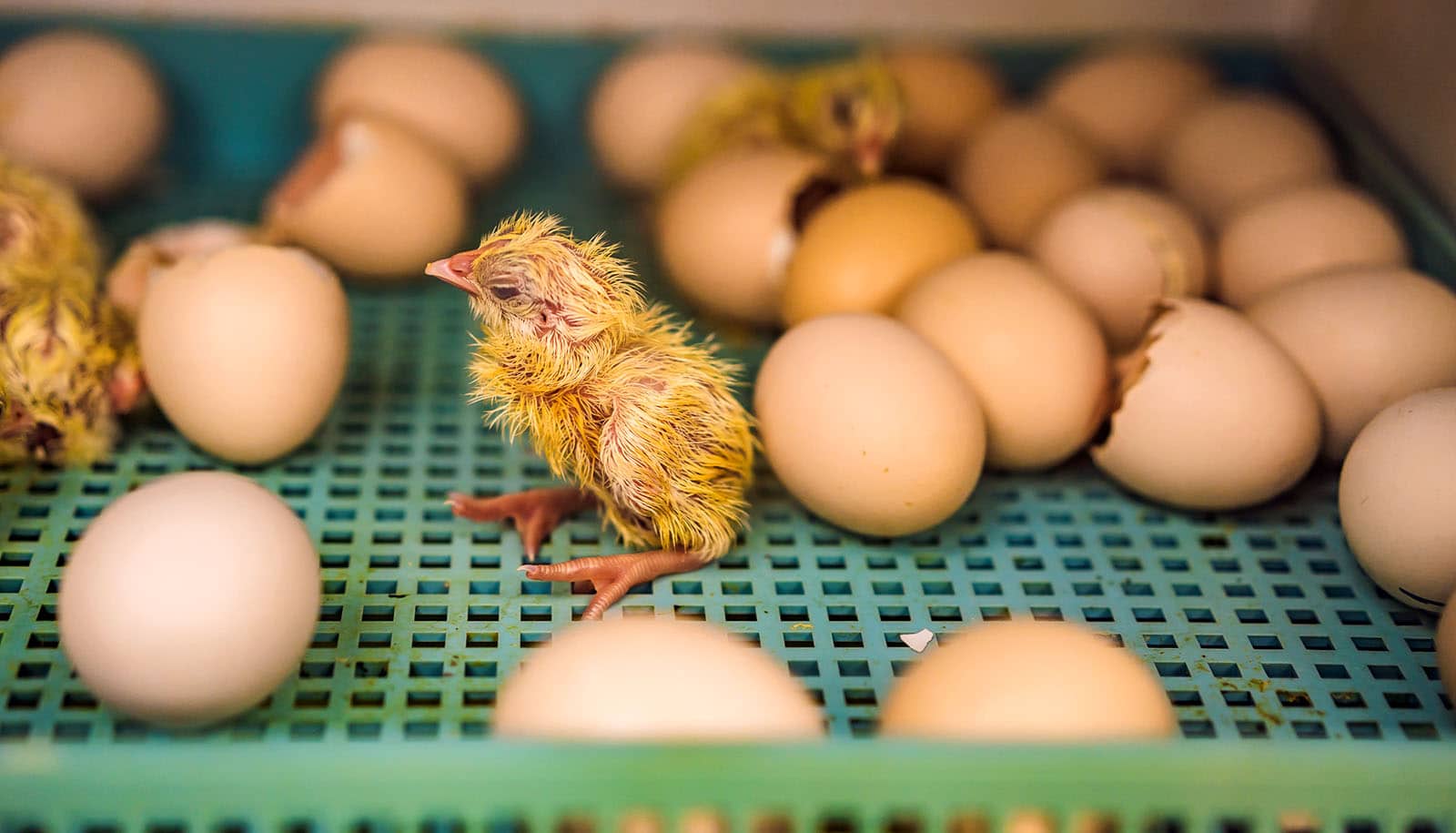
A researcher is working to create chickens that hatch useful medical proteins.
Chicken eggs are already used to harvest helpful proteins called antibodies to protect humans from viruses such as influenza.
A new breakthrough at the University of Missouri could one day lead to chickens that produce other useful medical proteins in their eggs.
In a new study, Mizzou researchers solved a common issue in the field of avian genetics known as epigenetic silencing.
In the past, scientists have learned that if they insert a new gene into random places in a chicken’s DNA, the new gene may get “silenced” or turned off over time. Therefore, the chicken—and more importantly, its offspring—might either not inherit the benefit linked with the new gene or the benefit may diminish over time as the new gene gets passed down from generation to generation. That makes it difficult to create a stable line of genetically engineered chickens that produce useful medical proteins.
So, Mizzou scientists tried a new approach to avoid epigenetic silencing. Using the gene-editing tool CRISPR, researchers focused on a specific enzyme that plays a key role in glucose metabolism inside a chicken cell. They attached a marker that glows green, allowing them to easily see whether a gene stays turned on.
“This enzyme, GAPDH, is needed to break down sugar to make energy, so every cell needs it to survive,” Kiho Lee, a professor in the College of Agriculture, Food and Natural Resources and study author, says.
“Our hypothesis was that since this enzyme is active all the time, the gene segment we introduce into that location should stay on all the time.”
After multiple months and many rounds of cell division, the researchers were excited by what they saw in the chicken cells in Lee’s lab: the reporter genes were still glowing bright green, indicating that gene silencing never occurred.
The success of this proof-of-concept study paves the way to see whether Lee and his team can create a platform for developing a stable line of genetically modified chickens. They’re collaborating with scientists and industry partners to see which genetic modifications would be most helpful to various stakeholders.
“This work could ultimately support efforts to make a stable line of genetically engineered birds that lay many eggs, all of which will hopefully contain useful proteins that can be used in various clinical applications for human medicine,” Lee says.
“There could also be agricultural and economic implications of this work, too. With how devastating avian influenza is to birds, if a new gene segment that can mitigate transmission of the virus can be inserted into the chicken’s genome, we would want that new gene segment to stay on and get passed down from generation to generation.”
The research appears in Poultry Science.
The study was funded by the National Institute of Food and Agriculture in the United States Department of Agriculture.
Source: University of Missouri