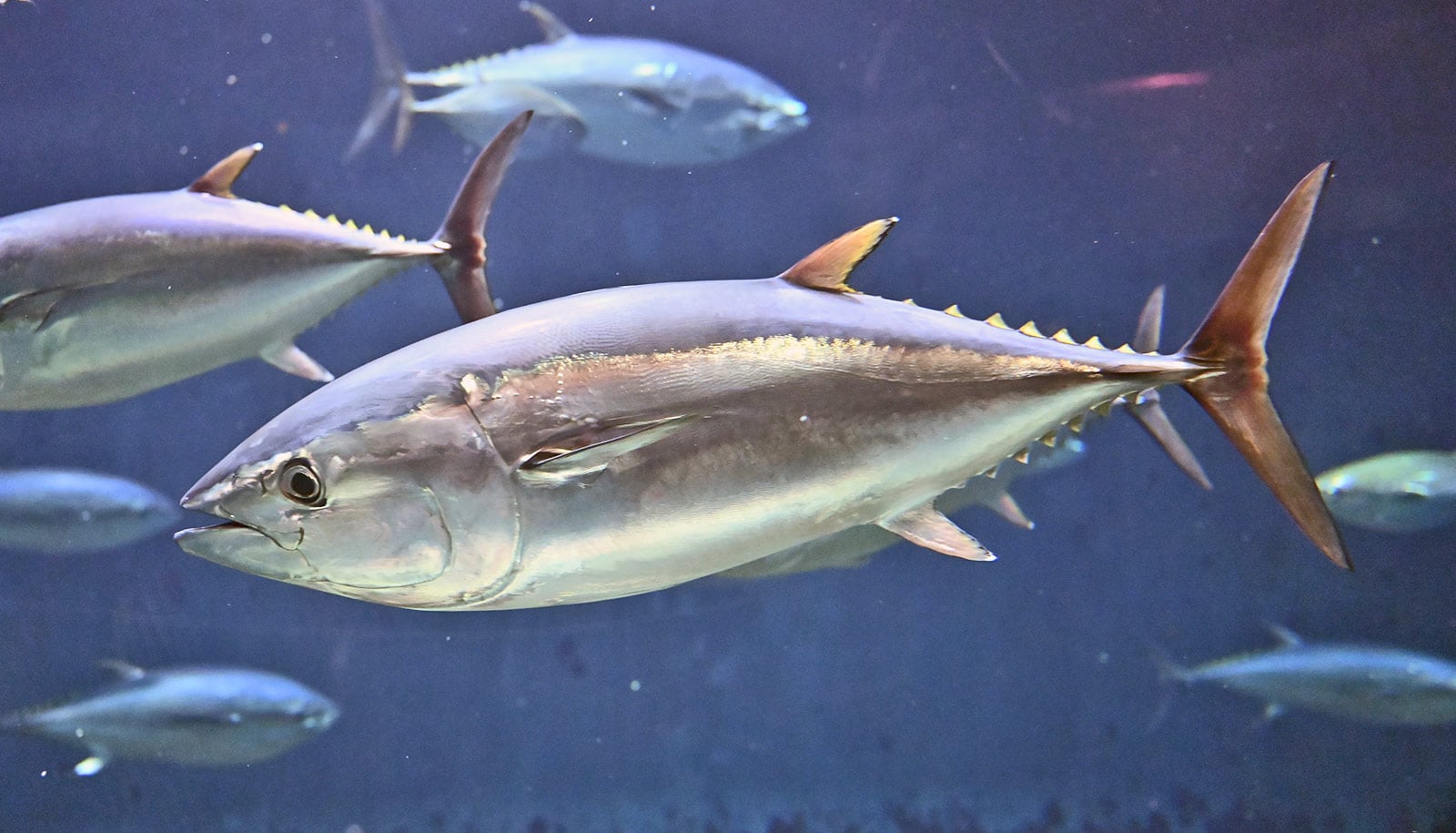
A new study reveals that tunas evolved their signature size, speed, and warm-bloodedness gradually over 50 million years rather than in rapid response to the mass extinction that ended the age of dinosaurs.
A long-held theory suggests that the asteroid strike that killed off non-avian dinosaurs—and most large marine predators—66 million years ago created an ecological opportunity that spurred the rapid evolution of tunas, and other large, fast, and warm-blooded predators.
The idea is that tunas and their carnivorous counterparts filled a niche left by their massive, predatory predecessors, much like how mammals replaced the world’s non-avian dinosaurs after the K-Pg extinction event.
But that theory doesn’t quite hold water, according to the new Yale study that provides new insights into how these economically important fishes evolved their imposing size, speed, and ability to regulate their body temperatures in cold seas.
For the study, researchers combined genetic data with fossil specimens to create the most complete time-calibrated evolutionary tree available for Scombridae, a family that includes tunas and mackerels along with about half of living warm-blooded, ray-finned fish species.
Their analysis placed the origins of Scombridae near the time of the asteroid strike. However, it also showed that tunas, mackerels, and related predatory fishes independently evolved large body sizes and endothermy—the ability to regulate body temperature—long after the K-Pg extinction.
“Our results demonstrate the K-Pg extinction did not trigger the evolution of tunas and related large, endothermic predators,” says Chase Brownstein, a graduate student in ecology and evolutionary biology at Yale, and the study’s lead author.
“We show that the body plans of these predators evolved over tens of millions of years and that there is no connection between the origins of endothermy and large body sizes in these lineages. More broadly, this paper highlights the need to be cautious when interpreting the evolution of species’ body plans directly from evolutionary trees.”
The study appears in the journal Proceedings of the Royal Society B. Thomas Near, professor of ecology and evolutionary biology at Yale, is the study’s senior author.
According to their findings, differing types of endothermy—a trait that helps tunas and other predatory fish swim fast—evolved independently three times in Scombridae lineages, with at least two of the three occurring 10 to 15 million years after the asteroid strike. Endothermy and the animals’ large body sizes were thought to be linked, but the study showed that there is little evidence for this. Instead, increases in body size occurred sporadically throughout the evolution of tunas and other Scombridae lineages. All told, the body plans of today’s tunas and mackerel evolved over the course of 50 million years, the researchers says.
The dataset for the time-calibrated evolutionary tree included tissue and DNA samples collected from several institutions, including the Yale Peabody Museum.
Better understanding the evolutionary biology of tunas, a nutrient-rich food source for people worldwide, can support conservation efforts, Near says. Populations of the commercially important Atlantic bluefin tuna, he noted, have dramatically declined over the last several decades due to overfishing.
It also has potential implications for the study of human health, he says.
“Understanding that endothermy independently evolved multiple times in tunas and mackerels provides insight into the fundamental machinery underlying metabolism and thermoregulation,” says Near, who is also the Bingham Oceanographic Curator of Ichthyology at the Peabody Museum.
“These are systems that are central to disease and health conditions in humans, such as obesity, diabetes, and metabolic syndrome. To be clear, there is no explicit connection here, but studying how our biodiversity has dealt with similar challenges over the long sweep of time is relevant to better understanding human health.”
Coauthors of the study are from Yale, Virginia Polytechnic Institute and State University, the Santa Barbara Museum of Natural History and the Natural History Museum of Los Angeles County, Purdue University, and the Marine Resources Institute at the South Carolina Department of Natural Resources.
The research was supported by the Yale Training Program in Genetics, the Bingham Oceanographic Fund of the Yale Peabody Museum, and the National Science Foundation.
Source: Yale University