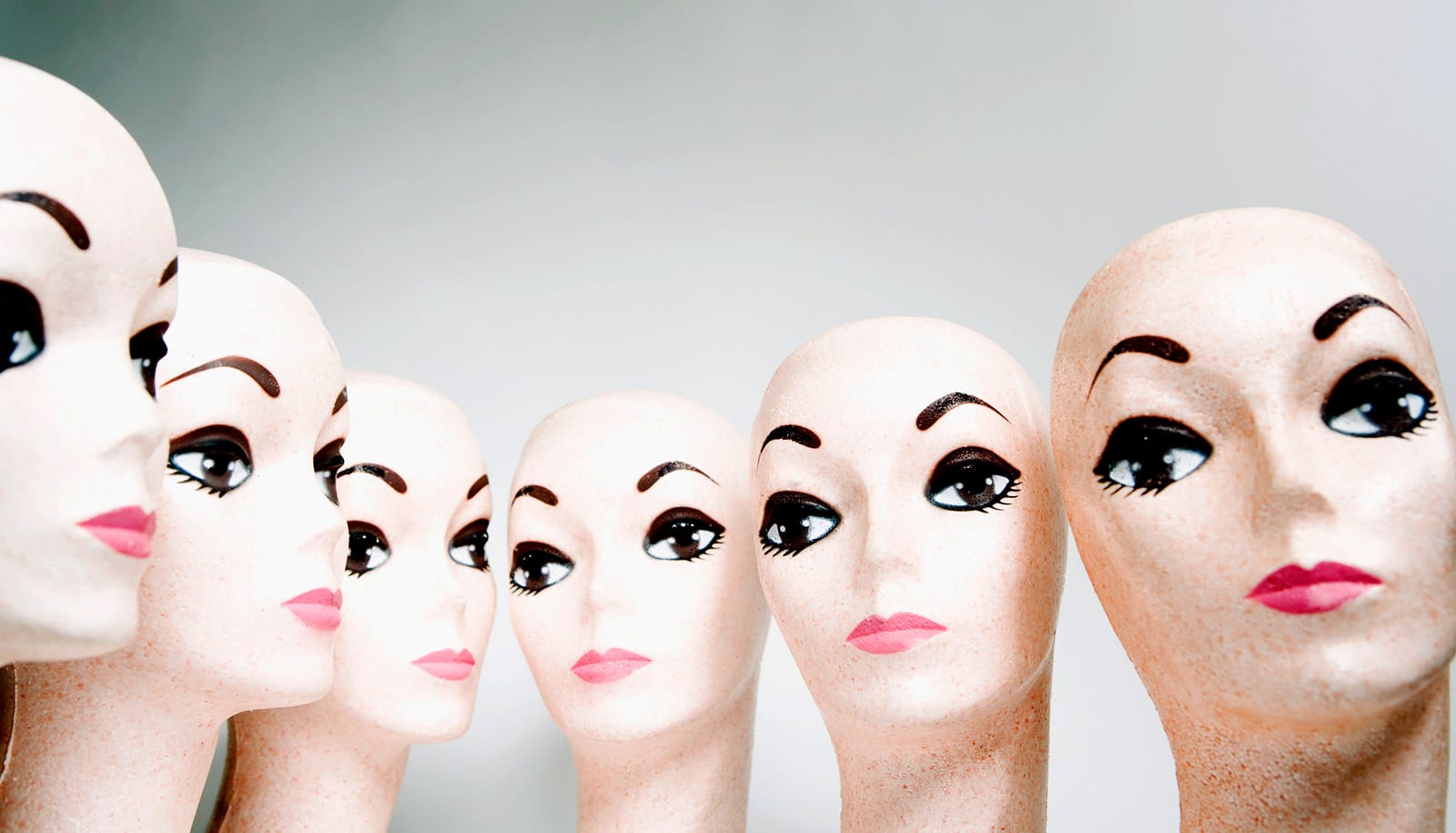
A new study digs into whether artificial intelligence is better than humans at recognizing faces.
Facial recognition is now a fixture of modern life, powering everything from national border security to the simple convenience of unlocking a smartphone. However, these advancements bring significant risks to privacy, equity, and civil rights.
While AI can now match faces as accurately as humans, the specific logic these algorithms use to calculate similarity remains a “black box” (closed source).
To bridge this gap, new research from the University of Notre Dame compared commercial and open-source AI against the judgment of 4,000 human participants.
While humans and AI generally agree on facial similarity, three factors heavily influence accuracy: the race of the participant, the race of the face being viewed, and the individual’s natural recognition skill, according to Ahmed Abbasi, a professor of IT, analytics, and operations at Notre Dame’s Mendoza College of Business.
Abbasi’s research appears in the Journal of Applied Research in Memory and Cognition.
“Top-tier AI is now as good as the best human experts,” notes Abbasi, the director of Notre Dame’s Lucy Family Institute for Data & Society, deputy director of the Data, AI, and Computing Initiative, and codirector of the Human-centered Analytics Lab.
“If we use AI as the benchmark for ‘good’ recognition, it suggests a large portion of the population is actually not that great at recognizing faces.”
This overlap is critical because law enforcement often uses a “human-in-the-loop” system, where an algorithm flags matches and a person makes the final call.
“Humans and AI usually see face similarity the same way,” Abbasi says. “However, people who are naturally better at recognizing faces match the AI’s judgments much more closely—at least 15% more often, depending on the model.”
The research also highlighted systemic flaws. AI models often disagree with one another and show decreased accuracy when analyzing races underrepresented in their training data. To test this, researchers used 329 standardized cross-race photos in controlled trials.
“Unfortunately, these systemic flaws are grounded in 20-plus years of research in computer vision, making them difficult to easily overcome,” Abbasi says.
Abbasi argues that while we rightfully scrutinize AI for bias, we often overlook human fallibility.
“We should be mindful of human recognition limits, especially in high-stakes scenarios like eyewitness testimony,” he says. He notes that while privacy and fairness concerns have led several states to ban automated facial recognition, human error remains a significant, yet less regulated, variable.
The study also underscores the legal dangers of black box systems. It cites State v. Arteaga, a landmark New Jersey case where a court required a police department to disclose an AI’s design so a defendant could properly challenge the evidence.
Ultimately, the research suggests that as we move toward an AI-integrated future, we must evaluate the reliability of both the machine and the human making the final decision.
Additional coauthors are from the University of Colorado at Boulder, the University of Central Florida, New Mexico State University, and the University of Virginia.
Source: University of Notre Dame