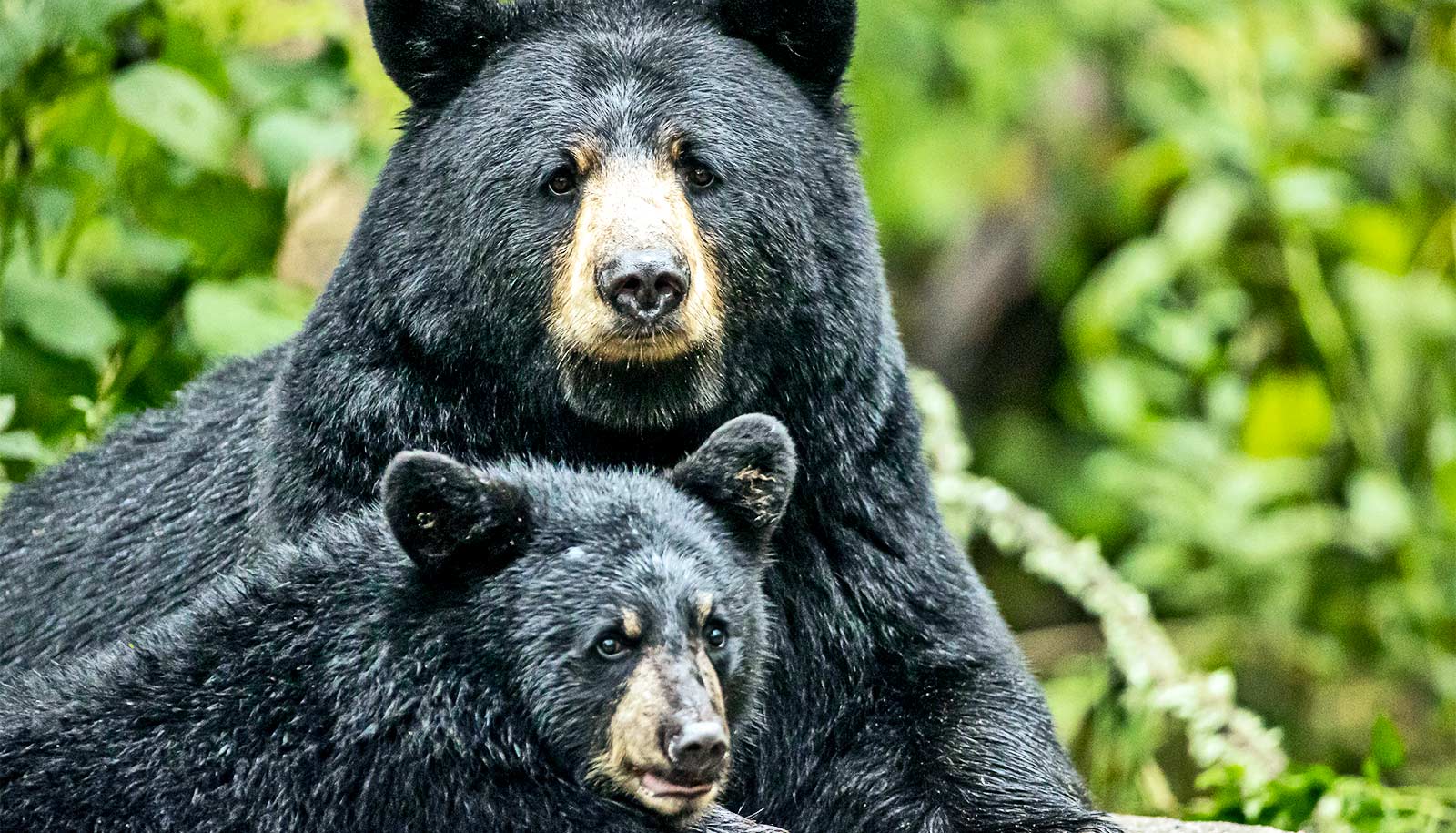
New research provides fresh insight into how environmental conditions influence black bear hibernation.
The findings have implications for wildlife management in today’s environment.
The study, led by Brogan Holcombe, a doctoral student in the Department of Fish and Wildlife Conservation in the Virginia Tech College of Natural Resources and Environment, and coauthored by Professor Marcella Kelly and Bernardo Mesa-Cruz, examines how ambient temperature and day length interact to shape hibernation behavior in American black bears.
“As temperatures rise, bears may become more active during times when they would traditionally remain dormant,” Holcombe wrote in the study.
This increased activity could lead to mismatches between bear behavior and seasonal food availability, potentially driving bears to seek out human-associated resources.
Using more than 22,000 hours of continuous video footage collected at Virginia Tech’s Black Bear Research Center during Mesa-Cruz’s original study, Holcombe tracked the activity of four wild, pregnant female bears across multiple stages of the hibernation cycle. The analysis categorized 45 distinct behaviors and linked them to environmental cues such as temperature and photoperiod—the seasonal pattern of daylight—as well as physiological changes during hibernation.
The team found that both temperature and day length play important and interacting roles in driving bear activity, particularly during critical periods such as pre-hibernation feeding and den emergence. While temperature alone influenced behavior during the onset of hibernation, the combined effects of temperature and photoperiod were key drivers of activity in other stages.
These findings challenge the long-standing assumption that hibernation timing in black bears is driven primarily by temperature. Instead, the results suggest a more complex relationship between environmental signals, one that could be disrupted as climate patterns shift.
Because photoperiod remains constant while temperatures fluctuate, the researchers highlight the risk that climate change could decouple these environmental cues. Such mismatches may alter hibernation timing, with cascading effects for ecosystems and increases in human-wildlife interactions.
The study in the Proceedings of the Royal Society B: Biological Sciences, represents one of the first to directly examine the combined influence of temperature and photoperiod in bear hibernation ecology, offering new data to inform conservation strategies.
By improving understanding of how black bears respond to environmental change, the research provides wildlife managers with better tools to anticipate behavioral shifts and plan for future conditions.
Source: Virginia Tech